
Pedro, the elder son of King João …
Years: 1828 - 1828
June
Pedro, the elder son of King João VI of Portugal, had stayed in his father's stead as regent of Brazi when the latter left Brazil to return to his European territory in 1821.
One year later, Pedro had written a paper (not so well known as his alleged proclamation—"Independence or Death") to state the reasons for the secession of Brazil from Portugal and bequeathed a constitution instituting a constitutional monarchy in Brazil, assuming its head as Emperor Pedro I of Brazil, also known as "Dom Pedro.” Dom Pedro is liked by the common people, but displeases both the landed elite, who think him too liberal, and the intellectuals, who feel he is not liberal enough.
In 1822, about thirty percent, or one million, of Brazil's population had consisted of African-born or African-descended slaves.
Slavery is so pervasive that beggars have slaves, and naval volunteers take theirs aboard ship.
As Brazilian coffee exports have risen steadily, so have the numbers of imported slaves; in Rio de Janeiro alone, they have soared from 26,254 in 1825 to 43,555 in 1828.
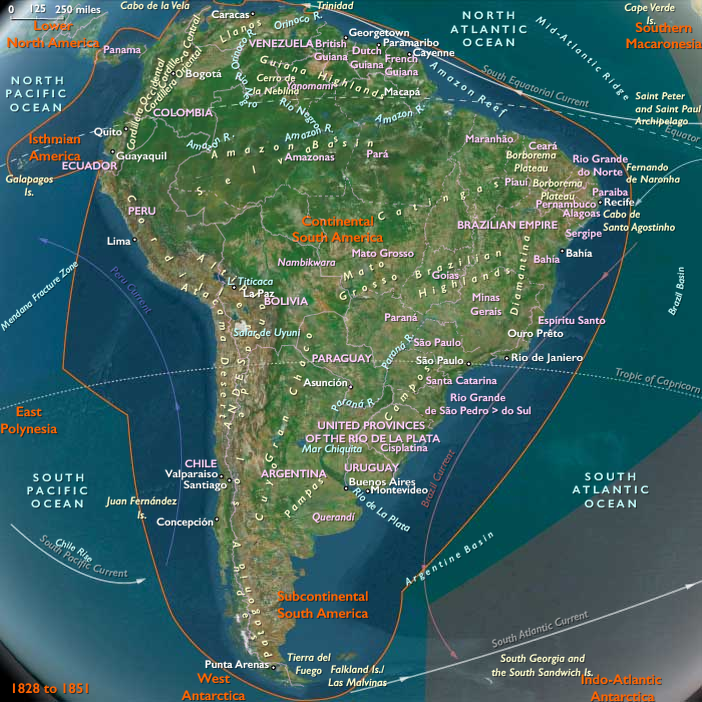
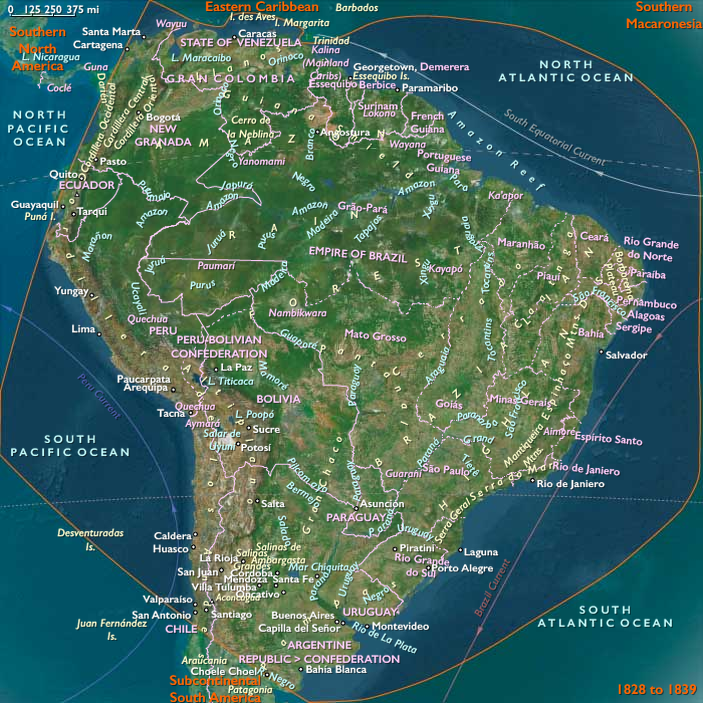
In 1825, war had flared over Argentina's determination to annex the Cisplatine Province (present-day Uruguay, on the East bank of the Plata River).
The Empire of Brazil could little afford the troops, some of whom were recruited in Ireland and Germany, or the sixty warships needed to blockade the Río de la Plata.
A loan from London bankers had been expended by 1826, and Pedro had had to call the General Assembly to finance the war.
The blockade had raised objections from the United States and Britain, and defeats on land in 1827 had necessitated a negotiated end to the thirty million dollar Argentina-Brazil War.
The war, at least, leaves Uruguay independent instead of an Argentine province.
This is possible because, following the wars led by José Gervasio Artigas against the centralist government of Buenos Aires, many people neither want to submit to Buenos Aires, nor to Brazil.
In June 1828, harsh discipline and xenophobia provokes a mutiny of mercenary troops in Rio de Janeiro; the Irish are shipped home and the Germans sent to the South.
The army is reduced to fifteen thousand members, and the anti-slavery Pedro, now without military muscle, faces a Parliament controlled by slave-owners and their allies.
Locations
People
Groups
- Portugal, Bragança Kingdom of
- Britain (United Kingdom of Great Britain and Ireland)
- France, constitutional monarchy of
- Brazilian Empire
- Uruguay, Eastern Republic of
- Argentina (Argentine Republic)
Topics
Commodoties
Subjects
Regions
Subregions
Years: 1828 - 1828
June
Locations
People
Groups
- Portugal, Bragança Kingdom of
- Britain (United Kingdom of Great Britain and Ireland)
- France, constitutional monarchy of
- Brazilian Empire
- Uruguay, Eastern Republic of
- Argentina (Argentine Republic)
Topics
Commodoties
Subjects
Regions
Subregions