
Filters:
The Rebellion of William of Arques and …
Years: 1053 - 1053
The Rebellion of William of Arques and the Death of Enguerrand II (1053)
In 1053, Duke William of Normandy faced a widespread rebellion among his own nobles, most notably his uncle, William of Arques, who was supported by King Henry I of France. At the same time, Enguerrand II, Count of Ponthieu, also allied against William, leading to a decisive battle in which Enguerrand was killed. Despite French intervention, William successfully crushed the rebellion, forcing William of Arques into exile.
Background: The Rebellion of William of Arques
- William of Arques, a powerful Norman noble and uncle to Duke William, had previously challenged William’s legitimacy due to his illegitimate birth.
- Although William had granted him the County of Talou as a fief, William of Arques remained defiant and built a fortified castle at Arques without ducal approval.
- By 1053, he was in open rebellion, and Henry I of France, eager to weaken Normandy, intervened to support him.
The Role of Enguerrand II of Ponthieu
- Enguerrand II of Ponthieu, another Norman noble, became involved due to his family ties—his sister was married to William of Arques.
- His own grievances against William dated back to 1049, when the Council of Reims had ruled his marriage to Adelaide of Normandy (William’s sister) invalid, citing consanguinity.
- Despite the annulment of the marriage, Adelaide retained Aumale, which had been given to her as dower land, possibly creating further tension between Enguerrand and William.
The Siege of Arques and the Battle in the Countryside
- Duke William laid siege to Arques, isolating the rebellious castle while maintaining a mobile force nearby to counter any relief attempts.
- King Henry I of France marched an army into Normandy to relieve the siege, bringing Enguerrand II with him.
- The decisive engagement occurred when the Normans feigned a retreat, luring Enguerrand and his forces into a trap.
- The Normans ambushed the pursuing French forces, killing Enguerrand II on October 25, 1053.
- This tactic of feigned retreat was a hallmark of Norman military strategy and would later be crucial to William’s success at the Battle of Hastings in 1066.
The Failure of the Rebellion and the Fate of William of Arques
- With Enguerrand dead and Henry I unable to break the siege, the rebellion collapsed.
- By late 1053, William of Arques was exiled, ending his challenge to William’s rule.
- The victory secured William’s position as Duke, eliminating one of his most persistent internal threats.
Significance and Consequences
- William proved his ability to counter both internal and external threats, further solidifying his control over Normandy.
- The tactical success at Arques, using feigned retreat and ambush, foreshadowed William’s later military brilliance, including at Hastings in 1066.
- The rebellion’s failure demonstrated Henry I of France’s weakening ability to interfere in Normandy, setting the stage for future Capetian-Norman tensions.
- With Ponthieu weakened, William later secured closer ties to the region, ensuring his dominance along Normandy’s borders.
The defeat of William of Arques and the death of Enguerrand II marked another step in William’s rise to undisputed power in Normandy, further preparing him for his eventual conquest of England.
Locations
People
Groups
Subjects
Regions
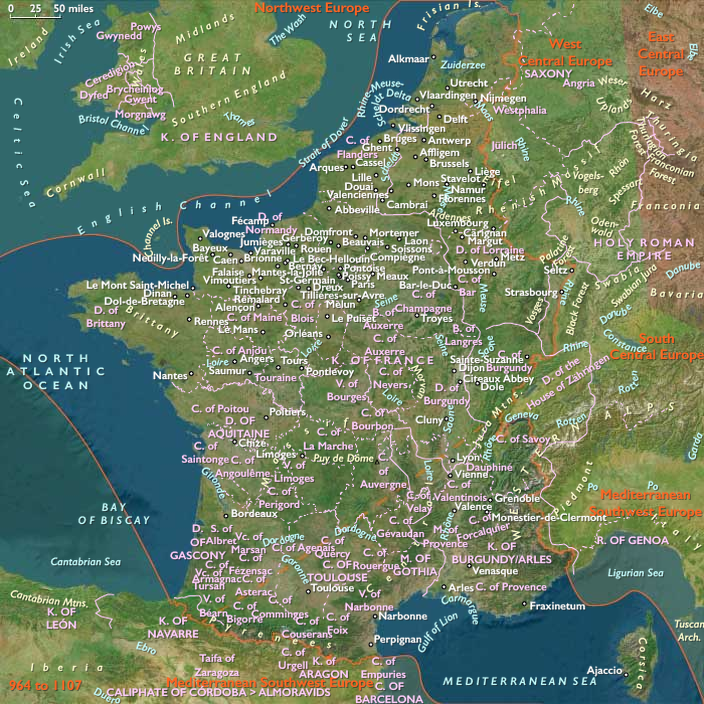
Subregions
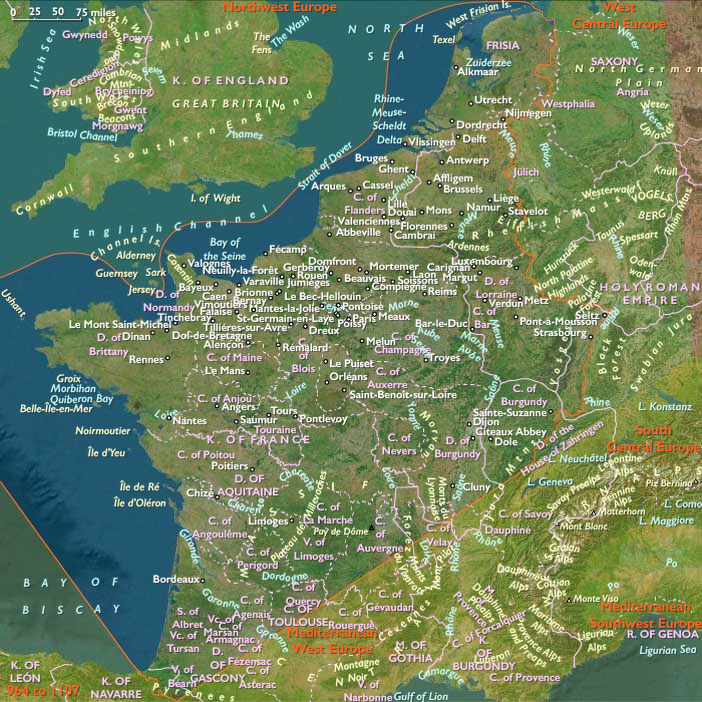
Years: 1053 - 1053
Locations
People
Groups
Subjects
Regions
Subregions