
William IV of Aquitaine: The Iron Arm …
Years: 988 - 988
William IV of Aquitaine: The Iron Arm and His Struggle for Independence (963–990)
William IV of Aquitaine, known as Fierebras ("Iron Arm"), ruled as Duke of Aquitaine and Count of Poitou from 963. A warlike and independent-minded noble, he spent much of his reign embroiled in conflicts against the Counts of Anjou and later against Hugh Capet, the first Capetian King of France. His resistance to Capetian authority and his support for the Carolingian claimant to the throne positioned him as one of the most formidable opponents of the newly established French monarchy.
Family and Early Life
William IV was the son of William III of Aquitaine and Gerloc (Adela of Normandy), daughter of Rollo, the Viking founder of Normandy. His sister, Adelaide, became the wife of Hugh Capet, forging an uneasy familial connection between the Capetians and the House of Poitiers.
William’s early rule was shaped by conflict and territorial ambition:
- He inherited Aquitaine after his father’s abdication to the Abbey of Saint-Cyprien in Poitiers, a monastic retirement that William himself would later emulate.
- His reign was characterized by frequent wars, particularly against the Counts of Anjou, in an effort to secure control over disputed borderlands.
- He fought Geoffrey Greymantle, Count of Anjou, who had seized Loudun, a key strategic stronghold in Poitou.
A Stormy Marriage and Monastic Retirement
In 968, William married Emma (or Emmeline) of Blois, daughter of Theobald I of Blois and Luitgarde of Vermandois. However, their union was deeply troubled:
- William’s infidelity and obsession with hunting led to repeated tensions.
- Emma banished his mistresses and they separated twice for extended periods.
- Eventually, following the example of his father, William retired to a monastery, leaving Emma to govern Aquitaine on behalf of their son, William V.
War with Hugh Capet (988)
Following the death of Louis V, the last Carolingian king, in 987, William IV refused to recognize Hugh Capet as the legitimate ruler of France.
- Hugh Capet, who had once been granted Aquitaine by King Lothair, renewed his claim on the duchy after taking the throne.
- In 988, he launched a royal invasion of Aquitaine, seeking to impose Capetian authority over the powerful and independent duchy.
- William IV decisively defeated Capet’s forces on the plains of the Loire Valley, ensuring Aquitaine’s continued autonomy from the French crown.
Protector of the Carolingian Heir
A committed opponent of Capetian rule, William IV extended his support to Louis, the young son of Charles, Duke of Lower Lorraine, the last Carolingian claimant to the throne.
- He welcomed Louis to Poitiers, treating him as royalty, and recognized him as the rightful king of France.
- His defiance of Hugh Capet reinforced Aquitaine’s status as a quasi-independent principality, resisting integration into the nascent Capetian state.
Legacy and the Future of Aquitaine
William IV’s resistance to Capetian rule set the stage for Aquitaine’s continued semi-autonomous status throughout the early Capetian era. His retirement from rule, leaving Duchess Emma to govern in the name of their son, ensured that the House of Poitiers retained power and influence.
While his wars and personal scandals defined his rule, his defiance of Hugh Capet and support for the Carolingian heir demonstrated that Aquitaine was not yet ready to submit to the authority of the French monarchy, a reality that would persist for centuries.
Locations
People
Groups
- Lorraine (Lotharingia), Lower, (first) Duchy of
- German, or Ottonian (Roman) Empire
- Aquitaine, (Angevin) Duchy of
- France, (Capetian) Kingdom of
Commodoties
Subjects
Regions
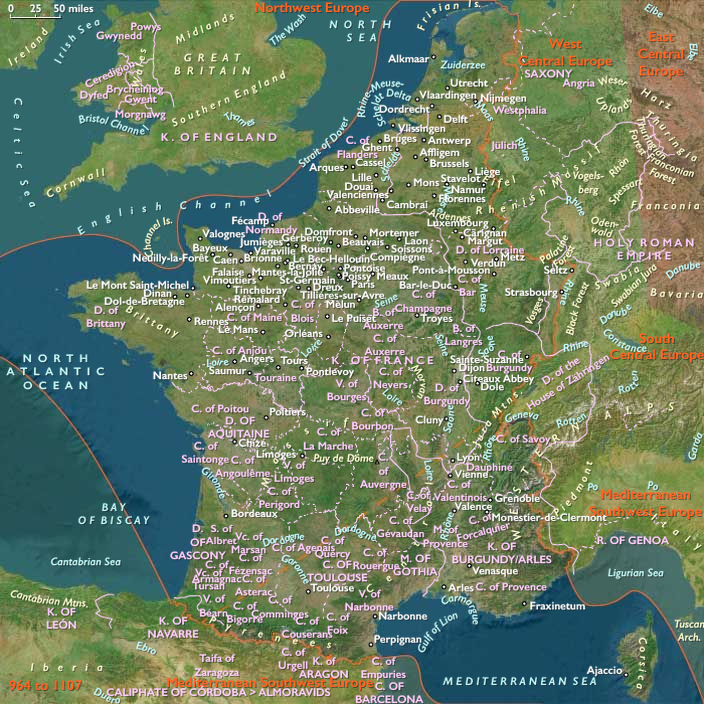
Subregions
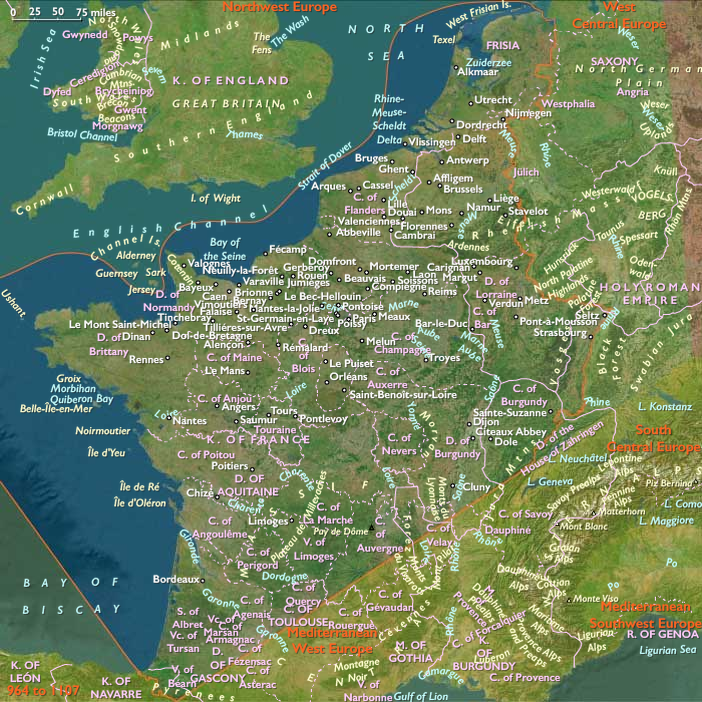
Years: 988 - 988
Locations
People
Groups
- Lorraine (Lotharingia), Lower, (first) Duchy of
- German, or Ottonian (Roman) Empire
- Aquitaine, (Angevin) Duchy of
- France, (Capetian) Kingdom of
Commodoties
Subjects
Regions
Subregions