
Filters:
William's Escape and King Henry I's Intervention …
Years: 1046 - 1046
William's Escape and King Henry I's Intervention (1046–1047)
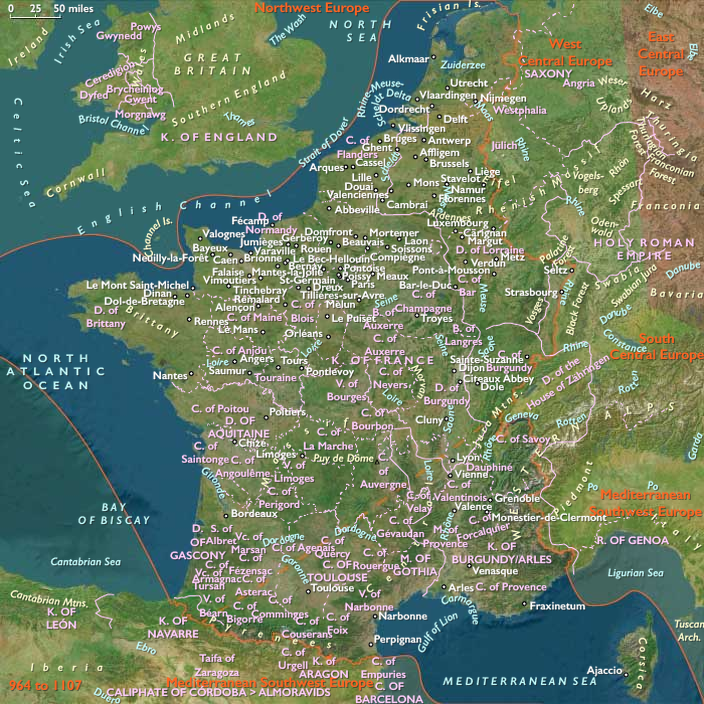
Following his narrow escape from an ambush at Valognes, Duke William of Normandy rode directly to King Henry I’s court in Poissy, where he appealed for assistance against the rebellious Norman nobles. William reminded Henry that an attack on him was, in effect, an attack on the king’s authority, since William was a faithful vassal of the French crown.
William’s Appeal to King Henry I
- After evading capture, William made a direct appeal to King Henry I of France, seeking protection and military support.
- He framed the Norman revolt as a rebellion against the Capetian monarchy, arguing that if his rule was overthrown, Henry’s influence over Normandy would be severely weakened.
- Recognizing the threat, Henry decided to intervene decisively in the conflict.
King Henry Raises an Army
- King Henry assembled an army of about ten thousand men, a considerable force for the time.
- The French royal army marched into Normandy, supporting William’s bid to crush the rebellion.
- This marked a turning point in the conflict, as it provided William with a decisive military advantage over his opponents.
March Toward the Battle of Val-ès-Dunes (1047)
- With royal backing, William prepared to confront the rebellious Norman lords, including Guy of Brionne, Nigel of the Cotentin, and Ranulf of the Bessin.
- The French-Norman army advanced, leading to the Battle of Val-ès-Dunes (1047), where William and Henry faced off against the rebel forces.
- This battle would prove crucial in securing William’s hold on Normandy, marking the first major step in his path to consolidating power.
Legacy and Impact
- King Henry’s support saved William’s rule, reinforcing the feudal bond between the Capetians and the Normans.
- The intervention set a precedent for French kings influencing Norman affairs, though this relationship would later become contentious.
- William’s military and political survival from this rebellion hardened him as a leader, shaping the strategic mindset that would eventually lead him to the conquest of England in 1066.
By securing French royal backing, William transformed a near disaster into a defining moment, cementing his claim to Normandy and beginning his rise as one of medieval Europe’s most formidable rulers.
Locations
People
Groups
- Christianity, Chalcedonian
- Normandy, Duchy of
- Normans
- French people (Latins)
- Burgundy, County of
- France, (Capetian) Kingdom of
- England, (Anglo-Saxon) Kingdom of
Commodoties
Subjects
Regions
Subregions

Years: 1046 - 1046
Locations
People
Groups
- Christianity, Chalcedonian
- Normandy, Duchy of
- Normans
- French people (Latins)
- Burgundy, County of
- France, (Capetian) Kingdom of
- England, (Anglo-Saxon) Kingdom of
Commodoties
Subjects
Regions
Subregions