
Willibrord and the Christianization of Frisia …
Years: 715 - 715
Willibrord and the Christianization of Frisia
Willibrord and the Christianization of Frisia
Born around 672 in Crediton, Devon, Willibrord devoted himself early to the monastic life, receiving his theological training in the Benedictine monasteries of Adescancastre (near Exeter) and Nursling (between Winchester and Southampton), under the abbot Winbert. A disciple of St. Wilfrid, he was sent to the Abbey of Ripon as a child and later joined the Benedictines. By the age of thirty, he had become a priest, spending his formative years at the Abbey of Rathmelsigi, a major center of learning in the seventh century, where he studied under Saint Egbert.
Mission to Frisia and Episcopal Consecration
At Egbert’s urging, Willibrord and twelve companions set out to Christianize the pagan North Germanic tribes of Frisia, answering a request from Pepin of Herstal, the Frankish ruler and nominal suzerain of the region. Willibrord made two journeys to Rome, where he was consecrated Bishop of the Frisians by Pope Sergius I in the Church of St. Cecilia on November 21, 695. He was given the name Clement and received the pallium, marking his status as the leader of the Frisian church.
Upon returning to Frisia, he established numerous churches and founded a monastery at Utrecht, where he set up his cathedral and became the first Bishop of Utrecht. In 698, with the patronage of Irmina, daughter of Dagobert II, he also founded the Abbey of Echternach in Luxembourg, a center that would endure as an important religious institution.
The Frankish-Frisian Struggle and Willibrord’s Flight
Around the turn of the 8th century, the Archbishopric (or Bishopric) of the Frisians was formally established for Willibrord, and in 711, a political marriage between Grimoald the Younger, the eldest son of Pepin of Herstal, and Thiadsvind, daughter of Radbod, ruler of Frisia, sought to cement ties between the Franks and the Frisians.
However, following Pepin’s death in 714, Radbod reasserts Frisian independence. As a pagan ruler, he views Christianity as a tool of Frankish domination and launches a campaign to eradicate it from his lands. Willibrord and his monks are forced to flee as Radbod retakes Frisia, burning churches and executing many missionaries. The Frisians’ resistance to Christianization underscores the deep tensions between Frankish influence and indigenous pagan traditions, a conflict that will continue until the eventual triumph of Carolingian power in the mid-8th century.
Mission to Frisia and Episcopal Consecration
At Egbert’s urging, Willibrord and twelve companions set out to Christianize the pagan North Germanic tribes of Frisia, answering a request from Pepin of Herstal, the Frankish ruler and nominal suzerain of the region. Willibrord made two journeys to Rome, where he was consecrated Bishop of the Frisians by Pope Sergius I in the Church of St. Cecilia on November 21, 695. He was given the name Clement and received the pallium, marking his status as the leader of the Frisian church.
Upon returning to Frisia, he established numerous churches and founded a monastery at Utrecht, where he set up his cathedral and became the first Bishop of Utrecht. In 698, with the patronage of Irmina, daughter of Dagobert II, he also founded the Abbey of Echternach in Luxembourg, a center that would endure as an important religious institution.
The Frankish-Frisian Struggle and Willibrord’s Flight
Around the turn of the 8th century, the Archbishopric (or Bishopric) of the Frisians was formally established for Willibrord, and in 711, a political marriage between Grimoald the Younger, the eldest son of Pepin of Herstal, and Thiadsvind, daughter of Radbod, ruler of Frisia, sought to cement ties between the Franks and the Frisians.
However, following Pepin’s death in 714, Radbod reasserts Frisian independence. As a pagan ruler, he views Christianity as a tool of Frankish domination and launches a campaign to eradicate it from his lands. Willibrord and his monks are forced to flee as Radbod retakes Frisia, burning churches and executing many missionaries. The Frisians’ resistance to Christianization underscores the deep tensions between Frankish influence and indigenous pagan traditions, a conflict that will continue until the eventual triumph of Carolingian power in the mid-8th century.
Locations
People
Groups
- Polytheism (“paganism”)
- Franks
- Saxons
- Angles
- Christianity, Chalcedonian
- Frisians
- Benedictines, or Order of St. Benedict
- Frisian Kingdom
- Burgundy, Frankish Kingdom of
- Northumbria, Kingdom of
- Francia (mayors of the palaces of Austrasia and Neustria)
Topics
Commodoties
Subjects
Regions
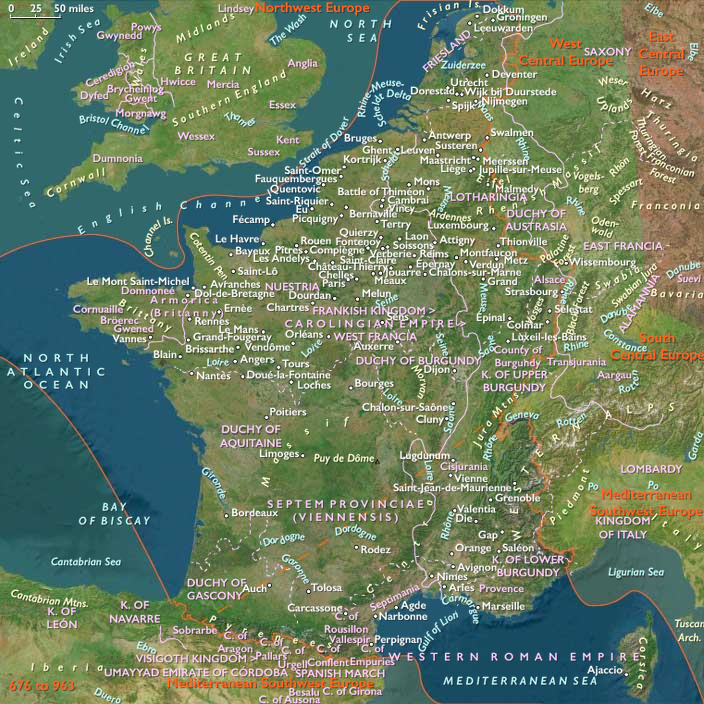
Subregions
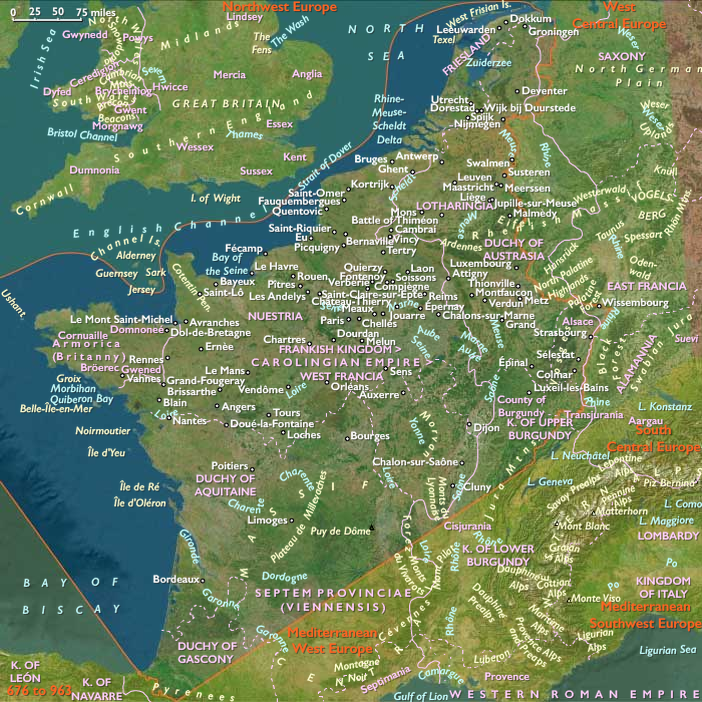
Years: 715 - 715
Locations
People
Groups
- Polytheism (“paganism”)
- Franks
- Saxons
- Angles
- Christianity, Chalcedonian
- Frisians
- Benedictines, or Order of St. Benedict
- Frisian Kingdom
- Burgundy, Frankish Kingdom of
- Northumbria, Kingdom of
- Francia (mayors of the palaces of Austrasia and Neustria)
Topics
Commodoties
Subjects
Regions
Subregions