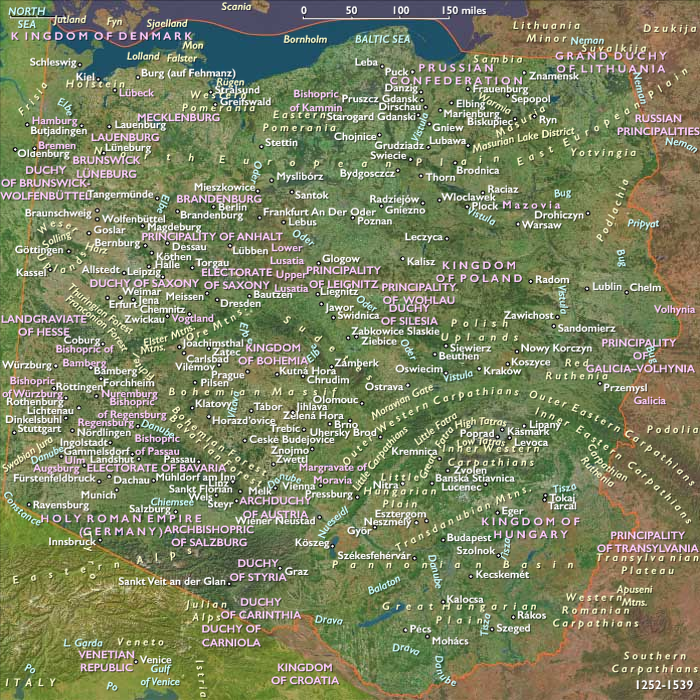
…with its county of Plock, in 1351. …
Years: 1351 - 1351
…with its county of Plock, in 1351. (Poland will lose it again, however, after Casimir’s death in 1370).
Locations
People
Groups
Subjects
Regions
Subregions
Related Events
Filter results
Showing 10 events out of 44180 total
Ramathibodi, the former Prince U-thong (meaning "source of gold"), or Suppanaphum, establishes the strongly Khmer-influenced Thai Kingdom of Ayutthaya (Ayuthia, or Ayudhya) forty-five miles (seventy-two kilometers) north of present Bangkok, as a strong autocratic bureaucracy.
A native of Chiang Saen (now in Chiang Rai Province) he claims descent from Khun Borom and propagates Theravada Buddhism as the state religion.
Ramathibodi I's position is likely secured by political marriage and family ties.
He is married to a daughter of the ruling family of the Suphanburi Kingdom, and may have also married into an alliance with the rulers of Lavo Kingdom (also known as Lopburi), it is likely the king of Lavo that he had initially been chosen to succeed.
He appoints both his brother-in-law and son to positions of leadership in Suphanburi and Lavo, respectively, and establishes his own capital in the new city of Ayutthaya in 1351.
King Ramathabodi's reign binds together the Khmer rulers of Lavo, the Tai in the west, and the Chinese, Javanese, Bugis and Acehnese merchants who inhabit the coastal areas.
According to a better-known source, a seventeenth-century account by Dutchman Jeremias Van Vliet, a Renowned Legend stated that Ramatibodi was an ethnic Chinese, having sailed down from China.
After succeeding in trade, he became influential enough to rule the city of Phetchaburi, a coastal town of the Gulf of Thailand, before traveling up to Ayutthaya.

Poland’s King Casimir III succeeds in reincorporating into the royal fief Bohemian-controlled Mazovia, …
Ottoman raiding parties have begun to move regularly through Gallipoli into Thrace, where Kantakouzenos had in 1347 given a principality to his eldest son, Matthew, in return for the support he had given to his father during his struggle with John V Palaiologos.
The Hesychast controversy had been taken up by Gregory Palamas after being asked by his fellow monks on Mt.
Athos to defend hesychasm from the attacks of Barlaam of Seminara.
Trained in Western Scholastic theology, Barlaam was scandalized by hesychasm and began to combat it both orally and in his writings.
As a private teacher of theology in the Western Scholastic mode, Barlaam propounded a more intellectual and propositional approach to the knowledge of God than the Hesychasts taught.
Barlaam also took exception to the doctrine held by the Hesychasts as to the uncreated nature of the light, the experience of which was said to be the goal of Hesychast practice, regarding it as heretical and blasphemous.
It was maintained by the Hesychasts to be of divine origin and to be identical to the light which had been manifested to Jesus' disciples on Mount Tabor at the Transfiguration.
Barlaam viewed this doctrine of "uncreated light" to be polytheistic because as it postulated two eternal substances, a visible and an invisible God.
Barlaam accuses the use of the Jesus Prayer as being a practice of Bogomilism.
The hesychasm dispute had continued through a synod convened by Barlaam supporters that refused to accept Patriarch Isidore before a final settlement of the dispute comes about at a sixth synod in 1351 during the patriarchate of Callistus I. Palamas, well-educated in Greek philosophy, has written a number of works in its defense and has defended hesychasm at six different synods in Constantinople, ultimately triumphing over its attackers in the synod of 1351.
As a consequence, a real (or formal) distinction between the essence (ousia) and the energies (energeia) of God become a central principle of Eastern Orthodox theology.
Palestine has suffered the ravages of several epidemics, including the great pestilence, the same Black Death that from 1347 to 1351 has devastated Europe.
A major Genoese fleet under Paganino Doria, following clashes between local forces in the Aegean and around the Bosporus, besieges the Venetian colony of Negroponte (Chalcis, on Euboea) in 1351 before advancing to Constantinople.
The citizens of Zürich swear allegiance before representatives of the cantons of Lucerne, Schwyz, Uri and Unterwalden, the other members of the Swiss Confederacy.
Thus, Zürich becomes the fifth member of the Swiss Confederacy, which is at this time a loose confederation of de facto independent states.
The Black Death has ravaged the population throughout the lands of Savoy from 1348 through 1351, cutting the population in some villages in half.
Many of the peasants in 1348 thought that it was caused by Jews poisoning wells and fountains.
Though the castellans in some places had tried to protect them, quite a few had been killed.
In Chambéry, the Jews had been locked in the castle for their protection, but a mob had broken in and killed several.
Court officers were then pressured into finding the remainder guilty of poisoning, executing eleven and charging the remainder a fine of one hundred and sixty florins per month for the next six years.
The Venetians hastily form alliances with Constantinople’s emperor John VI Kantakouzenos and King Peter IV of Aragon and wage an indecisive naval battle at the Bosporus.
Archbishop Giovanni Visconti, lord of Milan, allies himself with the Ghibellines in Tuscany in 1351 and orders an invasion of Florentine territory.
The Florentines battle Milanese forces for two months, checking the invaders’ advance at Scarperia and eventually forcing them back to Bologna.