
The Great Blizzard of 1888 begins along …
Years: 1888 - 1888
March
The Great Blizzard of 1888 begins along the eastern seaboard of the United States on March 11, shutting down commerce and killing more than four hundred.
The weather had been unseasonably mild just before the blizzard, with heavy rains that turned to snow as temperatures dropped rapidly.
The storm begins in earnest shortly after midnight on March 12 and continues unabated for a full day and a half.
In a 2007 article, the National Weather Service will estimaet that this Nor'easter dumped as much as 50 inches (130 cm) of snow in parts of Connecticut and Massachusetts, while parts of New Jersey and New York had up to 40 inches (100 cm).
Most of northern Vermont receives from 20 inches (51 cm) to 30 inches (76 cm).
Drifts averaged 30–40 feet (9.1–12.2 m), over the tops of houses from New York to New England, with reports of drifts covering three-story houses. The highest drift was recorded in Gravesend, Brooklyn at 52 feet or 16 metres. 58 inches (150 cm) of snow fell in Saratoga Springs, New York; 48 inches (120 cm) in Albany, New York; 45 inches (110 cm) in New Haven, Connecticut; and 22 inches (56 cm) in New York City.[6] The storm also produced severe winds; 80 miles per hour (129 km/h) wind gusts were reported, although the highest official report in New York City was 40 miles per hour (64 km/h), with a 54 miles per hour (87 km/h) gust reported at Block Island.[6] New York's Central Park Observatory reported a minimum temperature of 6 °F (−14 °C), and a daytime average of 9 °F (−13 °C) on March 13, the coldest ever for March.[6]
Impacts
In New York, neither rail nor road transport is possible anywhere for days, and drifts across the New York–New Haven rail line at Westport, Connecticut, take eight days to clear.
Transportation gridlock as a result of the storm is partially responsible for the creation of the first underground subway system in the United States, which will open nine years later in Boston.
The New York Stock Exchange is closed for two days.
Similarly, telegraph infrastructure is disabled, isolating Montreal and most of the large northeastern U.S. cities from Washington, D.C. to Boston for days.
Following the storm, New York begins placing its telegraph and telephone infrastructure underground to prevent their destruction.
Fire stations are immobilized, and property loss from fire alone is estimated at $25 million (equivalent to $710 million in 2020)
The blizzard results in the founding of the Christman Bird and Wildlife Sanctuary located near Delanson, New York.
From Chesapeake Bay through the New England area, more than two hundred ships are either grounded or wrecked, resulting in the deaths of at least one hundred seamen
More than four hundred people die from the storm and the ensuing cold, including two hundred in New York City alone.
Efforts are made to push the snow into the Atlantic Ocean.
Severe flooding occurs after the storm due to melting snow, especially in the Brooklyn area, which is susceptible to flooding because of its topography.
Not all areas are notably affected by the Blizzard of 1888; an article in the Cambridge Press published five days after the storm noted that the "fall of snow in this vicinity was comparatively small, and had it not been accompanied by a strong wind it would have been regarded as rather trifling in amount, the total depth, on a level, not exceeding ten inches".
New Yorker Roscoe Conkling, an influential Republican politician, dies as a result of the storm.
Groups
- Newfoundland (British Colony)
- Rhode Island, State of (U.S.A.)
- New Jersey, State of (U.S.A.)
- Connecticut, State of (U.S.A.)
- New York State (U.S.A.)
- Vermont, State of (U.S.A.)
- United States of America (US, USA) (Washington DC)
- New Brunswick (Canadian province)
- Quebec (Canadian province)
- Nova Scotia (Canadian province)
- Canada, Dominion of
- Prince Edward Island (Canadian province)
Topics
Subjects
Regions
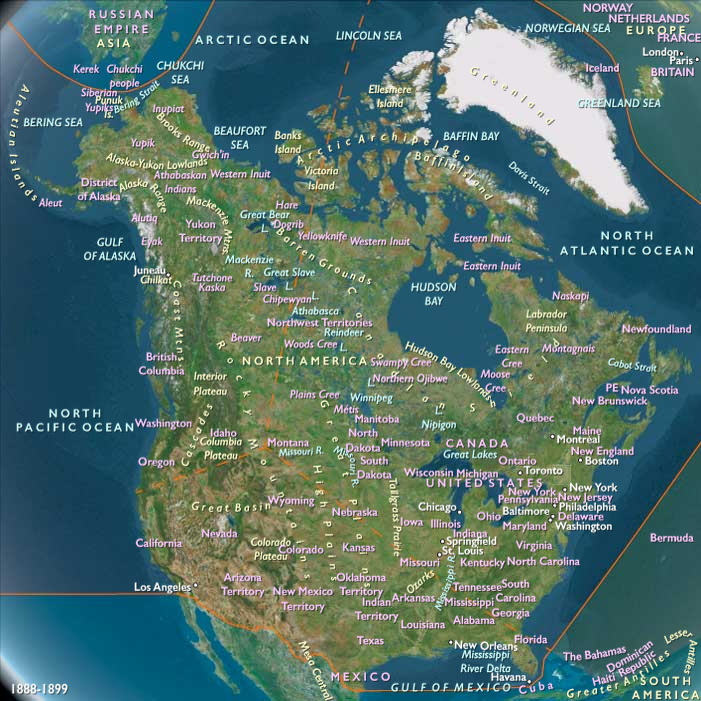
Subregions
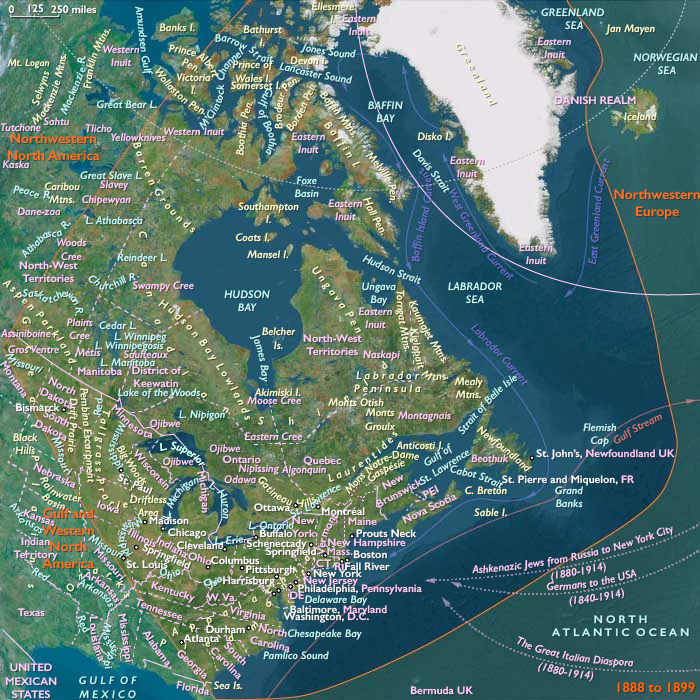
Years: 1888 - 1888
March
Groups
- Newfoundland (British Colony)
- Rhode Island, State of (U.S.A.)
- New Jersey, State of (U.S.A.)
- Connecticut, State of (U.S.A.)
- New York State (U.S.A.)
- Vermont, State of (U.S.A.)
- United States of America (US, USA) (Washington DC)
- New Brunswick (Canadian province)
- Quebec (Canadian province)
- Nova Scotia (Canadian province)
- Canada, Dominion of
- Prince Edward Island (Canadian province)
Topics
Subjects
Regions
Subregions