
The construction of Beaumaris Castle on Anglesey, …
Years: 1295 - 1295
The construction of Beaumaris Castle on Anglesey, last of the ring of castles built by Edward I of England to subdue Wales, begins in 1295.
Plans were probably first made to construct the castle in 1284, but this had been delayed due to lack of funds and work only begins in 1295 following the Madog ap Llywelyn uprising.
A substantial workforce will be employed in the initial years under the direction of James of St. George.
Edward's invasion of Scotland will soon divert funding from the project, however, and work will stop, only recommencing after an invasion scare in 1306.
Locations
People
Groups
- Welsh people
- Scottish people
- English people
- Anglo-Normans
- England, (Plantagenet, Angevin) Kingdom of
- Scotland, Kingdom of
Topics
Commodoties
Subjects
Regions
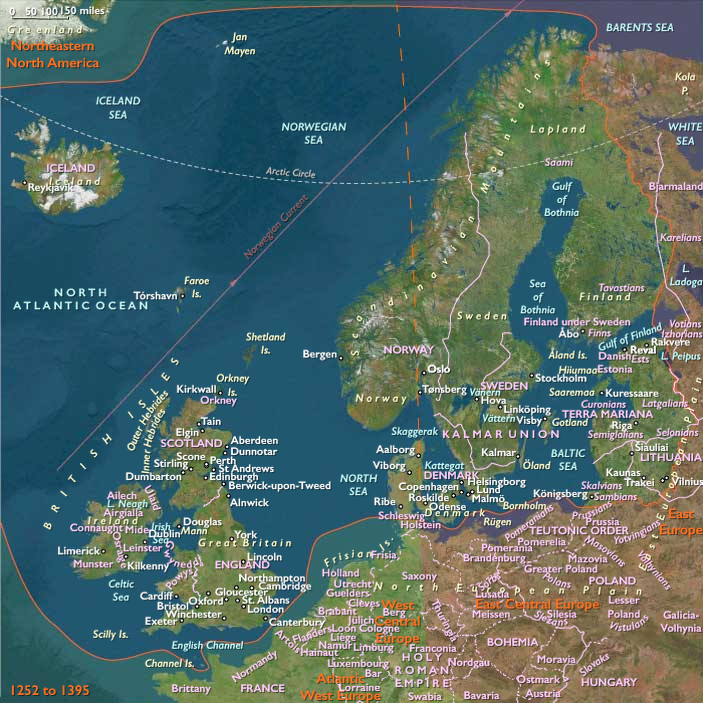
Subregions
Related Events
Filter results
Showing 10 events out of 45232 total
The Prussian uprising of 1295 is limited to Natangia and Sambia and depends upon help from Vytenis, Grand Duke of Lithuania.
The rebels capture Bartenstein (Bartoszyce) by surprise and plunder as far as Königsberg, but are never a serious threat.
By this time the Prussian nobility is already baptized and pro-Teutonic to the extent that peasants kill them first before attacking the Knights.
This last attempt effectively ends the Prussian Crusade and the Knights concentrate on conquering Samogitia and Lithuania.
Lithuanian historians note that fierce resistance by the Prussians won time for the young Lithuanian state to mature and strengthen so it could withstand the hundred-year crusade, culminating in the 1410 Battle of Grunwald, with minimal territorial losses.
The Prussian lands will be repopulated by colonists from Germany, who after the sixteenth century will eventually outnumber the natives.
It is estimated that Prussians numbered one hundred thousand around 1400, and comprised about half of the total population in Prussia.
Subject to Germanization and assimilation, the Prussians will eventually become extinct sometime after the sixteenth century.
It is believed that the Prussian language became extinct sometime at the beginning of the eighteenth century.
Andronikos II Palaiologos makes his son coemperor, as Michael IX, in 1295.
In reaction against his father's policy, Andronikos has pursued a line of almost total isolation from the papacy and the West.
The union of Lyon had been solemnly repudiated and Orthodoxy restored, to the deep satisfaction of most Greeks, but there are still divisive conflicts in society.
The Arsenite schism in the church is unhealed; the rulers of Epirus and Thessaly remain defiant and have kept contact with the successors of Charles I in Italy; and the people of Anatolia air their grievances in rebellion.
It is no longer possible for Constantinople to raise armies to fight in Europe and Asia simultaneously.
The native recruitment fostered by the Komnenian emperors has fallen off since 1261.
Estates held in pronoia have become hereditary possessions of their landlords, who ignore or are relieved of the obligation to render military service to the government.
The knights of the Fourth Crusade had found many familiar elements of feudalism in the social structure of the imperial provinces.
By the end of the thirteenth century, the development has gone much further.
The officers of the imperial army are still mostly drawn from the native aristocracy, but the troops are hired, and the cost of maintaining a large army in Europe, added to the lavish subsidies that Michael VIII had paid to his friends and allies, has crippled the economy.
His son Andronikos, an intellectual and a theologian rather than a statesman or soldier, has unwisely attempted to economize by reducing Constantinople’s land forces to a few thousand cavalry and infantry and eliminating the navy altogether, relying solely on a Genoese mercenary fleet.
Unemployed Greek sailors sell their services to the new Turkish emirs, who are already raiding the Aegean islands.
Ghazan, the son of Arghun, had been prevented from pursuing his claim of leadership in the capital after his father's death in 1291 because he was engaged both with Nawruz's raids, and dealing with rebellion and famine in Khorasan and Nishapur.
Taghachar, an army commander who had served the previous three generations of Ilkhan, was probably behind the death of Arghun, and supports Ghazan's uncle Gaykhatu as the new Ilkhan.
Ghazan is loyal to his uncle, though he refuses to follow Gaykhatu's lead in introducing paper currency to his province, explaining that the weather of Khorasan is too humid to handle paper.
In 1294/1295, Ghazan forces Nawruz to surrender at Nishapur, and Nawruz now becomes one of Ghazan's lieutenants.
During Gaykhatu's reign, Kökechin, who had been brought from the Yuan Dynasty from the east by Marco Polo,had originally been betrothed to Ghazan's father, the Ilkhan Arghun, but since he had died during her months-long journey from the capital, she had instead married Ghazan, his son.
She will be Ghazan’s principal wife during his lifetime.
Taghachar and his conspirators, who had been behind the death of Arghun, have his successor Gaykhatu killed as well in 1295.
They now place the controllable Baydu, a cousin of Ghazan, on the throne.
Baydu is primarily a figurehead, allowing the conspirators to divide the Ilkhanate among themselves.
Within a few months, Ghazan challengeds Baydu for the throne, ending by having him executed on October 5, 1295.
Ghazan is assisted in this by his earlier enemy, the prominent Muslim Mongol emir Nawruz.
Ghazan had converted to Islam, on June 16, 1295,at the hands of Ibrahim ibn Muhammad ibn al Mu’ayyid ibn Hamweyh al-Khurasani al-Jawini as a condition for Nawruz's military support.
Another who has assisted Ghazan was Taghachar, but Ghazan deems him unreliable, exiles him to Anatolia, and later has him discreetly murdered.
The Polos return in 1295 to Venice from the Far East, by way of Persia, with a recipe for a frozen dessert that includes milk, possibly representing the introduction of ice cream into Europe. (The Italians are credited with popularizing the dish.)
According to legend, Marco Polo had also brought with him a noodle recipe from Asia.
Pasta quickly becomes a major element in the Italian diet, and its use will soon spread throughout Europe.
Malatesta da Verucchio, originally the leader of the Guelphs in Romagna , had become podestà (chief magistrate) of Rimini in 1239.
He makes himself complete master of Rimini in 1295 by killing the chief members of the rival Ghibelline family, the Parcitati, including their leader Montagna.
He establishes his family's rule over the city.
His eldest son is Giovanni Malatesta, famous for the 1285 tragedy, recorded in Dante's Inferno, in which he killed his wife Francesca da Polenta and his younger brother Paolo, having discovered them in adultery.
The apse mosaics of Santa Maria Maggiore in Rome, executed in 1295, combine such themes as the Coronation of the Virgin with ancient and Early Christian motifs to produce rich and elegant images.
Pope Boniface VIII, who has backed the Angevin claim to Sicily, proposes a treaty seeking to bring peace between the house of Anjou and Sicily, in vain.
Under the Treaty of Anagni, signed on June 20, 1295, King James II of Aragon relinquishes control of Sicily and is compensated the Pope with the kingship of Sardinia and CorsicaAnd by the arrangement of marriage with Charles' daughter Bianca.
This ends French claims in Aragon.
The Sicilians, displeased by the papacy-backed confirmation of the Angevin claim to Sicily in 1295, rebel and crown James II’s brother as King Frederick II, who continues the Aragonese war with the Angevins.
The eighteen-year-old Charles Martel d’Anjou had been set up by Pope Nicholas IV and the ecclesiastical party as the titular King of Hungary in 1290 as successor of his maternal uncle, the childless Ladislaus IV of Hungary.
He has never managed to govern the Kingdom of Hungary, where an agnate of the Árpád dynasty, his cousin Andrew III of Hungary rules.
Charles Martel has, however, been unsuccessful in asserting his claim in Kingdom of Croatia, at this time in personal union with Hungary.
Charles Martel dies young in Naples, during the lifetime of his parents, on August 12, 1295.
His son, Charles (or Charles Robert), will later succeed in winning the throne of Hungary.
Charles was apparently known personally to Dante: in the Divine Comedy, the poet speaks warmly of and to Charles's spirit when they meet in the Heaven of Venus (in Paradiso VIII).
Master Honoré and the Evolution of Illumination (1295)
Master Honoré, a Parisian miniaturist, was one of the first manuscript illuminators to emerge from a secular workshop, rather than a monastic scriptorium. Working for the court of King Philip IV (Philip the Fair), he played a key role in shaping late 13th-century manuscript illumination, particularly in the increasing use of illusionism.
- In 1295, Honoré completed the "Prayer Book of Philip the Fair," a masterpiece that showcased innovative techniques in shading and highlights, creating an illusion of three-dimensionality.
- While his figures remained two-dimensional, his careful application of light and shadow on drapery and facial features gave his compositions a greater sense of depth and realism.
- His work inspired later Gothic manuscript illumination, setting the stage for the more advanced illusionistic effects of the 14th and 15th centuries.
The Auld Alliance: Scotland and France Unite Against England (1295)
In 1295, following increasing tensions with King Edward I of England, John de Balliol, King of Scots, sought an alliance with France to counter English aggression.
- On October 23, 1295, the first formal treaty of the Auld Alliance was signed in Paris, officially binding Scotland and France against England.
- The treaty guaranteed mutual military support, ensuring that if one nation was attacked by England, the other would provide aid.
- This alliance set the foundation for centuries of Franco-Scottish cooperation, enduring even beyond the Middle Ages and influencing the diplomatic landscape of Britain and France well into the 16th century.
Long-Term Impact of the Auld Alliance
- The Auld Alliance played a crucial role in Scotland’s resistance to English rule, most notably during the Wars of Scottish Independence (1296–1357).
- France and Scotland remained close allies for over 250 years, until the Treaty of Edinburgh (1560) formally ended their military cooperation.
- The alliance also influenced trade, culture, and diplomacy, fostering strong Franco-Scottish relations that persisted even after Scotland’s union with England in 1707.
Conclusion
The year 1295 marked significant cultural and political developments:
- Master Honoré’s innovations in manuscript illumination paved the way for a more illusionistic style in Gothic art.
- The Auld Alliance treaty cemented a long-standing Franco-Scottish relationship, shaping medieval and early modern European geopolitics.
Both events exemplify the interplay between artistic evolution and political maneuvering in late 13th-century Europe.
Years: 1295 - 1295
Locations
People
Groups
- Welsh people
- Scottish people
- English people
- Anglo-Normans
- England, (Plantagenet, Angevin) Kingdom of
- Scotland, Kingdom of
