Xuanwu's concubine Consort Hu gives birth in …
Years: 510 - 510
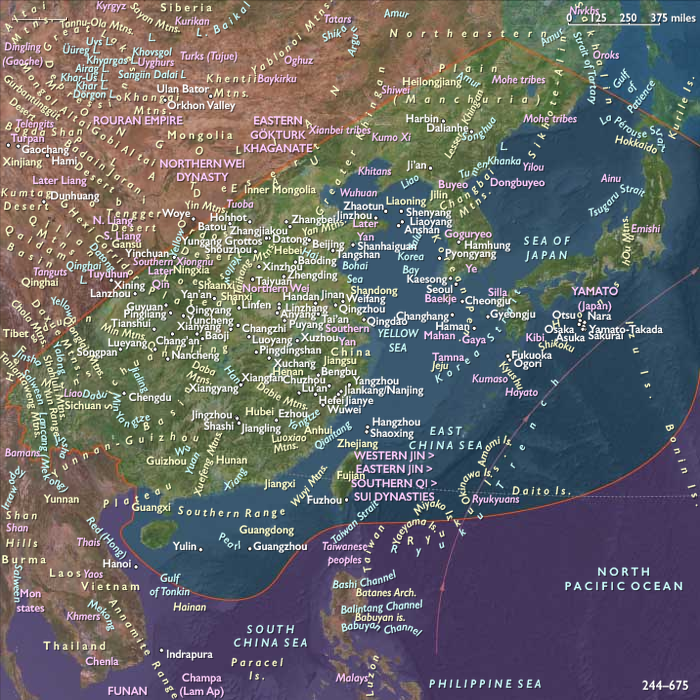
Xuanwu's concubine Consort Hu gives birth in 510 to a son, Yuan Xu.
Because Xuanwu has lost multiple sons in childhood by this point, he carefully selects several experienced mothers to serve as Yuan Xu's wet nurses, and disallows both Gao and Hu from seeing him.
Locations
People
Groups
- Xianbei
- Tuoba
- Chinese (Han) people
- Northern Wei, Xianbei, or Tuoba Empire
- Liang Dynasty, Southern (Chinese dynasty)
Topics
Commodoties
Subjects
Regions
Subregions
Related Events
Filter results
Showing 10 events out of 58238 total
The Ghassanid emigration, as passed down in the rich oral tradition of Syria, Palestine, Jordan and Lebanon, originated in the city of Ma'rib in Yemen.
There was a dam in this city; however, one year there was so much rain that the dam was carried away by the ensuing flood.
Thus the people there had to leave.
The inhabitants emigrated seeking to live in less arid lands and became scattered far and wide.
The proverb “They were scattered like the people of Saba” refers to that exodus in history.
The emigrants were from the southern Arab tribe of Azd of the Kahlan branch of Qahtani tribes.
Another version of the story refers also to the persecution of the Christian tribes in Ancient Yemen by its rulers and the powerful Jewish tribes.
A reference to that is mentioned in the Quran about "As-haab al-ukhdood" where many Christians were buried alive in mass graves.
Those who were able to flee headed north settling in what is today south of The Levant.
The date of the migration to Syria is unclear; their earliest appearance in records is dated to 473, when their chief, Amorkesos, signed a treaty with the Eastern Roman Empire acknowledging their status as foederati controlling parts of Palestine.
He apparently became a Christian at this time; by around 510, the Ghassanids are no longer Chalcedonian, but Monophysite.
The king Jafna bin ‘Amr had emigrated with his family and retinue north and settled in Hauran, where the Ghassanid state was founded.
From him the Ghassanid line are also sometimes known as the Jafnids.
It is assumed that the Ghassanids adopted the religion of Christianity after they reached their new home.
The Romans had found a powerful ally in the new coming Arabs.
The Ghassanid kingdom serves as the buffer zone against the Lakhmids penetrating Roman territory.
In addition, as kings of their own people, they are also phylarchs, native rulers of client frontier states.
The capital is at Jabiyah in the Golan Heights.
Geographically, it occupies much of Syria, Lebanon, Jordan, Israel and the Palestinian Territories, and its authority extends via tribal alliances with other Azdi tribes all the way to the northern Hijaz as far south as Yathrib (Medina).
The Empire is focused more on the East and a long war with the Persians is always their main concern.
The Ghassanids maintain their rule as the guardian of trade routes, police Lakhmid tribes and are a source of troops for the Imeprial army.

Isidore of Seville provides a hint that Gundobad had exploited the Visigothic defeat at Vouillé by plundering Narbonne.
Delayed by the threat of the Imperial Navy, which had been hovering off the Italian shore around the time of the battle, the Ostrogothic army arrives to relieve the Burgundian siege of Arles, heroically defended by its inhabitants with the assistance of the Ostrogothic general Theudis.
Theodoric, in assuming control of Italy, employs such able Roman administrators as Liberius and Flavius Magnus Aurelius Cassiodorus.
A patron of the arts, Theodoric enlists support of influential Romans, including his friend and advisor Anicius Manlius Severinus Boethius, a descendant of an ancient Roman family.
Orphaned at an early age and classically educated in Latin and Greek.
Boethius becomes a Roman consul in 510.
Boethius was born around 480, but his exact birth date is unknown.
Boethius was born to a patrician family; his father Manlius Boethius was appointed consul in 487.
However, his father died when Boethius was young, and he had been adopted by another patrician, Quintus Aurelius Memmius Symmachus.
Memmius Symmachus had raised him and instilled in him a love for literature and philosophy.
Both Memmius Symmachus and Boethius are fluent in Greek, an increasingly rare skill at this time in the Western Empire, which has led some scholars to think that Boethius was educated in the East.
According to John Moorhead, the traditional view is that Boethius studied in Athens based on Cassiodorus's rhetoric describing Boethius' learning in one of his letters, but this appears to be a misreading and his studying in Athens is more likely a legend.
The French scholar Pierre Courcelle has argued that Boethius studied at Alexandria with the Neo-Platonist philosopher Ammonius Hermiae.
However, Moorhead observes that the evidence supporting Boethius having studied in Alexandria "is not as strong as it may appear", and concludes "Perhaps Boethius was able to acquire his formidable learning without travelling".
(Moorhead, "Boethius' life and the world of late antique philosophy", in The Cambridge Companion to Boethius, edited by John Marenbon (Cambridge: University Press, 2009), p. 29) Due to his erudition, Boethius had entered the service of Theodoric.
His earliest documented acts on behalf of the Ostrogothic ruler were to investigate allegations that the paymaster of Theodoric's bodyguards had debased the coins of their pay, to produce a water clock that Theodoric intended to give to king Gundobad of the Burgunds, and to recruit a lyre-player to perform for king Clovis of the Franks.
Boethius had married his foster-father's daughter Rusticiana, and their children include two boys, Symmachus and Boethius.
He holds many important offices during Theodoric's reign, including being appointed consul for the year 510.
Macedonius II is deposed by Emperor Anastasius as patriarch of Constantinople and replaced the following day by Timothy I.
Riots erupt in 511 in the streets of Antioch between supporters of patriarch Flavian II and emperor Anastasius I in sympathy of Non-Chalcedonianism.
The Ostrogoths overrun Provence and consolidate their gains in the region.
According to Herwig Wolfram, the Burgundians were "the real victims of the Ostrogothic counteroffensive" following the defeat of their cousins at Vouillé.
"Not only had they lost all their conquered territories and hope of acquiring Arles and Avignon but all their territory as far as Orange had been devastated.”
Visigothic nobles had spirited the heir of Alaric II, the child-king Amalaric, first to Narbonne, which was the last Gothic outpost in Gaul, and further across the Pyrenees into Hispania.
The center of Visigothic rule shifts initially to Barcelona.
The Visigoths are ruled from 511 by Theoderic of the Ostrogoths as de jure regent for the young Amalaric.
Theodoric sends his sword bearer, Theudis, to govern the Visigothic kingdom during the minority of Amalaric.
Visigothic king Gesalec, driven from the throne by Theodoric of the Ostrogoths, finds a refuge in Carthage from the Vandal king Thrasamund.
The Vandal king supports his cause, providing him money and men, and in 510 and 511 the Vandal navy supports Gesalec's invasion of Spain.
However, after receiving some stern letters from Theodoric, Thrasamund recognizes he is no match for the Ostrogoths and withdraws his support for Gesalec, offering an apology and gold to Theodoric.
The First Council of Orléans (511 CE): Clovis' Alliance with the Catholic Church
As Clovis I nears the end of his reign, he strengthens his ties with the Catholic Church, recognizing its influence over the Gallo-Roman population. To formalize this relationship, he calls a synod of Gallic bishops to meet at Orléans in 511 CE, leading to the First Council of Orléans.
Purpose and Political Significance
- Clovis seeks to integrate the Frankish kingdom with the Catholic Church, ensuring stability and religious unity.
- The council aims to reform the Church, establishing its role under Frankish rule while preserving Roman religious traditions.
- By calling the bishops together, Clovis strengthens his royal authority, securing Church backing for Merovingian rule.
The Council’s Attendees and Decisions
- Thirty-three bishops attend, representing both Frankish and Gallo-Roman territories.
- The council passes thirty-one decrees, covering:
- The duties and obligations of individuals within Church society.
- The right of sanctuary, ensuring protection for those seeking refuge in churches.
- Ecclesiastical discipline, defining the authority of bishops and the conduct of clergy.
First Legal Establishment of Equality in the Frankish Kingdom
- The decrees are equally applicable to both Franks and Gallo-Romans, ensuring:
- Legal parity between the conquering Franks and the native Romanized population.
- A unified legal and religious structure, helping merge Frankish and Roman traditions.
- The acceptance of Clovis’ rule among the Gallo-Roman elite, cementing Frankish legitimacy.
The Long-Term Impact of the Council
- The Frankish monarchy and the Catholic episcopate form a lasting alliance, shaping medieval French kingship.
- The council establishes the Church’s autonomy under royal patronage while securing its role in governance.
- The precedent set at Orléans will influence later Merovingian and Carolingian councils, reinforcing the close bond between Church and state in Frankish rule.
By the time of Clovis’ death in 511 CE, he has successfully merged Catholic Christianity with Frankish kingship, ensuring the stability of his realm and laying the foundation for the Frankish monarchy’s future relationship with the Church.
Years: 510 - 510
Locations
People
Groups
- Xianbei
- Tuoba
- Chinese (Han) people
- Northern Wei, Xianbei, or Tuoba Empire
- Liang Dynasty, Southern (Chinese dynasty)