Zhai Liao dies in 391 and is …
Years: 391 - 391
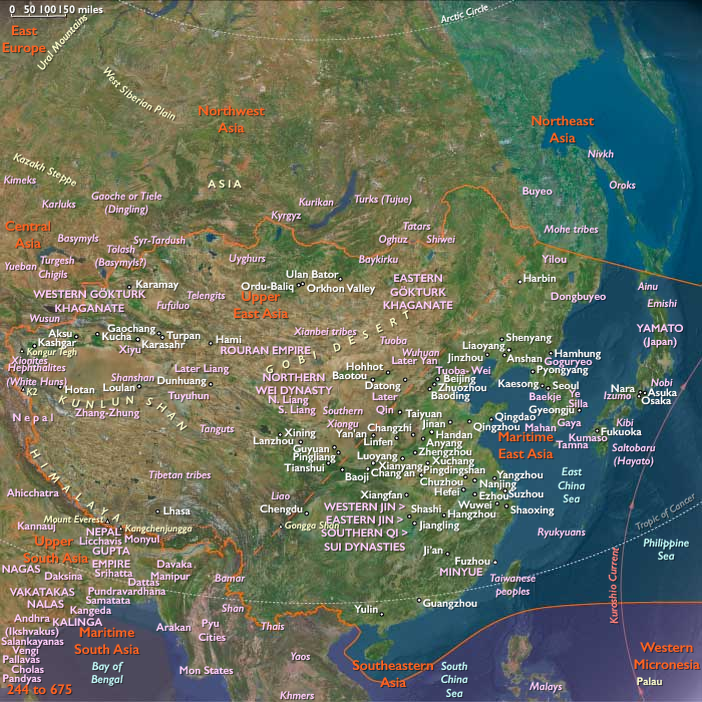
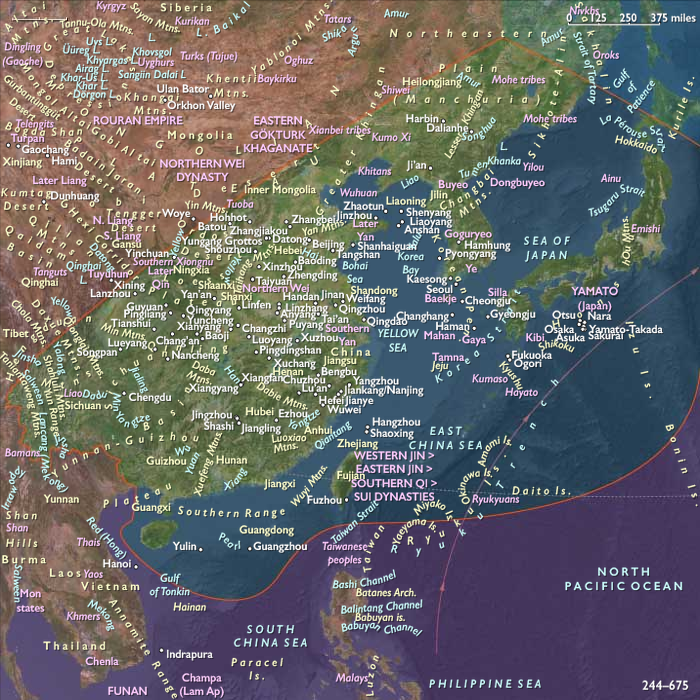
Zhai Liao dies in 391 and is succeeded by his son Zhai Zhao as the Heavenly Prince of Wei.
Zhai Zhao soon attempts to attack Later Yan's important city Yecheng, but is repelled by Murong Chui's son Murong Nong.
Locations
People
Groups
Topics
- Six Dynasties Period in China
- Sixteen Kingdoms Period in China
- Civil Wars in China triggered by the Wu Hu Invasion
Commodoties
Subjects
Regions
Subregions
Related Events
Filter results
Showing 10 events out of 59364 total
Goguryeo, surrounded by the powerful forces of Baekje to its south and west, is therefore inclined to avoid conflict with its peninsular neighbor while cultivating constructive relations with the Xianbei and Rouran in order to defend itself from future invasions, and even the possible destruction of its state.
Gwanggaeto succeeds his father, King Gogukyang, upon his death in 391.
Immediately upon being crowned king of Goguryeo, Gwanggaeto grants himself the title Emperor Yeongnak, affirming himself as equal to the rulers of China and the king of Baekje.
He now begins to rebuild and retrain Goguryeo's cavalry units and naval fleet.
Persecution of pagans by newly Christian Romans in the late fourth century reaches new levels of intensity, as the decrees of Theodosius have forbidden public observances of any rites but Christian.
Theodosius in 388 had sent a prefect to Syria, Egypt, and Asia Minor with the aim of breaking up pagan associations and the destruction of their temples.
Theodosius has progressively made the sacred feasts of other faiths into workdays (389), forbidden public sacrifices under punishment of death, closed temples and libraries, and colluded in acts of local violence by Christians against major cult sites.
The decree promulgated in 391 that "no one is to go to the sanctuaries, [or] walk through the temples" results in the abandonment of many temples throughout the Empire, which sets the stage for widespread practice of converting or replacing these sites with Christian churches.
Bishop Theophilus of Alexandria, Nicene patriarch here from 385, obtains legal authority over one such forcibly abandoned temple of Dionysus, which he intends to turn into a church.
During the renovations, the contents of subterranean spaces ("secret caverns" in the Christian sources) are uncovered and profaned, which allegedly incites crowds of non-Christians to seek revenge.
The Christians retaliate, as Theophilus withdraws, causing the pagans to retreat into the Serapeum, still the most imposing of the city's remaining sanctuaries, and to barricade themselves inside, taking captured Christians with them.
The Serapeum, a temple built by Ptolemy III (reigned 246–222 BCE) and dedicated to Serapis, the syncretic Hellenistic-Egyptian god who was made the protector of Alexandria, is, by all of the detailed descriptions, the largest and most magnificent of all temples in the Greek quarter of Alexandria.
Besides the image of the god, the temple precinct houses an offshoot collection of the great Library of Alexandria.
According to the Christian writers Rufinus and Sozomen, the captives are reportedly forced to offer sacrifices to the banned deities, and that those who refuse are tortured (their shins broken) and ultimately cast into caves that had been built for blood sacrifices.
The trapped pagans plunder the Serapeum (Rufinus & MacMullen 1984).
A letter is sent by Theodosius to Theophilus, asking him to grant the offending pagans pardon but calling for the destruction of all pagan images, suggesting that these were at the origin of the commotion.
Consequently, the Serapeum is leveled by Roman soldiers and monks called in from the desert, as are the buildings dedicated to the Egyptian god Canopus.
The wave of destruction of non-Christian idols spreads throughout Egypt in the following weeks, as documented by a marginal illustration on papyrus from a world chronicle written in Alexandria in the early fifth century, which shows Theophilus in triumph; the cult image of Serapis, crowned with the modius, is visible within the temple at the bottom (MacMullen 1984).
A slightly different version of this account of the destruction of the Serapeum begins with bishop Theophilus closing down a Mithraeum, rather than the temple of Dionysus, but details of the ensuing profanation and insinuation of human sacrifices substantially agree.
A second account of the incident is found in writings by Eunapius, the pagan historian of later Neoplatonism.
Here, an unprovoked Christian mob successfully used military-like tactics to destroy the Serapeum and steal anything that may have survived the attack.
According to Eunapius, the remains of criminals and slaves, who had been occupying the Serapeum at the time of the attack, were appropriated by non-Christians, placed in (surviving) pagan temples, and venerated as martyrs (Turcan, 1996).
Arbogast has become all-powerful in Gaul by 391.
When Emperor Valentinian attempts to dismiss him, Arbogast tears up the order and declares that only Theodosius possesses the power to do so.
Vesta, the virgin goddess of the hearth, home, and family in Roman mythology, had had a large, albeit mysterious role in Roman religion.
Although she is analogous to Hestia in Greek mythology, Vesta is much more important to the Romans than Hestia had been to the Greeks.
Little is known about the goddess, as unlike other Roman deities, she, like Hestia, had no distinct personality, was never depicted and went without mention in myths.
Vesta's presence has long been symbolized by the sacred fire that burns at her hearth and temples, guarded by her priestesses, the Vestales, who renew the fire every March 1 until 391, when Theodosius forbids public pagan worship.
Quintus Aurelius Symmachus, the cultured and prominent son of a prominent father, Lucius Aurelius Avianius Symmachus, in the patrician gens Aurelia, had held the offices of proconsul of Africa in 373 and urban Prefect of Rome in 384 and 385.
A representative of the traditional cursus honorum, Symmachus is a pagan at a time when the senatorial aristocracy is rapidly converting to Christianity.
In 382, the Emperor Gratian, a Christian, had ordered the Altar of Victory removed from the Curia, the Roman Senate house in the Forum.
Symmachus had led a delegation of protest, which the emperor had refused to receive.
Two years later, Gratian had been assassinated in Lugdunum, and Symmachus, now Prefect of Rome, had renewed the appeal to Gratian's successor, Valentinian II, in a famous dispatch that had been rebutted by Ambrose, the bishop of Milan.
Symmachus's career had been temporarily derailed when he delivered a panegyric to the short-lived usurper Magnus Maximus, but he shortly recovered and in 391 is granted the consulship, the highest honor in the empire.
In an age when all religious communities credit the divine power with direct involvement in human affairs, Symmachus argues that the removal of the altar has caused a famine and its restoration would be beneficial in other ways.
Subtly he pleads for tolerance for traditional cult practices and beliefs that Christianity is poised to suppress in the Theodosian edicts of 391.
Symmachus petitions Theodosius to reopen the pagan temples; he is opposed by Ambrose.
The Symmachi–Nicomachi diptych is a Late Antique ivory diptych dating to the late fourth or early fifth century whose panels depict scenes of ritual pagan religious practices.
Produced in Rome sometime between 388 and 401, or in Milan, by the identical border details in the ivory panel of the Maries at the Tomb.
The panels are generally believed to celebrate the alliance through marriage of two senatorial families, the Symmachi and Nicomachi.
The most likely candidates are the daughter of Senator Quintus Aurelius Symmachus and Nicomachus Flavianus, the son of his colleague and friend Virius Nicomachus Flavianus, although it has also been suggested that the panels may instead commemorate the marriage of Symmachus' son, Quintus Fabius Memmius Symmachus with the granddaughter of the aforementioned colleague.
Diptychs are often commissioned by leading Roman families to celebrate important events, most often the attainment of the consulship.
The diptych form, at least originally, serves as a pair of covers for wax writing tablets.
Both its style and its content reflect the short-lived revival of traditional Roman religion and Classicism at a time when the Roman world is increasingly turning to Christianity and rejecting the Classical tradition.
Just as the majority of the Roman world has rejected polytheism in favor of Christianity, so too it has left behind the techniques of proportion and perspective that characterized the art of its forebears.

Augustine, who has studied Ambrose's preaching style and adopted much of his theology, is unexpectedly ordained to the priesthood in Hippo Regius by popular acclamation during a visit in 391.
This event redirects his attention from the philosophic Christianity he had absorbed in Milan from Ambrose to the popular, contentious Christianity of the North African centers.
His assignment is the reunification of the Church in Africa, primarily focusing on the Donatist movement led by Primianus and named for the Berber Christian Donatus Magnus.
The primary disagreement between Donatists and the rest of the Christian church is over the treatment of those who renounced their faith during the persecution of Roman emperor Diocletian (303–305), a disagreement that had implications both for the Church's understanding of the Sacrament of Penance and of the other sacraments in general.
The Donatists also draw their beliefs from the writings of Tertullian and Cyprian.
As a result, many towns are divided between Donatist and non-Donatist congregations.
The sect has particularly developed and grown in northern Africa.
Constantine, as emperor, had begun to get involved in the dispute, and in 314 he had called a Council at Arles; the issue was debated and the decision went against the Donatists.
The Donatists refused to accept the decision of the council, their distaste for bishops who had collaborated with Rome came out of their broader view of the Roman Empire.
After the Constantinian shift, when other Christians accepted the emperor as a leader in the church, the Donatists continued to see the emperor as the devil.
More laws against the Donatists had been issued by Valentinian I after the defeat of the Donatist usurper Firmus in Northern Africa.
Augustine would campaign against this heterodox belief throughout his tenure as bishop of Hippo, and through his efforts the Orthodox Catholic Church would gain the upper hand.
His view, which is also the majority view within the Church, is that it is the office of priest, not the personal character of the incumbent, that gives validity to the celebration of the sacraments.
Theodosius, while maintaining an entirely friendly attitude toward the church, still takes care in his legislation to see that the material interests of the state are sacrificed only to a very limited extent to church or clergy.
In addition, Theodosius decides to enforce more strongly against the pagans the religious policy he has pursued since 379.
Up to this time, he has tolerated the pantheists and has entrusted adherents of the old cults with the highest offices, but in February 391, he prohibits sacrifices and the visiting of temples.
By remaining in Italy until the spring of 391, where he resides mostly in Milan, Theodosius emphasizes his claim to supreme authority throughout the empire.
Quarrels between his second wife, Galla, and his son Arcadius, as well as his own view of the eastern capital as the center of the empire, prompt Theodosius to move his residence back to Constantinople, where he will arrive in November 391.
Murong Chui personally attacks Zhai Zhao in 392, heading for his capital Huatai.
Zhai Zhao seeks aid from Western Yan's emperor Murong Yong, but Murong Yong, believing that Zhai Zhao could wear Later Yan out without his aid, refuses.
Murong Chui now pretends to build rafts to ready to cross the Yellow River, and Zhai Zhao tries to attack his flotilla; however, Murong Chui's general Murong Zhen crosses the river at a different spot and encamps.
Zhai Zhao tries to attack both places, but his army is worn out and collapses completely.
(Wei, destroyed in 392 by Later Yan forces, is generally not included by historians among the Sixteen Kingdoms because of its relatively small size and short lifespan.)
Zhai Zhao flees alone to Western Yan.
Yao Chang, during his fight with Former Qin and Western Yan for the past several years, has often entrusted his son Yao Xing with guarding the base of operations (initially Beidi, in modern Tongchuan, Shaanxi, later Chang'an after Western Yan captured and then abandoned it), while his father engaged in campaigns.
Considered to be firm and gracious, he has spent much time studying literature despite the work necessary in maintaining a home base.
In 392, while Yao Chang is away on a campaign, Yao Xing, at the suggestion of the general Yao Fangcheng, executes a number of Former Qin generals whom Yao Chang had taken captive earlier.
While Yao Chang is angry on the surface, he appears to be secretly happy that Yao Xing had realized the danger that these generals posed.
Gwanggaeto’s military forces see action in 392 against Baekje.
With Gwanggaeto in personal command, Goguryeo attacks Baekje with fifty thousand cavalry, taking ten walled cities along the two countries' mutual border.
Armenia during the reign of Shapur III had been divided between the Roman and Persian empires according to the terms of a peace treaty, but this arrangement has barely survived his reign.
Khosrov III, the Arsacid King of Armenia under Persian suzerainty, has by about 390 grown wary of his subordination to Persia and entered into a treaty with the Roman Emperor Theodosius who in return for this allegiance had deposed Arshak III in Roman Armenia and made Khosrov the king of a united Armenia.
Enraged, Bahram IV takes Khosrov prisoner in 392 and confines him to the Castle of Oblivion, placing his brother Varahran-Shapur upon the Armenian throne.
Khosrov appeals to Theodosius for help but the latter refuses to intervene, as it would constitute a breach of the peace of 384.
Years: 391 - 391
Locations
People
Groups
Topics
- Six Dynasties Period in China
- Sixteen Kingdoms Period in China
- Civil Wars in China triggered by the Wu Hu Invasion