
Zhang Daoling had announced in 142 that …
Years: 184 - 195
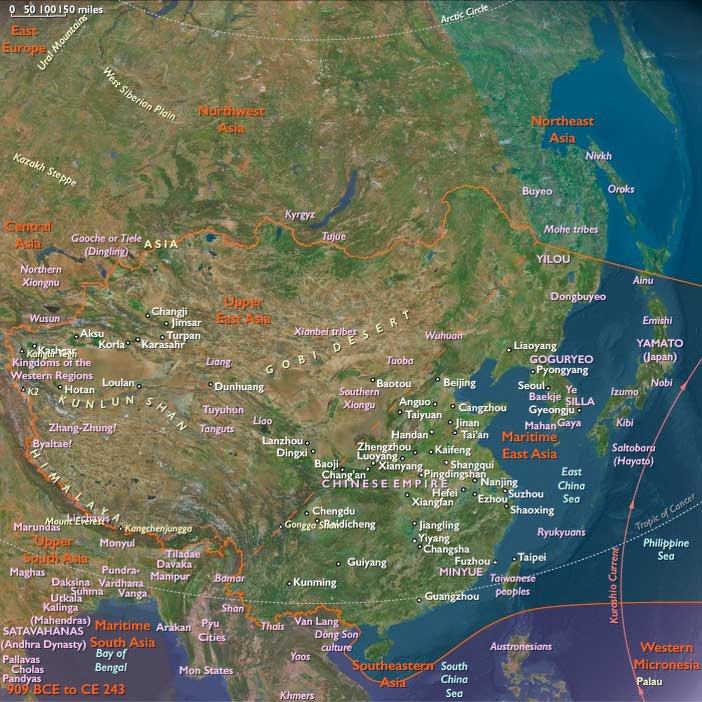
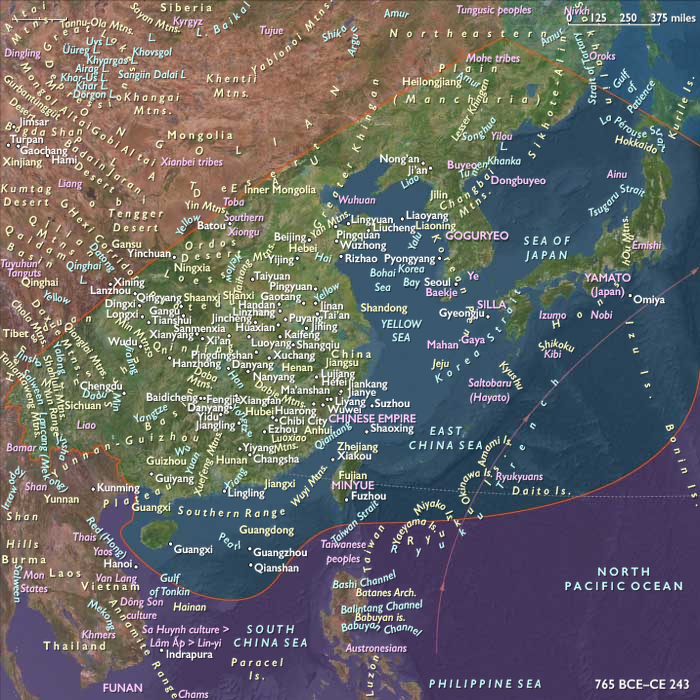
Zhang Daoling had announced in 142 that Laozi had appeared to him and commanded him to rid the world of decadence and establish a new state consisting only of the ‘chosen people.’
Becoming the first Celestial Master, Zhang had begun to spread his newly founded movement throughout the province of Sichuan.
The movement was initially called the Way of the Five Pecks of Rice, because each person wishing to join was required to donate five pecks of rice.
The movement has spread rapidly, particularly under his son Zhang Heng and grandson Zhang Lu.
The Zhangs have been able to convert many groups to their cause, such as the Bandun Man (belonging to the Ba people), which strengthen their movement.
Zhang Xiu (not related to Zhang Lu) rebels against the Han Dynasty in 184.
Zhang Lu and Zhang Xiu are sent in 191, to conquer the Hanzhong Valley, just north of Sichuan, a city under Zhang Xiu's control.
Zhang Xiu is killed during the subsequent battle, and Zhang Lu establishes the theocratic state of Zhanghan, enjoying full independence.
The Yellow Turban Rebellion, also translated as Yellow Scarves Rebellion, is a peasant revolt that breaks out in 184 in China during the reign of Emperor Ling of the Han Dynasty.
The rebellion, which takes its name from the color of the scarves that the rebels wear on their heads, marks an important point in the history of Taoism due to the rebels' association with secret Taoist societies.
The revolt is also used as the opening event in Luo Guanzhong's historical novel Romance of the Three Kingdoms.
The Liang Province Rebellion of 184 to 189 starts as an insurrection of the Qiang peoples against the Han Dynasty in the western province of Liang (Liangzhou, more-or-less today's Wuwei, in the province of Gansu) of second century China, but the Lesser Yuezhi and sympathetic Han rebels soon join the cause to wrestle control of the province away from central authority.
This rebellion, which closely follows the Yellow Turban Rebellion, is part of a series of disturbances that will lead to the decline and ultimate downfall of the Han Dynasty.
Despite receiving relatively little attention in the hands of traditional historians, the rebellion nonetheless has lasting importance, as it removes Han Chinese power in the Northwest and prepares that land for a number of non-Han-Chinese states in the centuries to come.
A coalition of warlords and regional officials in the late Eastern Han Dynasty initiates a punitive expedition against the warlord Dong Zhuo in 190.
The members of the coalition claim that Dong intends to usurp the throne by holding Emperor Xian hostage and by establishing a strong influence in the imperial court.
They justify their campaign as to remove Dong from power.
The campaign leads to the evacuation of the capital Luoyang and the shifting of the imperial court to Chang'an.
It is a prelude to the end of the Han Dynasty and, subsequently, the Three Kingdoms period.
People
Groups
Topics
- Classical antiquity
- Han dynasty China
- Disasters of Partisan Prohibitions
- Liang Province Rebellion
- Yellow Turban Rebellion
- Five Pecks of Rice
- Dong Zhuo, campaign against
- Sun Ce's Conquests in Jiangdong
Commodoties
Subjects
- Commerce
- Language
- Environment
- Labor and Service
- Conflict
- Faith
- Government
- Technology
- Movements
- Linguistics
Regions
Subregions
Years: 184 - 195
People
Groups
Topics
- Classical antiquity
- Han dynasty China
- Disasters of Partisan Prohibitions
- Liang Province Rebellion
- Yellow Turban Rebellion
- Five Pecks of Rice
- Dong Zhuo, campaign against
- Sun Ce's Conquests in Jiangdong
Commodoties
Subjects
- Commerce
- Language
- Environment
- Labor and Service
- Conflict
- Faith
- Government
- Technology
- Movements
- Linguistics
Regions
Subregions