Zhang Daoling, the Taoist hermit who has …
Years: 156 - 156
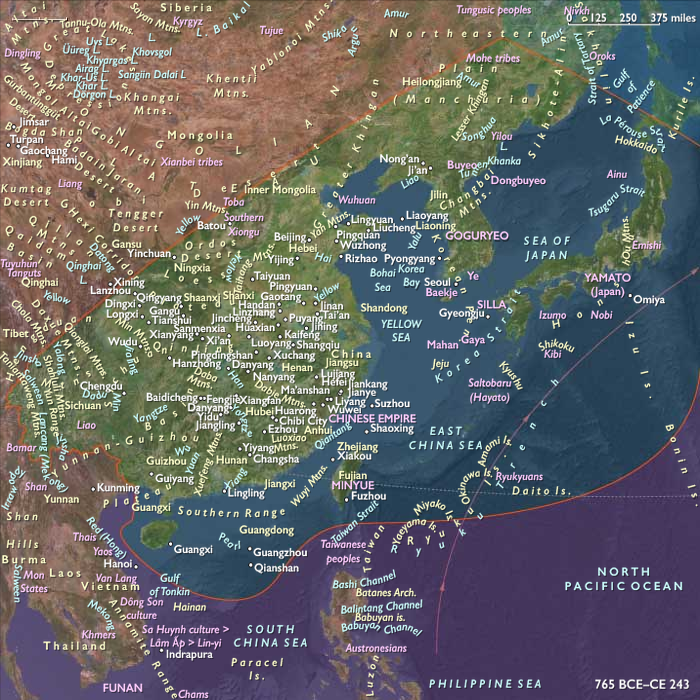
Zhang Daoling, the Taoist hermit who has founded the movement known as the Way of the Celestial Masters sect of Taoism, which is also known as the Way of the Five Pecks of Rice, dies on Mount Qingcheng in 156 during the reign of Emperor Huan of Han at the age of 123.
However, it is also said that Zhang did not die but learned the arcana of Taoism to ascend in broad daylight (Xiandao).
Instead, his body became like luminous ether, disappearing from eyesight and became an immortal.
His movement spreads rapidly, particularly under his son Zhang Heng and grandson Zhang Lu, who are able to convert many groups to their cause, strengthening their movement.
Locations
People
Groups
- Taoism
- Chinese (Han) people
- Chinese Empire, Tung (Eastern) Han Dynasty
- Way of the Five Pecks of Rice
Topics
Subjects
Regions
Subregions
Related Events
Filter results
Showing 10 events out of 61048 total
Apuleius sets out upon a new journey to Alexandria not long after returns home.
On his way there, he is taken ill at the town of Oea (modern-day Tripoli) and is hospitably received into the house of Sicinius Pontianus, with whom he had been friends when he had studied in Athens.
The mother of Pontianus, Pudentilla, is a very rich widow.
With her son's consent—indeed encouragement—Apuleius agrees to marry her.
Meanwhile Pontianus himself marries the daughter of one Herennius Rufinus; he, indignant that Pudentilla's wealth should pass out of the family, instigates his son-in-law, together with a younger brother, Sicinius Pudens, a mere boy, and their paternal uncle, Sicinius Aemilianus, to join him in impeaching Apuleius upon the charge that he had gained the affections of Pudentilla by charms and magic spells.
The case is heard at Sabratha, near Tripoli, before Claudius Maximus, proconsul of Africa, in about 158 CE.
The accusation itself seems to have been ridiculous, and the spirited and triumphant defense spoken by Apuleius is still extant.
This is known as the Apologia (A Discourse on Magic).
The work has very little to do with magic, and a lot to do with skewering his opponents with hilarity and panache.
It is among the funniest works that have come down to us from Antiquity, and one of the most entertaining examples of Latin courtroom oratory to survive.
Emperor Huan becomes increasingly disgruntled at Liang Ji's control of the government as the years pass, and is also angered by Empress Liang's behavior.
Because of her position as Empress Dowager Liang and Liang Ji's sister, Empress Liang is wasteful in her luxurious living, far exceeding any past empress, and is exceedingly jealous.
She does not have a son, and because she does not want any other imperial consorts to have sons, if one becomes pregnant, Empress Liang finds some way to murder her.
Emperor Huan does not dare to react to her due to Liang Ji's power, but rarely has sexual relations with her.
Angry and depressed that she has lost her husband's favor, Empress Liang dies in 159, initiating a chain of events that lead to Liang Ji's downfall.
Liang, in order to continue to control Emperor Huan, has adopted his wife's beautiful cousin Deng Mengnü (the stepdaughter of her uncle Liang Ji (written with a different Chinese character despite the same pronunciation), as his own daughter, changing her family name to Liang.
He and Sun give Liang Mengnü to Emperor Huan as an imperial consort, and, after Empress Liang's death, they hope that she will be eventually created empress.
To completely control her, Liang Ji plans to have her mother, Lady Xuan , killed, and in fact sends assassins against her, but the assassination is foiled by the powerful eunuch Yuan She, a neighbor of Lady Xuan.
Lady Xuan reports the assassination attempt to Emperor Huan, who is greatly angered.
He enters into a conspiracy with eunuchs Tang Heng, Zuo Guan, Dan Chao, Xu Huang, and Ju Yuan to overthrow Liang—sealing the oath by biting open Dan's arm and swearing by his blood.
Liang Ji has some suspicions about what Emperor Huan and the eunuchs are up to, and investigates.
The five eunuchs quickly react.
They have Emperor Huan openly announce that he is taking back power from Liang Ji and mobilize the imperial guards to defend the palace against a counterattack by Liang.
They then surround Liang's house and force him to surrender.
Liang and Sun, unable to respond with any force, commit suicide.
The entire Liang and Sun clans (except for Liang Ji's brothers Li Buyi and Liang Meng, who had previously already died) are arrested and slaughtered.
A large number of officials are executed or deposed for close association with Liang—so many that the government is almost unable to function for some time.
Liang and Sun's properties are confiscated by the imperial treasury, which allows the government to reduce taxes.
After Liang Ji's death, Emperor Huan creates Liang Mengnü empress, but dislikes her family name, and therefore orders her to take the family name Bo.
Later, he discovers that her original family name was actually Deng, and therefore has her family name restored.
The people have great expectations for Emperor Huan's administration after the death of Liang Ji.
However, having been able to overthrow Liang Ji with the five eunuchs' help, Emperor Huan greatly rewards them, creating them and several other eunuchs who had participated in the coup d'état marquesses and further gives them governmental posts that confer tremendous power.
Further, the five eunuch-marquesses openly engage in massive corruption and become extremely wealthy, with Emperor Huan's approval.
Emperor Huan himself is also corrupt and unwilling to accept any criticism.
In 159, when the honest county magistrate Li Yun submits a petition urging him to curb the power of the eunuchs, Emperor Huan is deeply offended that he has included the phrase, "Is the emperor turning blind?"
and, despite intercessions by a number of officials and even some fair-minded eunuchs, has Li and his friend Du Zhong both executed.

Apuleius’ Metamorphoses is an imaginative, irreverent, and amusing work that relates the ludicrous adventures of one Lucius, who experiments with magic and is accidentally turned into an ass.
In this guise he hears and sees many unusual things, until escaping from his predicament in a rather unexpected way.
Within this frame story are found multiple digressions, the longest among them being the well-known tale of Cupid and Psyche.
The Metamorphoses ends with the (once again human) hero, Lucius, eager to be initiated into the mystery cult of Isis; he abstains from forbidden foods, bathes and purifies himself.
He is introduced to the Navigium Isidis.
Then the secrets of the cult's books are explained to him, and further secrets revealed before going through the process of initiation which involves a trial by the elements in a journey to the underworld.
Lucius is then asked to seek initiation into the cult of Osiris in Rome, and eventually is initiated into the pastophoroi—a group of priests that serves Isis and Osiris.
Apuleius wrote many other works which have not survived, including works of poetry and fiction, as well as technical treatises on politics, dendrology, agriculture, medicine, natural history, astronomy, music, and arithmetic, and he translated Plato's Phaedo.
Of his subsequent career we know little.
Judging from the many works of which he was author, he must have devoted himself assiduously to literature.
He occasionally gave speeches in public with great applause; he had the charge of exhibiting gladiatorial shows and wild beast events in the province, and statues were erected in his honor by the senate of Carthage and of other senates.
The Disasters of Partisan Prohibitions refers to two incidents in China in which a number of Confucian scholars who serve as officials in the Han imperial government and opposed to powerful eunuchs, and the university students in the capital, Luoyang, who support them (collectively referred to by the eunuchs as “partisans") are imprisoned.
Some are executed; some are released but lose their civil rights.
The first incident (in 166) is largely bloodless, but the second incident (in 169), which comes after the Confucian scholars Dou Wu (the father of Empress Dowager Dou) and Chen Fan are defeated by eunuchs in a physical confrontation, see a large number of the partisans lose their lives.
The restrictions on civil liberties imposed on the surviving partisans will not be lifted until 184, when Emperor Ling grows concerned that the partisans will join the Yellow Turban Rebellion.
The Antonine Plague is a pandemic believed to be either of smallpox or measles, and will ultimately claim the lives of two Roman emperors—Lucius Verus and Marcus Aurelius, whose family name, Antoninus, is given to the epidemic.
The disease will break out again nine years later, according to the Roman historian Dio Cassius, and cause up to two thousand deaths a day at Rome, one quarter of those infected.
Total deaths have been estimated at five million.
The Marcomannic Wars, a series of wars lasting over a dozen years beginning about 166, pit the Roman Empire against, principally, the Germanic Marcomanni and Quadi and the Sarmatian Iazyges; related conflicts occur with several other barbarian peoples along both sides of the whole length of the River Danube, the Roman empire's northeastern European border.
The Early Movements of the Great Migrations and Germanic Pressure on Rome (3rd Century CE)
During the 3rd century CE, the first major movements of the Great Migrations began, as the Goths migrated westward, displacing and pressuring Germanic tribes in Central and Eastern Europe. This triggered a chain reaction, forcing various tribes and nomadic groups to move toward the Roman Empire, launching raids along Rome’s northern borders.
1. The Gothic Migrations and Their Impact
- The Goths, originally from Scandinavia and the Baltic region, began moving westward and southward into the Pontic Steppe and Central Europe.
- This displaced other Germanic tribes, pushing them toward Roman frontiers in search of new lands and resources.
- The Gothic advance weakened Roman border defenses, forcing Rome to increase military expenditures and fortify key regions.
2. Raids into Gaul and Across the Danube
- Germanic tribes, particularly the Franks, Alamanni, and Vandals, intensified raids into Gaul, exploiting Rome’s internal instability during the Crisis of the Third Century (235–284 CE).
- The Goths, Gepids, and other steppe tribes crossed the Danube, raiding deep into Moesia, Thrace, and even Greece.
- These incursions strained Rome’s resources, forcing emperors to mobilize defensive campaigns and recruit more Germanic auxiliaries into the Roman army.
3. The Broader Impact on the Roman Empire
- The increased pressure on Rome’s frontiers exposed the empire’s vulnerability, requiring more permanent military garrisons along the Rhine and Danube.
- The instability of the Roman economy made it harder to fund border defenses, leading to occasional provincial collapses.
- The pattern of Germanic and steppe incursions foreshadowed the larger-scale invasions of the 4th and 5th centuries, culminating in the fall of the Western Roman Empire.
Conclusion: The Prelude to the Great Migration Period
The early movements of Germanic tribes and Gothic incursions in the 3rd century CE set the stage for the full-scale Great Migrations of the 4th and 5th centuries. These pressures on Rome’s northern borders contributed to the empire’s long-term decline, demonstrating the shifting balance of power between Rome and the Germanic world.
A major offensive against the Marcomanni is postponed until 169 because of a shortage of imperial troops.
East Central Europe (160–171 CE): From Antonine Stability to Growing Frontier Tensions
Between 160 and 171 CE, East Central Europe—encompassing Poland, Czechia, Slovakia, Hungary, and those portions of Germany and Austria lying east of 10°E and north of a line stretching from roughly 48.2°N at 10°E southeastward to the Austro-Slovenian border near 46.7°N, 15.4°E—transitioned from a sustained era of stability under Emperor Antoninus Pius into a period of growing tension during the early reign of Emperor Marcus Aurelius. Increasingly strained relations with Germanic tribes, particularly the Marcomanni, Quadi, and the Sarmatian Iazyges, foreshadowed imminent conflict and disruption along the Roman frontier.
Political and Military Developments
Final Years of Antonine Stability
-
The last year of Emperor Antoninus Pius’s reign (160–161 CE) saw continued frontier stability along the Danube, sustained by the well-established Roman defensive system.
Accession of Marcus Aurelius and Early Frontier Challenges
-
Upon Emperor Marcus Aurelius’s accession (161 CE), Roman provinces of Pannonia Superior, Pannonia Inferior, and Noricum faced increased tension from neighboring Germanic and Sarmatian tribes.
-
Early signs of unrest and dissatisfaction emerged, particularly among the Marcomanni, Quadi, and Iazyges, driven by population pressures, economic disparities, and shifting tribal alliances.
Increased Frontier Military Activity
-
Between 166 and 171 CE, initial raids and skirmishes along the Danube frontier increased noticeably, prompting a stronger Roman military presence and preparations for a larger-scale confrontation.
Economic and Technological Developments
Economic Pressures and Shifting Trade
-
Growing frontier tensions slightly disrupted trade routes between Roman provinces and tribal territories. Despite this, economic activity—trading Roman manufactured goods for Germanic and Sarmatian resources—continued, though with increased risks.
Continued Technological Exchange
-
Even amidst growing political and military uncertainty, technological exchanges persisted. Roman metallurgical and agricultural methods continued to influence regional tribes, maintaining productivity despite rising tensions.
Cultural and Artistic Developments
Cultural Continuity Amid Rising Uncertainty
-
The era still witnessed a vibrant hybrid cultural environment along the frontier, with artifacts and material culture reflecting Roman-Germanic interactions.
-
However, the increasing tensions began subtly influencing regional art and craftsmanship, with artifacts increasingly emphasizing military and defensive motifs.
Settlement and Urban Development
Frontier Fortifications Strengthened
-
Anticipating further conflicts, the Romans reinforced frontier fortifications significantly, particularly at key strategic settlements (Carnuntum, Vindobona, Aquincum).
-
This defensive buildup reshaped local urban and military landscapes, preparing the provinces for potential conflict.
Increased Germanic Defensive Settlement Patterns
-
Germanic tribes, particularly the Marcomanni and Quadi, began strengthening their settlements and adopting more defensive structures in anticipation of increased hostilities.
Social and Religious Developments
Tribal Leadership Under Pressure
-
Tribal leadership among the Marcomanni, Quadi, and Iazyges experienced mounting pressure from population growth, economic challenges, and Roman diplomatic maneuvers.
-
Military elites and warrior chieftains gained influence as defensive considerations became increasingly critical.
Religious Practices and Growing Anxiety
-
Traditional Germanic religious practices persisted strongly, but the growing uncertainty and impending conflict likely intensified ritual practices emphasizing war, protection, and tribal solidarity.
Long-Term Consequences and Historical Significance
The period from 160 to 171 CE marked a critical turning point in East Central Europe, transitioning from peaceful frontier stability toward growing conflict and instability. Initial tensions experienced under Marcus Aurelius laid the foundations for the subsequent major conflicts—collectively known as the Marcomannic Wars (166–180 CE)—that would dramatically alter the regional balance of power, reshaping relationships between Roman provinces and surrounding Germanic and Sarmatian tribal societies.
Years: 156 - 156
Locations
People
Groups
- Taoism
- Chinese (Han) people
- Chinese Empire, Tung (Eastern) Han Dynasty
- Way of the Five Pecks of Rice