José Antonio Páez
President of Venezuela
Years: 1790 - 1873
José Antonio Páez Herrera (13 June 1790 – 6 May 1873) is General in Chief of the army fighting Spain during the Venezuelan Wars of Independence, in addition to becoming the President of Venezuela once itis independent of the Gran Colombia (1830–1835; 1839–1843; 1861–1863).
He is considered a prime example of a 19th century South American caudillo.
Related Events
Filter results
Showing 10 events out of 10 total
Nearly two years later, in June 1821, Bolivar's troops fought the decisive Battle of Carabobo that liberates Caracas from Spanish rule.
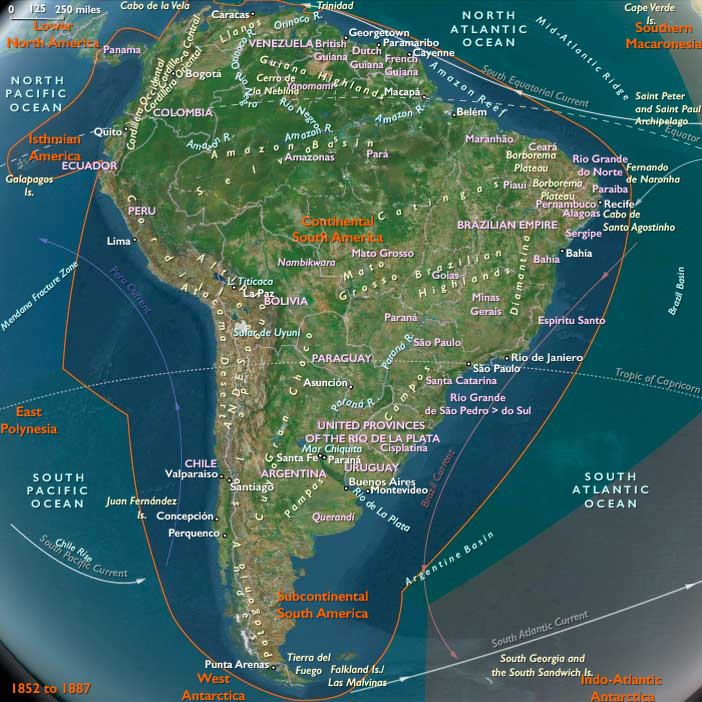
In August delegates from Venezuela and Colombia meet at the border town of Cucuta to formally sign the Constitution of the Republic of Gran Colombia, with its capital in Bogota.
Bolivar is named president, and Francisco de Paula Santander, a Colombian, is named vice president.
Bolivar, however, continues the fight for the liberation of Spanish America, leading his forces against the royalist troops remaining in Ecuador, Bolivia, and Peru.
In the meantime, the Bolivarian dream of Gran Colombia is proving to be politically unworkable.
Bolivar's fellow Venezuelans become his enemies.
King Ferdinand, after an 1820 revolt by liberals in Spain, has lost the political will to recover the rebellious American colonies, but the Venezuelans themselves express resentment at being governed once again from far-off Bogota.
Venezuelan nationalism, politically and economically centered in Caracas, has been an ever-increasing force for over a century.
During the 1820s, Venezuelan nationalism is embodied in the figure of José Antonio Páez.
Even the tremendous prestige of Bolivar cannot overcome the historical reality of nationalism, and in 1829 Páez will lead Venezuela in its separation from Gran Colombia, and order the ailing and friendless Bolivar into exile.
Shortly before his death in December 1830, the liberator of northern South America will liken his efforts at Latin American unity to having "plowed the sea."
In 1824 Colombia even raises a foreign loan on the London market for the extraordinary sum of thirty million pesos (at this time equivalent to dollars).
This consists in part of mere refinancing of earlier obligations incurred during the independence struggle.
It will prove impossible to maintain debt service, but the fact that the loan is even granted, on what for the time are quite favorable terms, attests to the prestige of Bolivar's creation.
Another sign of the Republic of Colombia's international prestige is the fact that it plays host to Bolivar's Congress of Panama of 1826, which in the end accomplishes little but is the first in a long line of Pan-American gatherings.
Yet even before this meeting begins, the fragility of the republic's unity is becoming apparent.
The first serious crack comes in Venezuela, where many people have been unhappy from the start with formal subjection to authorities in Bogota, particularly when the head of government turns out to be the New Granadan, Vice President Santander, who becomes acting chief executive when Bolivar continues personally leading his armies against Spain.
Indeed, Bolivar carries the struggle into Peru and stays there even after the Battle of Ayacucho, won by Sucre in December 1824, puts an end to serious royalist resistance.
Venezuelans do have some real grievances, but equally important is the feeling that their present status is a step down from that of the colonial captaincy general, which for most purposes took orders (not necessarily obeyed) directly from Madrid.
Thus, when General José Antonio Páez, the leading military figure in Venezuela, is summoned to Bogota early in 1826 to answer charges against him in the Congress of the Republic (Congreso de la Republica), he refuses to go, and most of Venezuela joins him in defiance.
Both Páez and Santander look for support to Bolivar, still absent in Peru, but he proves less interested in the immediate dispute than in the opportunity that the crisis seems to offer to revamp Colombian institutions in a form more to his liking.
Bolivar knows that Venezuelan regionalism is not the only problem to be faced.
There is similar, if less critical, unrest in Ecuador.
Bolivar, as a committed freethinker, does not oppose the objectives of these first anticlerical measures, and as one who supports total abolition of slavery, he definitely opposes the campaign of slaveholders to water down the free-birth law passed by the Congress of Cucuta in 1821, but he feels that many of the reforms adopted are premature, thus needlessly promoting unrest, and he assigns part of the blame to Vice President Santander, a man who had dropped out of law study to fight for independence but as chief executive surrounds himself with ardent young lawyers as helpers and advisers.
What the country needs, in Bolivar's view, is a stronger executive, a less assertive legislature, and a partial rollback of overhasty reforms.
He also hopes to see some form of a new constitution that he has drafted for Bolivia adopted in the Republic of Colombia.
Its central feature is a president serving for life and appointing his successor.
Some other features are highly liberal, but what attracts attention is the call for a life-term president, who in the Colombian case will obviously be himself.
Bolivar journeys back from Peru to Colombia in September-November 1826.
He finds little real support for introducing his constitutional panacea, but he solves the Venezuelan rebellion by meeting with General Paéz in Venezuela in January 1827 and pardoning him, as well as by promising to call a convention to reform the existing constitution in some way.
This September Bolivar returns to Bogota and resumes the presidency of Colombia.
Two decades of warfare in Venezuela have cost the lives of between one-fourth and one-third of the country's population, which by 1830 is estimated at about eight hundred thousand.
Furthermore, the cocoa-based export economy lies in ruins, a victim of physical destruction, neglect, and the disruption of trade.
As a result, it is relatively simple for the young nation to shift its agricultural export activity to the production of coffee, a commodity whose price is booming in the North Atlantic nations with which Venezuela is now free to trade.
The production of coffee for export will, along with subsistence agriculture, dominate Venezuela's economic life until the initiation of the petroleum boom well into the twentieth century.
Venezuela's century-long post-independence era of caudillismo is perhaps best understood as a competition among various social and regional factions for the control of the Caracas-based bureaucracy that serves the trade with the North Atlantic nations.
Venezuelan nationalism, politically and economically centered in Caracas, has been an ever-increasing force for over a century.
During the 1820s, Venezuelan nationalism is embodied in the figure of General José Antonio Páez.
Even the tremendous prestige of Bolivar cannot overcome the historical reality of nationalism, and in 1829 Páez leads Venezuela in its separation from Gran Colombia.
Páez orders the ailing and friendless Bolivar into exile.
Shortly before his death in December 1830, the liberator of northern South America likens his efforts at Latin American unity to having "plowed the sea."
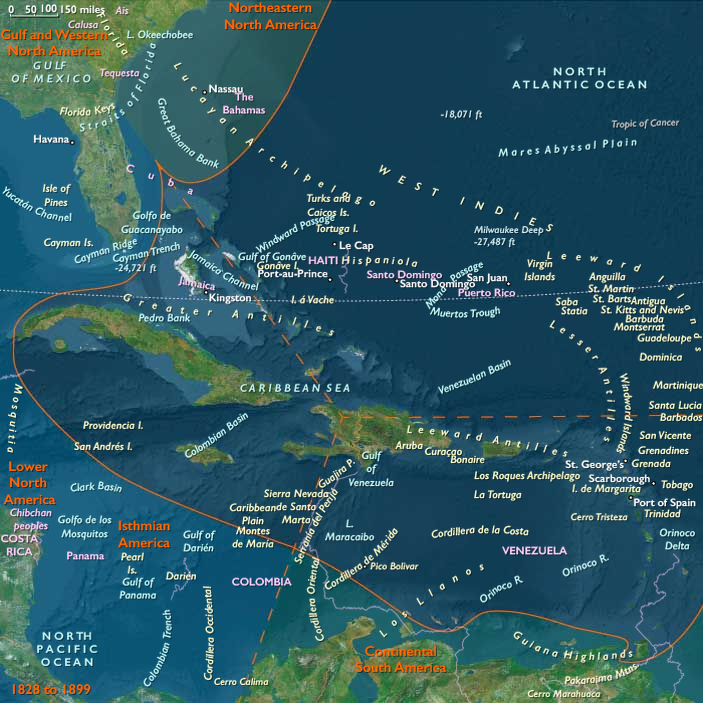
Simón Bolívar, President of Colombia (and former President of Venezuela, Peru and Bolivia), departs from the capital at Bogotá on March 18, 1828, in order to help his ally, General José Antonio Páez, suppress an uprising near the Venezuelan border, but is sidetracked by another rebellion in Cartagena.
The century of the caudillo had started auspiciously in Venezuela, with sixteen relatively peaceful and prosperous years under the authority of General Páez.
Twice elected president under the 1830 constitution, Páez, on the one hand, has consolidated the young republic by putting down a number of armed challenges by regional chieftains.
On the other hand, Páez usually respects the civil rights of his legitimate political opponents.
Using funds earned during the coffee-induced economic boom, he oversees the building of fledgling social and economic infrastructures.
Generally considered second only to Bolívar as a national hero, Páez rules in conjunction with the criollo elite, which maintains its unity around the mestizo caudillo as long as coffee prices remain high.
In the 1840s, however, coffee prices plunge, and the elite divide into two factions: those who remain with Páez call themselves Conservatives, while his rivals call themselves Liberals.
The Liberals first come to prominence in 1846 with Páez's surprising selection of General José Tadeo Monagas as his successor.
Two years later, Monagas ousts all the Conservatives from his government and sends Páez into exile, precipitating a decade of dictatorial rule shared with his brother, José Gregorio.
Some regions of Germany have suffered heavy economic losses since 1814, while its inhabitants are paying high taxes.
This has caused great poverty in the country, which gives many Germans the desire to immigrate in order to escape this plight.
Germans have an excellent reputation as settlers, a positive image created by pioneers in Brazil.
During the second government of José Antonio Páez, in 1840, the Congress enacted, in May of that year, a new immigration law that provided for a policy of economic and cultural exchanges between Venezuela and Europe.
The entrepreneurs received loans on the condition that they accept immigrants over a period of two years.
Given the huge population deficit that exists at this time in Venezuela, the Minister of Interior and Justice at the time, Angel Quintero, calls for collaboration to Agustín Codazzi (traveler and geographer) so that he can indicate the lands eligible to attract European immigration in order to increase the productivity of the country.
From the outset, Codazzi thought of Germans because of their economic situation and, along with Alexander Benitz, began planning an organized immigration.
Codazzi made explorations in various fields owned by the family Tovar, who had offered to donate them to establish a colony.
He chose to appeal to families in southwestern Germany, who then will then travel to colonize the country.
These families of masons, carpenters, blacksmiths, weavers, shoemakers and tailors, come from the Grand Duchy of Baden and surrounding areas in Germany, especially came from Kaiserstuhl.
These areas not only have various and high taxes, but also have problems related to agricultural productivity.
The German colonists, once in Tovar, find that of the eighty houses promised had been built only twenty.
In addition, the land assigned has been deforested.
Nor is there an access road.
The administrator to the settlers exploits their labor and prevents them from leaving the colony.
This situation will did not improve until 1845, when the government dismisses the administrator from office.
Fighting in Venezuela’s Federalist Wars is fierce, and the government has changed hands several times until 1861, when former president José Antonio Páez is recalled from exile to form a Conservative ministry.
The Federalist War is the biggest and bloodiest civil war that Venezuela, a country with a population of just over a million people, has had since its independence.
It is mainly a guerrilla war, largely without a centralized command for the Federalists, who professed to ride on social resentment.
Just three major conventional battles have been fought: The Battle of Santa Inés (December 10, 1859), in which Ezequiel Zamora and thirty-four hundred men defeated the Central Army of twenty-three hundred men, with about twelve hundred combined casualties; the Battle of Coplé (February 17, 1860), a victory of the government forces of general León de Febres Cordero over a Federalist army of forty-five hundred men, commanded by Juan Crisóstomo Falcón, and the Battle of Buchivacoa (December 26-December 27, 1862).
The hostilities end with the signing of the Treaty of Coche in April 1863, but the rule of the country remains dictatorial: as a result of the war, political power is centralized in the federal government.
Under the presidency of Falcon, Venezuela becomes in 1863 the first country to abolish capital punishment for all crimes, including serious offenses against the state.