Nicolás de Ovando
Governor of the Indies
Years: 1460 - 1511
Fray Nicolás de Ovando y Cáceres (Brozas, Extremadura, 1460 – Madrid, May 29, 1511) was a Spanish soldier from a noble family and a Knight of the Order of Alcántara.
He is Governor of the Indies (Hispaniola) from 1502 until 1509.
His administration is perhaps best known for its brutal treatment of the native Taíno population of Hispaniola.

Related Events
Filter results
Showing 10 events out of 36 total
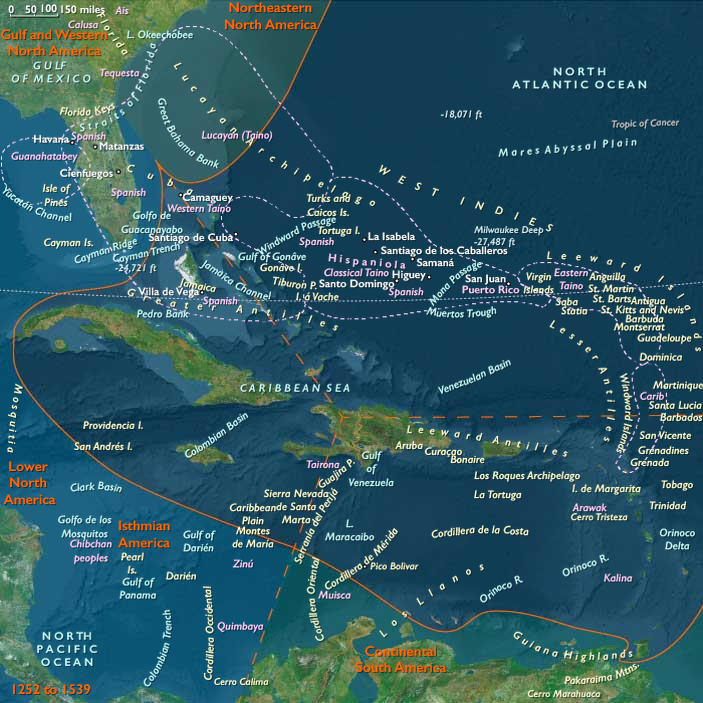
Spanish officials, desirous of increasing their labor supply as well as exploring possible new sources of wealth, also begin to look toward Cuba.
Columbus's son, Diego Columbus, who has been appointed governor of the Indies in 1508 and lives in Hispaniola, is particularly interested in extending the territory under his control.
As a preliminary step toward colonization, Nicolas de Ovando (governor of Hispaniola, 1502-9) sends an expedition headed by Sebastian de Ocampo that circumnavigates Cuba in 1508; he brings back tales of wealth and a more detailed picture of the island's fine terrain and harbors.
The choice finally falls on Diego Velazquez de Cuellar (governor of Hispaniola, 1511—21), Ovando's lieutenant and one of the wealthiest Spaniards in Hispaniola.
Although not as heroic or daring as later conquistadors such as Francisco Pizarro, conqueror of Peru, or as cunning as Hernán Cortés, conqueror of Mexico, Velazquez has achieved a reputation for courage and sagacity because of his role in subduing native caciques in Hispaniola.
From the start, Velazquez faces an outraged and hostile native population.
Led by Hatuey, a fugitive chieftain from Hispaniola, the natives of eastern Cuba resolve to resist the Spanish onslaught.
It is a futile gesture, for the peaceful Tainos lack the military skills and weapons to face the better armed and trained Spaniards.
Spanish horses and hounds, both unknown in Cuba, play a decisive role in terrorizing the indigenous peoples, who soon surrender or flee into the mountains to escape the wrath of the conquistadors.
Hatuey himself is captured, tried as a heretic and a rebel, and burned at the stake.
He induces groups of natives to lay down their weapons and work near the several new towns that he establishes throughout the island.
Among these are Baracoa, Bayamo, Trinidad, Sancti Spiritus, La Habana (hereafter, Havana), Puerto Principe, and Santiago de Cuba.
In this task, Velasquez is decisively aided by the work of Bartolome de Las Casas.
The Dominican friar precede the Spaniards into native villages on many occasions and succeeds in persuading the indigenous peoples to cooperate with the conquistadors.
Las Casas, however, is horrified by the massacre of the natives and becomes an outspoken critic of the conquest of Cuba.
He writes extensively, condemning the Spaniards' cruelty and claiming that the natives are rational and free and therefore entitled to retain their lands.
The crown uses the encomienda concept as a political instrument to consolidate its control over the indigenous population.
Many encomenderos, however, interested only in exploiting the resources of the island, disregard their moral, religious, and legal obligations to the natives.
A conflict soon develops between the crown and the Spanish settlers over the control and utilization of the labor by the exploitative encomenderos, and also over the crown's stated objective to Christianize the natives and the crown's own economic motivations.
In the reality of the New World, the sixteenth-century Christian ideal of converting souls is many times sacrificed for a profit.
Christianization is reduced to mass baptism; and despite the crown's insistence that natives are not slaves, many are bought and sold as chattels.
As soon as the conquest is completed and the natives subjugated, the crown begins introducing to the island the institutional apparatus necessary to govern the colony.
The landowners among the Spanish colonists had successfully conspired against Columbus as early as the 1490s.
His successor, Francisco de Bobadilla, is appointed chief justice and royal commissioner by the Spanish crown in 1499.
Bobadilla sends Columbus back to Spain in irons; Queen Isabella soon orders him released.
Bobadilla, who had proved an inept administrator, is replaced in 1503 by the more efficient Nicolas de Ovando, who assumes the titles of governor and supreme justice.
Because of his success in initiating reforms desired by the crown—the encomienda system among them—Ovando receives the title of Founder of Spain's Empire in the Indies.
Columbus insists on going before Ferdinand and Isabella bound, although the ship's captain had offered to remove his shackles.
After arrival in Cádiz in November 1500, the Columbus brothers linger in jail for six weeks before busy King Ferdinand orders their release.
The king and queen summon the Columbus brothers to the Alhambra palace in Granada in early 1501.
Here the royal couple hear the brothers' pleas; restore their freedom and wealth; and, after much persuasion, agree to fund Columbus' fourth voyage.
The door is firmly shut, however, on Columbus' role as governor.
Henceforth Nicolás de Ovando y Cáceres is to be the new governor of the West Indies.
The Spanish Crown intends to develop the West Indies economically and thereby expand Spanish political, religious, and administrative influence in the region.
Along with Ovando also comes Francisco Pizarro, who will later explore western South America and conquer the Inca Empire.
The largest fleet to sail to the New World—thirty ships carrying around twenty-five hundred colonists—had sailed from Spain on February 13, 1502, under Nicolás de Ovando, who becomes the third Governor and Captain-General of the Indies, Islands and Firm-Land of the Ocean Sea.
Unlike Columbus's earlier voyages, this group of colonists has been deliberately selected to represent an organized cross-section of Spanish society.
When Ovando arrives in Hispaniola in 1502, he finds the once-peaceful natives in revolt.
Ovando and his subordinates ruthlessly suppress this rebellion through a series of bloody campaigns, including the Jaragua Massacre and the Higüey Massacre.