
Related Events
Filter results
Showing 8 events out of 8 total
The Moderns are taller, more slender, and less muscular than the Neanderthals, with whom they share—perhaps uneasily—the Earth.
Though their brains are smaller in overall size, they are heavier in the forebrain, a difference that may allow for more abstract thought and the development of complex speech.
Yet, the inner world of the Neanderthals remains a mystery—no one knows the depths of their thoughts or how they truly expressed them.
Modern humans learn to modulate voice into audible oral speech in the period beginning around 70,000 BCE; this is a development apparently not accomplished by other archaic hominids and one peculiar to our species.
Some also learn at this time to count beyond “one, two, and many.”
The Quest for Gold and the European Age of Exploration
The desire for gold was one of the primary motivations behind European explorations and conquests in Africa and the Western Hemisphere during the 15th and 16th centuries. Wealth from gold fueled economies, financed wars, and expanded European influence worldwide.
Gold and the African Expeditions
-
Portuguese Expansion (15th Century)
- Portugal, under Prince Henry the Navigator, began exploring the West African coast in search of gold sources.
- The Portuguese established trading posts (feitorias) along the coasts of Senegal, Ghana (Gold Coast), and Benin, tapping into existing African gold trade networks.
- In 1471, the Portuguese reached the Gold Coast (modern Ghana), one of the richest gold-producing regions in Africa.
- By 1482, they built Elmina Castle, their first major African trading fort, to control the gold trade.
-
The Trans-Saharan Gold Trade Declines
- Before European expansion, gold was traded across the Sahara to North Africa and the Mediterranean.
- The Portuguese diverted the gold trade to the Atlantic, weakening North African and Islamic control over West African gold.
- European access to African gold strengthened monarchies and banking systems, financing further explorations and military conquests.
Gold and the Discovery of the Western Hemisphere
-
Christopher Columbus’s Voyages (1492–1504)
- Spain’s sponsorship of Columbus was partly motivated by the promise of gold.
- In Hispaniola and Cuba, Columbus’s men searched for gold deposits, enslaving indigenous peoples to work in gold mines.
- The lack of substantial gold deposits in the Caribbean pushed Spain to explore deeper into the Americas.
-
The Spanish Conquests in the Americas
- Hernán Cortés (1519–1521) defeated the Aztec Empire, capturing its golden treasures, melting them down to finance the Spanish Crown.
- Francisco Pizarro (1532–1533) conquered the Inca Empire, where gold was considered sacred, seizing vast quantities from temples, royal tombs, and palaces.
- The gold and silver mines of Potosí (Bolivia) and Zacatecas (Mexico) became the largest sources of wealth for Spain, financing its imperial dominance in Europe.
Impact of the Gold Rush on European Empires
-
Economic and Political Power
- Gold allowed European monarchies to strengthen their military and bureaucratic systems.
- The influx of gold fueled the Commercial Revolution, expanding banking, investment, and trade.
-
The Slave Trade and Labor Exploitation
- The insatiable demand for gold led to forced labor systems like the encomienda in the Americas.
- African slave labor became essential in gold and silver mining operations.
-
Increased Rivalries and Colonization
- European powers competed fiercely for control of gold-rich territories, leading to colonial wars and empire-building.
- The search for gold pushed explorers deeper into uncharted lands, accelerating European territorial expansion.
Conclusion: Gold as the Catalyst for Global Expansion
The quest for gold was one of the strongest driving forces behind European exploration and conquest. It funded empires, fueled wars, and transformed global economies, playing a pivotal role in shaping the Age of Exploration and the creation of the Atlantic World.
Portugal renews expansion into the African interior from the late 1870s through the early 1890s.
Part of the impetus comes from the Lisbon Geographical Society, founded in 1875 by a group of industrialists, scholars, and colonial and military officials.
This society stimulates a popular concern for the colonies in Portugal.
In reaction to the activities of the society and the growing interest among Europeans in colonial adventure, the Portuguese government allots large sums for public works in Africa and encourages a minor revival of missionary work.
An expedition to link Angola on the Atlantic coast with Mozambique on the Indian Ocean coast is formed in the 1870s by an advisory commission to Portugal's Ministry of the Navy and Colonies.
The Portuguese government supports this expedition because it aspires to control a solid strip of territory across the central part of the continent.
Nonetheless, Portugal is unable to gain control of the hinterland.
Serpa Pinto explores the headwaters of the Cuanza River in Angola and follows the course of the Zambezi River to Victoria Falls in present-day Zimbabwe.
Exploring areas now part of South Africa, he crosses the Transvaal and arrives in Natal in 1879.
In 1884 Capelo and Ivens depart from Mocamades on the coast of Angola and cross the continent through entirely unexplored territory, arriving at Quelimane on the east coast of Mozambique in 1885.
In the same year, Serpa Pinto and Augusto Cardoso explore the territory around Lake Nyassa.
Various Portuguese have explored the interior of Mozambique.
On June 28, 1889, an annular solar eclipse—the 47th eclipse of Solar Saros 125—is visible across the Atlantic Ocean, Africa, and the Indian Ocean.
An annular solar eclipse occurs when the Moon’s apparent diameter is smaller than the Sun’s, blocking most of the Sun’s light and creating the appearance of a bright ring (annulus) around the darkened Moon. While the annular phaseis visible along a specific path, the eclipse appears as a partial eclipse over a much wider region, spanning thousands of kilometers.
During this event, the Sun is 95% covered, producing a moderate annular eclipse that lasts 7 minutes and 22 seconds, with a maximum path width of 232 kilometers.
Saros cycle 125 is a series of 73 solar eclipses that occur at the Moon’s ascending node, repeating every 18 years and 11 days. All eclipses in this cycle take place at the ascending node of the Moon’s orbit.
Germany thus gains the small but strategic Heligoland archipelago, which its new navy needs to control the new Kiel Canal and the approaches to Germany's North Sea ports.
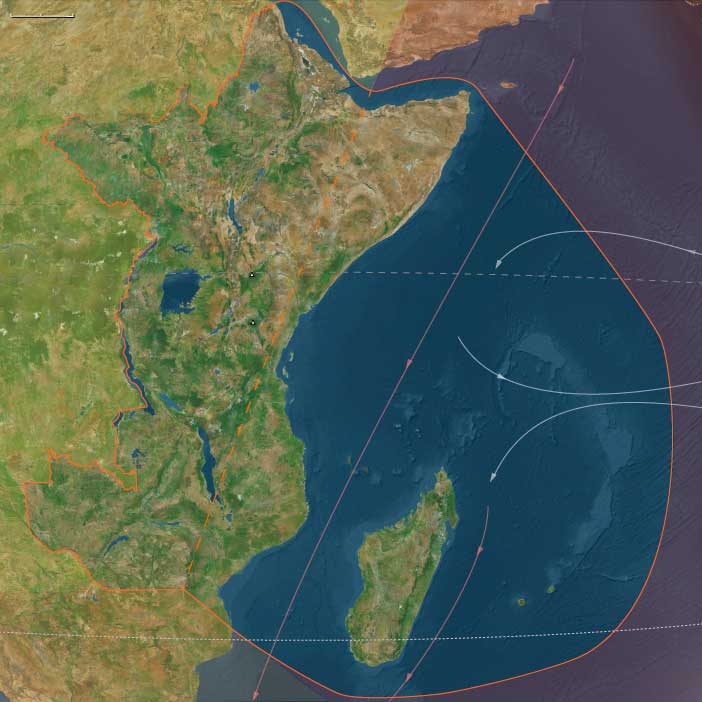
In exchange, Germany gives up its rights in the Zanzibar region in Africa, allowing Zanzibar to provide a key link in the British control of East Africa.
Germany gains the islands of Heligoland (German: Helgoland) in the North Sea, originally part of Danish Holstein-Gottorp but since 1814 a British possession, the so-called Caprivi Strip in what is now Namibia, and a free hand to control and acquire the coast of Dar es Salaam that will form the core of German East Africa (later Tanganyika, now the mainland component of Tanzania).
In exchange, Germany hands over to Britain the protectorate over the small sultanate of Wituland (Deutsch-Witu, on the Kenyan coast) and parts of East Africa vital for the British to build a railway to Lake Victoria, and pledges not to interfere with British actions vis-à-vis the independent Sultanate of Zanzibar (i.e. the islands of Unguja and Pemba)
In addition, the treaty establishes the German sphere of interest in German South West Africa (most of present-day Namibia) and settles the borders between German Togoland and the British Gold Coast (now Ghana), as well as between German Kamerun and British Nigeria.
Britain thereby divests itself of a naval base that covers the approaches to the main German naval bases in the North Sea, but which will be impossible to defend as Germany builds up its navy.
It immediately declares a protectorate over Zanzibar and, in the subsequent 1896 Anglo-Zanzibar War, will gain full control of the sultanate.
The treaty serves German chancellor Leo von Caprivi's aims for settlement with the British.
After the 1884 Berlin Conference, Germany had already lost the "Scramble for Africa": the German East Africa Company under Carl Peters had acquired a strip of land on the Tanganyikan coast (leading to the 1888 Abushiri Revolt), but had never had any control over the islands of the Zanzibar sultanate; the Germans give away no vital interest.
In return, they acquire Heligoland, strategically placed for control over the German Bight, which, with the construction of the Kiel Canal from 1887 onward, has become essential to Emperor Wilhelm's II plans for expansion of the Imperial Navy.
Wilhelm's naval policies abort an accommodation with the British and will ultimately lead to a rapprochement between Britain and France, sealed with the Entente cordiale in 1904.
The misleading name for the treaty will be introduced by ex-Chancellor Otto von Bismarck, who intends to attack his despised successor Caprivi for concluding an agreement that Bismarck himself had arranged during his incumbency.
However, Bismarck's nomenclature implies that Germany has swapped an African empire for tiny Heligoland ("trousers for a button").
This will be eagerly adopted by imperialists, who will complain about "treason" against German interests.
Carl Peters and Alfred Hugenberg will appeal for the foundation of the Alldeutscher Verband ("Pan-German League"), which will take place in 1891.