National Freemasonry, the most important of several …
Years: 1819 - 1819
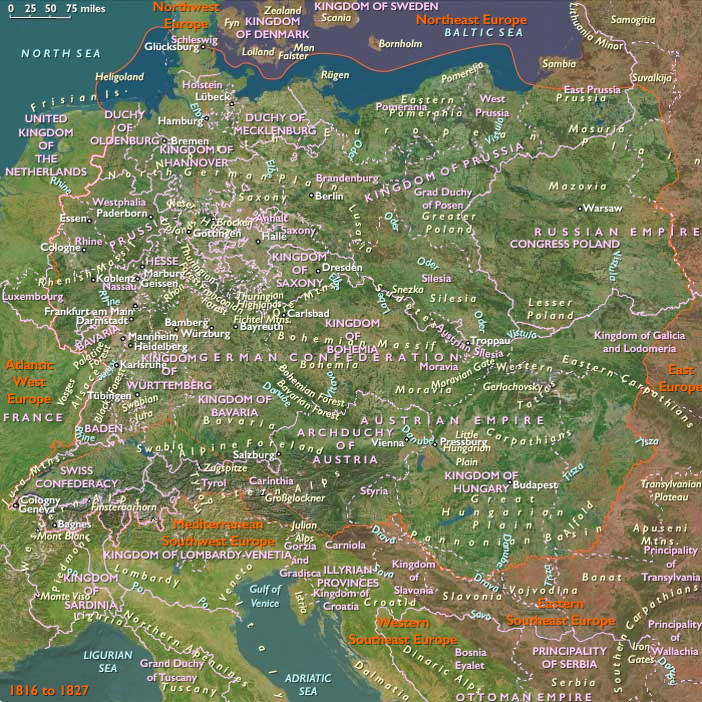
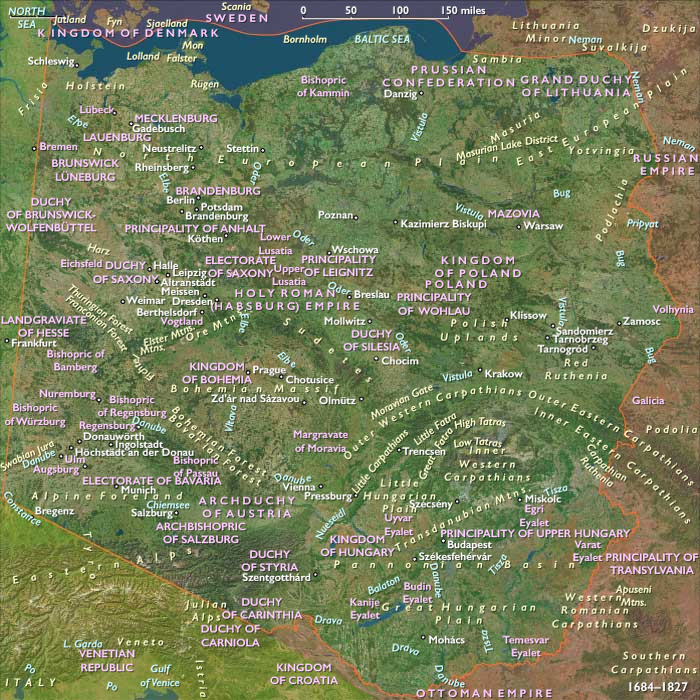
National Freemasonry, the most important of several Polish secret societies devoted to ousting the Russians from Poland, is founded in 1819.
Locations
Groups
Subjects
Regions
Subregions
Related Events
Filter results
Showing 10 events out of 74 total
The restoration of Spanish rule in 1809 had ushered in an era referred to by some historians as España Boba, "Foolish Spain".
Under the despotic rule of Ferdinand VII, the colony's economy has deteriorated severely.
After a dozen years of discontent and failed independence plots by various opposing groups, some Dominicans begin to wonder if the sort of independence movement currently sweeping the South American colonies would not best serve their interests.
In keeping with this sentiment, Spanish lieutenant governor José Núñez de Cáceres announces the colony's independence as the state of Spanish Haiti on November 30, 1821.
Cáceres requests admission to the Republic of Gran Colombia recently proclaimed established by Simón Bolivar and his followers and comprising what will later become Colombia, Ecuador, and Venezuela.
This period is also known as the Ephemeral independence, as the newly independent republic will end two months later under the Haitian government led by Jean-Pierre Boyer.
Haitian president Jean-Pierre Boyer takes advantage of internecine conflict in Santo Domingo, while José Cáceres' request for admission to Gran Colombia is in transit, by invading the newly founded Dominican Republic from the east to secure the Spanish part of Hispaniola on February 6, 1822.
Succeeding where Toussaint and Dessalines had failed, Boyer abolishes slavery here and confiscates church property.
Haiti's constitution forbids whites from owning land, and the major landowning families have been forcibly deprived of their properties.
Most have emigrated to Cuba, Puerto Rico, or Gran Colombia, usually with the encouragement of Haitian officials, who acquired their lands.
The Haitians, who associate the Roman Catholic Church with the French slave-masters who had exploited them before independence, have confiscated all church property, deported all foreign clergy, and severed the ties of the remaining clergy to the Vatican.
Santo Domingo’s university, the oldest in the Western Hemisphere, lacking both students and teachers, has closed down.
In order to receive diplomatic recognition from France, Haiti has been forced to pay an indemnity of one hundred and fifty million francs to the former French colonists, which had subsequently been lowered to sixty million francs, and Haiti has imposed heavy taxes on the eastern part of the island.
Since Haiti is unable to adequately provision its army, the occupying forces largely survive by commandeering or confiscating food and supplies at gunpoint.
Attempts to redistribute land conflict with the system of communal land tenure (terrenos comuneros), which had arisen with the ranching economy, and newly emancipated slaves resent being forced to grow cash crops under Boyer's Code Rural.
Haiti's policies toward occupied Santo Domingo are induced in part by international financial pressures because Haiti had promised in an 1825 treaty to indemnify former French settlers in return for French recognition of Haitian independence.
Ultimately, it is a period of economic decline and of growing resentment of Haiti among Dominicans
The main activity is subsistence agriculture, and exports consist of small amounts of tobacco, cattle hides, caoba wood (Dominican mahogany), molasses, and rum; the population, in turn, had declined precipitously by 1809 to some seventy-five thousand people.
Haitian president jean-Pierre Boyer attempts to enforce in the new territory the Rural Code (Code Rural) he had decreed in an effort to improve productivity among the Haitian yeomanry; however, the Dominicans prove no more willing to adhere to its provisions than are the Haitians.
Increasing numbers of Dominican landowners choose to flee the island rather than live under Haitian rule; in many cases, Haitian administrators encourages such emigration.
Dominicans also resent the fact that Boyer, the ruler of an impoverished country, does not (or cannot) provision his army.
The occupying Haitian forces live off the land in Santo Domingo, commandeering or confiscating what they need.
Racial animosities also affect attitudes on both sides; black Haitian troops react with resentment toward lighter-skinned Dominicans, while Dominicans come to associate the Haitians' dark skin with the oppression and abuses of occupation.
Furthermore, Haitians, who associate the Roman Catholic Church with the French colonists who had so cruelly exploited and abused them before independence, confiscate all church property in the east, deport all foreign clergy, and sever the ties of the remaining clergy to the Vatican.
The occupation reinforces Dominicans' perception of themselves as different from Haitians with regard to culture, religion, race, and daily practices.
Scattered unrest and isolated confrontations between Haitians and Dominicans soon begins; by 1838 significant organized movements against Haitian domination have formed.
The most important is led by Juan Pablo Duarte of a prominent Santo Domingo family who has returned from seven years of study in Europe to find his father's business had been ruined under Haitian occupation.
Unlike many of the country's subsequent caudillo rulers, Duarte is an idealist, an ascetic, and a genuine nationalist.
Although he plays no significant part in its rule, he is considered the father of his country.
He certainly provides the inspiration and impetus for achieving independence from Haiti.
Santo Domingo's Juan Pablo Duarte leads the effort to create a secret movement, dubbed La Trinitaria (The Trinity), in July 1838.
Its original nine members have organized themselves into cells of three; the cells go on to recruit as separate organizations, maintaining strict secrecy.
At the same time, the name clearly evokes the Holy Trinity.
Its motto is "Dios, Patria, y Libertad" (God, Country, and Liberty), and the movement's flag and shield have a cross and an open Bible—all of which will become national symbols.
Dominican nationality will become defined in religious and Hispanic terms, which permits contrast to Haiti.
As the country's principal enemy is the anti-Catholic and non-Spanish- speaking Haiti, and perhaps because the Catholic Church is very weak in the country, Dominican liberals are largely pro- church, in contrast to their counterparts in the rest of Central and South America.
The Haitians, commanded by Jean-Pierre Boyer, had liberated the entire island of Hispaniola from slavery in 1822 after occupying the former Spanish colony of Santo Domingo with which Haiti shares the island.
The emigration of upper class Dominicans has served to forestall rebellion and to prolong the period of Haitian occupation because most Dominicans reflexively look to the upper class for leadership.
The occupation has proven unproductive for the Haitians, however.
Large-scale land expropriations have been accompanied by failed efforts to force production of export crops, impose military services, restrict the use of the Spanish language, and eliminate traditional customs such as cockfighting.
It has reinforced Dominicans' perceptions of themselves as different from Haitians in "language, race, religion and domestic customs."
Yet, this is also a period that has definitively ended slavery as an institution in the eastern part of the island.
In rural areas, the Haitian administration is usually too inefficient to enforce its own laws.
It is in the city of Santo Domingo that the effects of the occupation are most acutely felt, and it is here that the movement for independence has originated.
Juan Pablo Duarte, a Dominican of a prominent Santo Domingo family, had returned home five years earlier after seven years of study in Europe and been shocked by the deteriorated condition of his country.
The twenty-five-year-old Duarte and several other patriots, including Ramón Matías Mella and Francisco del Rosario Sanchez, organize a resistance movement to work toward independence and to stimulate liberalism.
Duarte dubs their secret society La Trinitaria (”The Trinity”) because its original nine members organize themselves into cells of three; the cells go on to recruit as separate organizations, maintaining strict secrecy, with little or no direct contact among themselves in order to minimize the possibility of detection or betrayal to the Haitian authorities.
Despite its elaborate codes and clandestine procedures, the burgeoning La Trinitaria movement will eventually be betrayed to the Haitians.
It is to survive largely intact, however, and emerge under the new designation, La Filantró.

Buenaventura Báez makes even more vigorous overtures to foreign powers to establish a Dominican protectorate.
Both France (Báez's personal preference) and the United States, although still unwilling to annex the entire country, express interest in acquiring the bay and peninsula of Samana as a naval or commercial port.
Consequently, in order to preserve its lucrative trade with the island nation and to deny a strategic asset to its rivals, Britain becomes more actively involved in Dominican affairs.
In 1850 the British sign a commercial and maritime treaty with the Dominicans.
The following year, Britain mediates a peace treaty between the Dominican Republic and Haiti.
Santana responds to a general discontent prompted mainly by the deteriorating currency and economy by resigning the presidency in February 1848 and retiring to his finca (ranch) in El Seibo.
He is replaced in August 1848 by minister of war Manuel Jimenez, whose tenure ends in May 1849.
The violent sequence of events that culminate in Jimenez's departure begins with a new invasion from Haiti, this time led by self-styled emperor Faustin Soulouque.
Santana returns to prominence at the head of the army that checks the Haitian advance at Las Carreras in April 1849.
As the Haitians retire, Santana presses his advantage against Jimenez, taking control of Santo Domingo and the government on May 30, 1849.