
The Election of Clement V and the …
Years: 1300 - 1311
The Election of Clement V and the Beginning of the Avignon Papacy (1305–1309)
The deadlocked papal conclave of 1305 culminated in the election of Clement V, a Frenchman, following a period of intense political strife between Pope Boniface VIII and King Philip IV of France. The conflict had reached its peak in 1303, when Boniface was briefly captured and humiliated at Anagni by agents of Philip IV. His successor, Benedict XI, reigned for only eight months before dying in 1304, deepening the crisis.
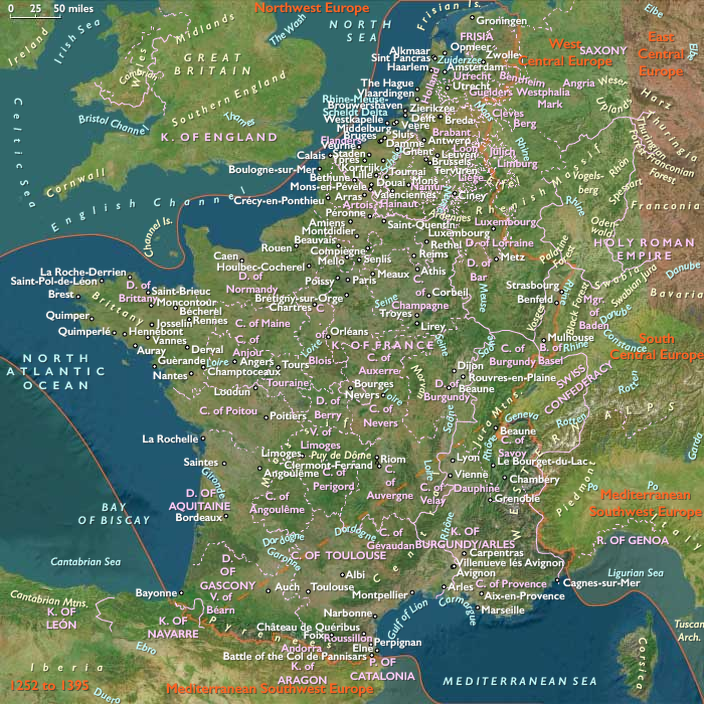
When the conclave finally settled on Clement V—who was not even present at the proceedings in Perugia—his election marked a significant shift in papal politics. Instead of relocating to Rome, he remained in France, avoiding the turbulent factional struggles of the Italian city-states. In 1309, he officially moved the papal court to Avignon, a papal enclave on the Rhone River, where the papacy would remain for sixty-seven years, a period later known as the Avignon Papacy (1309–1376).
This decision significantly weakened Rome's status as the center of Christendom and placed the papacy under increased French influence, a situation that would fuel tensions with both Italian factions and the Holy Roman Empire. The Avignon Papacy would eventually give rise to the Western Schism (1378–1417), deepening divisions within the Catholic Church.
People
Groups
Topics
Subjects
Regions
Subregions

Years: 1300 - 1311
People
Groups
Topics
Subjects
Regions
Subregions