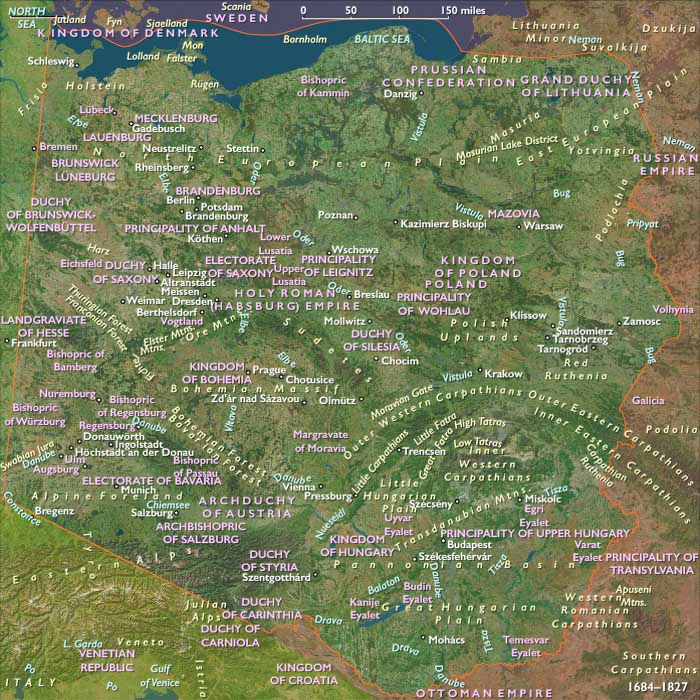
General Jean Victor's army had driven the…
December 1800 CE
General Jean Victor's army had driven the Austrian army of Feldzeugmeister Pál Kray from the Rhine River to the Inn River with victories at Stockach, Messkirch, and Höchstädt from April to July 1800.
On July 15, the combatants had agreed to an armistice.
Emperor Francis II, realizing that Kray was no longer up to the task, had removed him from command.
The Austrian chancellor Johann Amadeus Francis de Paula, Baron of Thugut, had first offered Archduke Ferdinand Karl Joseph of Austria-Este and Archduke Joseph, Palatine of Hungary command of the army but both had declined.
Because his brother, the capable Feldmarschall Archduke Charles, Duke of Teschen, had also refused the command, the emperor had appointed another brother, the eighteen-year-old Archduke John.
Clearly, the inexperienced youth could not cope with this enormous responsibility, so the emperor had nominated Franz von Lauer as John's second-in-command and promoted him to Feldzeugmeister.
John had been directed to follow Lauer's instructions.
To further complicate the clumsy command structure, the aggressive Oberst (Colonel) Franz von Weyrother had been named John's chief of staff.
The armistice had been renewed in September but lapsed on November 12.
By this time, Weyrother had convinced John and Lauer to adopt an offensive posture.
Weyrother's plan calls for crushing the French left wing near Landshut and lunging south to cut Moreau's communications west of Munich.
After a few days of marching, it becomes obvious that the Austrian army is too slow to execute such an ambitious plan, so Lauer persuades the archduke to convert the enterprise into a direct attack on Munich.
Even so, the sudden advance catches Moreau's somewhat scattered French forces by surprise and achieves local superiority.
In the Battle of Ampfing on December 1, the Austrians drive back part of General of Division Paul Grenier's Left Wing.
The defeated French manage to inflict three thousand casualties on the Austrians while only suffering seventeen hundred losses.
Yet, when the Austrian leaders find that Grenier has evacuated Haag in Oberbayern the next day, they become ecstatic.
Archduke John and Weyrother override Lauer's cautious counsel and launch an all-out pursuit of an enemy they believe to be fleeing.
However, Moreau decides to stand and fight, deploying his army in open ground near Hohenlinden.
To approach his position, the Austro-Bavarians have to advance directly west through heavily wooded terrain.
The French army under Moreau defeats the Austrians at Hohenlinden on December 3; this second major defeat forces Austria to sue for peace.
The Austrians report losses of seven hundred and ninety-eight killed, thirty-six hundred and eighty-seven wounded, and seven thousand one hundred and ninety-five prisoners, with fifty cannons and eighty-five artillery caissons captured.
Bavarian casualties number only twenty-four killed and ninety wounded, but their losses also include seventeen hundred and fifty-four prisoners, twenty-six artillery pieces, and thirty-six caissons.
In round numbers, this amounts to forty-six hundred killed and wounded, plus eight thousand nine hundred and fifty soldiers and seventy-six guns captured.
The French admit casualties of eighteen hundred and thirty-nine soldiers, one cannon, and two caissons.
Since several units fail to turn in reports, Moreau's army probably has lost at least three thousand men.
Bastoul has been mortally wounded.
After the disaster, the Austrian high command will find its scapegoat in Lauer, who will be summarily retired.
Archduke John will heap blame on Riesch for being slow, but will also consider Latour and Kienmayer at fault.
Weyrother will escape censure and in 1805 his plan at the Battle of Austerlitz will contribute to that disaster.
Bavarian Lieutenant General Christian Zweibrücken will blame Austrian ignorance and ineptitude.
Apart from Schwarzenberg, the Austrian commanders had showed little initiative.
Meanwhile, Moreau's division commanders had performed well, particularly Richepanse.
Locations
People
Groups
Topics
Subjects
Regions
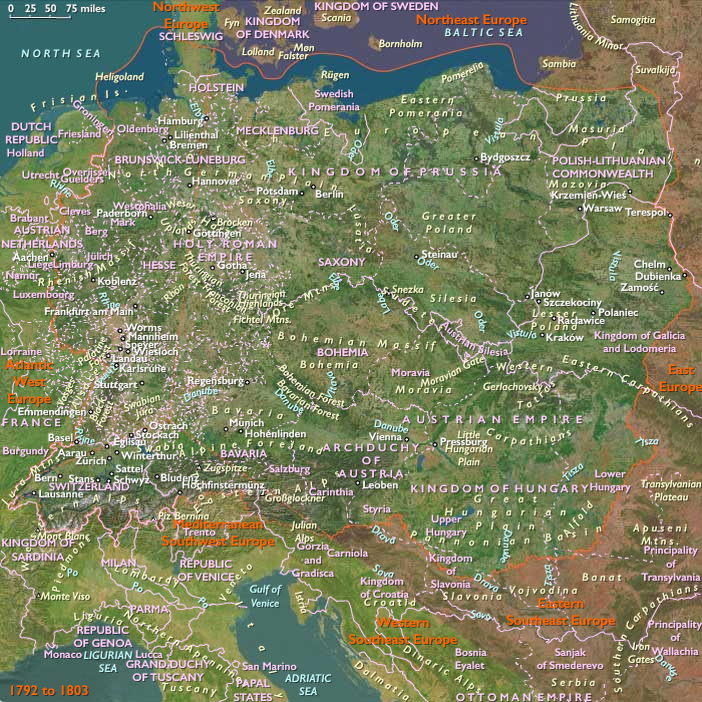
Central Europe
View →Subregions