The Arabian Nights, also called The Thousand…
1396 CE to 1539 CE
The Arabian Nights, also called The Thousand and One Nights, begins to be the name of a large collection of elaborately plotted stories, mostly of Arabian, Indian, or Persian folkloric origin and written in Arabic between the fourteenth and sixteenth centuries.
The frame story, Persian in origin, hinges on the woman-hating King Schahriah (Shahryar) who, emotionally wounded by the blatant infidelity of his first queen, whom he had put to death, weds a different woman each night and has her executed the next morning, thus ensuring her faithfulness.
The bride Scheherazade (Shahrazad), however, the daughter of his grand vizier, beguiles the king with a chain of stories, filled with intrigue, for a thousand and one nights, withholding the ending of each story until the next night.
In this way she heals the king’s psychological scars and preserves her life.
Three of the best known tales are "The History of Aladdin, or the Wonderful Lamp," "The History of Sinbad the Sailor," and "The History of Ali Baba and the Forty Thieves."
The history of the Nights is extremely complex and modern scholars have made many attempts to untangle the story of how the collection as it currently exists came about.
Some scholars have seen an ultimate Indian origin for the Nights.
The collection makes use of devices found in Sanskrit literature such as frame stories and animal fables.
Indian folklore is represented in the Nights by certain animal stories, which reflect influence from ancient Sanskrit fables.
The influence of the Panchatantra and Baital Pachisi is particularly notable.
The Jataka Tales are a collection of five hundred and forty-seven Buddhist stories, which are for the most part moral stories with an ethical purpose.
The Tale of the Bull and the Ass and the linked Tale of the Merchant and his Wife are found in the frame stories of both the Jataka and the Nights.
The earliest mentions of the Nights refer to it as an Arabic translation from a Persian book, Hazār Afsān (or Afsaneh or Afsana), meaning "The Thousand Stories".
In the tenh century Ibn al-Nadim compiled a catalogue of books (the "Fihrist") in Baghdad.
He noted that the Sassanid kings of Iran enjoyed "evening tales and fables".
Al-Nadim then writes about the Persian Hazār Afsān, explaining the frame story it employs: a bloodthirsty king kills off a succession of wives after their wedding night; finally one concubine had the intelligence to save herself by telling him a story every evening, leaving each tale unfinished until the next night so that the king would delay her execution.
In the same century Al-Masudi also refers to the Hazār Afsān, saying the Arabic translation is called Alf Khurafa ("A Thousand Entertaining Tales") but is generally known as Alf Layla ("A Thousand Nights").
He mentions the characters Shirazd (Scheherazade) and Dinazad.
No physical evidence of the Hazār Afsān has survived so its exact relationship with the existing later Arabic versions remains a mystery.
Apart from the Scheherazade frame story, several other tales have Persian origins, although it is unclear how they entered the collection.
These stories include the cycle of "King Jali'ad and his Wazir Shimas" and "The Ten Wazirs or the History of King Azadbakht and his Son" (derived from the seventh-century Persian Bakhtiyarnama)
Subjects
Regions
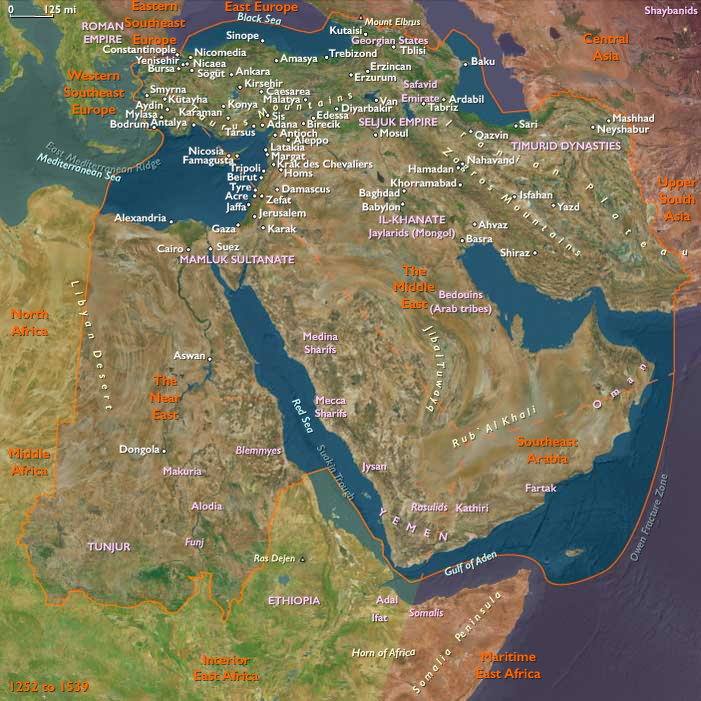
The Near and Middle East
View →Subregions