A nationwide "Festival of the Supreme Being"…
June 1794 CE
A nationwide "Festival of the Supreme Being" is held on June 8 (which is also the Christian holiday of Pentecost).
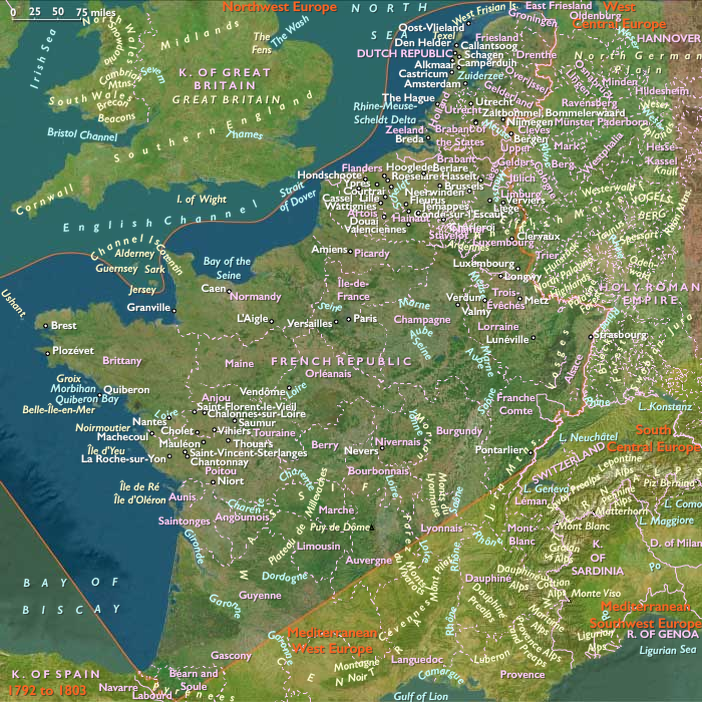
The festivities in Paris are held in the Champ de Mars, which is renamed the Champ de la Réunion ("Field of Reunion") for this day.
This is most likely in honor of the Champ de Mars Massacre, where the Republicans first rallied against the power of the Crown.
Robespierre, as President of the Convention, walks first in the festival procession and delivers a speech in which he emphasizes his concept of a Supreme Being.
Throughout the festival, Robespierre is beaming with joy; not even the negativity of his colleagues can disrupt his delight.
He is able to speak of the things about which he is truly passionate, including Virtue and Nature, typical deist beliefs, and, of course, his disagreements with atheism.
Everything is arranged to the exact specifications that had been previously set before the ceremony; the ominous and symbolic guillotine hads been moved to the original standing place of the Bastille, all of the people are placed in the appropriate area designated to them, and everyone is dressed accordingly.
Not only is everything going smoothly, but the Festival is also Robespierre’s first appearance in the public eye as an actual leader for the people, and also as President of the Convention, to which he had been elected only four days earlier.
While for some it is an excitement to see him at his finest, many other leaders involved in the Festival agree that Robespierre has taken things a bit too far.
Multiple sources state that Robespierre had come down the mountain in a way that resembled Moses as the leader of the people, and one of his colleagues, Jacques-Alexis Thuriot, was heard saying, “Look at the bugger; it’s not enough for him to be master, he has to be God.” While these words may have been a simple release of resentment at the time, this same idea will come back in an attempt to remove Robespierre from his lofty position in the very near future.
Marc-Guillaume Alexis Vadier is not one of Robespierre’s devotees, and is actually attempting to find something that Robespierre has done wrong.
Vadier is on a mission to attack Robespierre and his faith, and is also trying to bring down Robespierre’s political stature as well.
This is when he finds Catherine Théot, who is a seventy-eight-year old, self declared “prophetess” who had, at one point, been imprisoned in the Bastille.
By Théot stating that he is the “herald of the Last Days, prophet of the New Dawn,” (because his Festival had fallen on the Pentecost, which she had claimed would be the day revealing a “divine manifestation”) Catherine Théot has made it seem as though Robespierre has made these claims himself to her.
Many of her followers are supporters or friends of Robespierre as well, which makes it seem as though he is attempting to create a new religion with himself as its god.
While Robespierre has nothing to do with Catherine Théot or her followers, many assume that he is on his way to dictatorship, and it sends a current of fear throughout the Convention, which contributes to his downfall the following July.
Locations
Groups
Topics
Commodities
Subjects
Regions
West Europe
View →Subregions