The territory of present-day Uruguay contains no…
1516 CE to 1527 CE
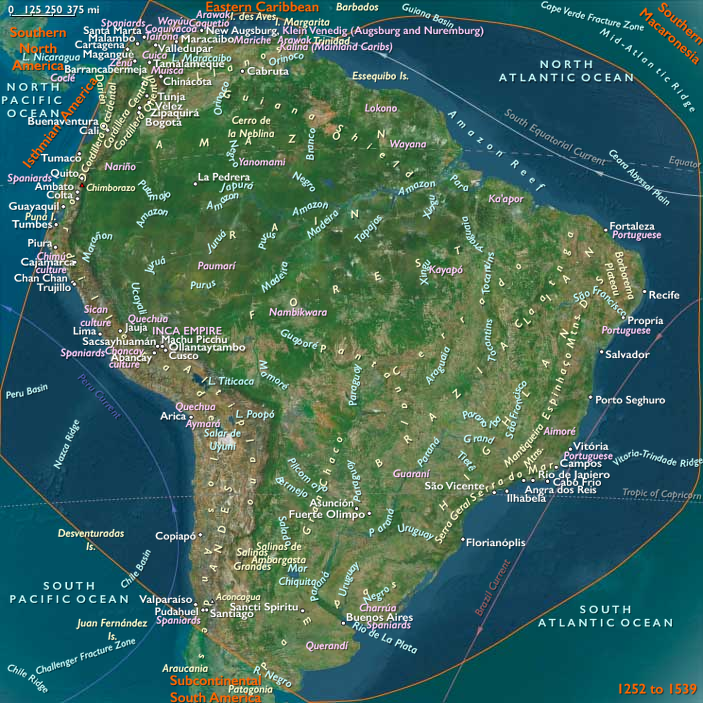
The territory of present-day Uruguay contains no significant vestiges of civilizations existing prior to the arrival of European settlers, in contrast to most Latin American countries.
Lithic remains dating back ten thousand years have been found in the north of the country.
They belonged to the Catalan and Cuareim cultures, whose members were presumably hunters and gatherers.
Other peoples arrived in the region four thousand years ago.
They belonged to two groups, the Charrua and the Tupi-Guarani, classified according to the linguistic family to which they belong.
Neither group has evolved past the middle or upper Paleolithic level, which is characterized by an economy based on hunting, fishing, and gathering.
Other, lesser indigenous groups in Uruguay include the Yaro, Chaná, and Bohán.
Presumably, the Chaná reached lower Neolithic levels with agriculture and ceramics.
Spanish seamen in the early sixteenth century search for the strait linking the Atlantic and the Pacific oceans.
Juan Diaz de Solis enters the Rio de la Plata by mistake in 1516 and thus discovers the region.
Charrua natives allegedly attack the ship as soon as it arrives and kill everyone in the party except for one boy (who is rescued a dozen years later by Sebastian Cabot, an Englishman in the service of Spain).
Although historians currently believe that Diaz de Solis was actually killed by the Guarani, the "Charrua legend" has survived, and Uruguay has found in it a mythical past of bravery and rebellion in the face of oppression.
The fierce Charrua will plague the Spanish settlers for the next three hundred years.
In 1520 the Portuguese captain Ferdinand Magellan casts anchor in a bay of the Rio de la Plata at the site that will become Montevideo.
Other expeditions reconnoiter the territory and its rivers.
Locations
Groups
Topics
Regions
South America
View →Subregions