A wave of the plague had assaulted …
Years: 1631 - 1631
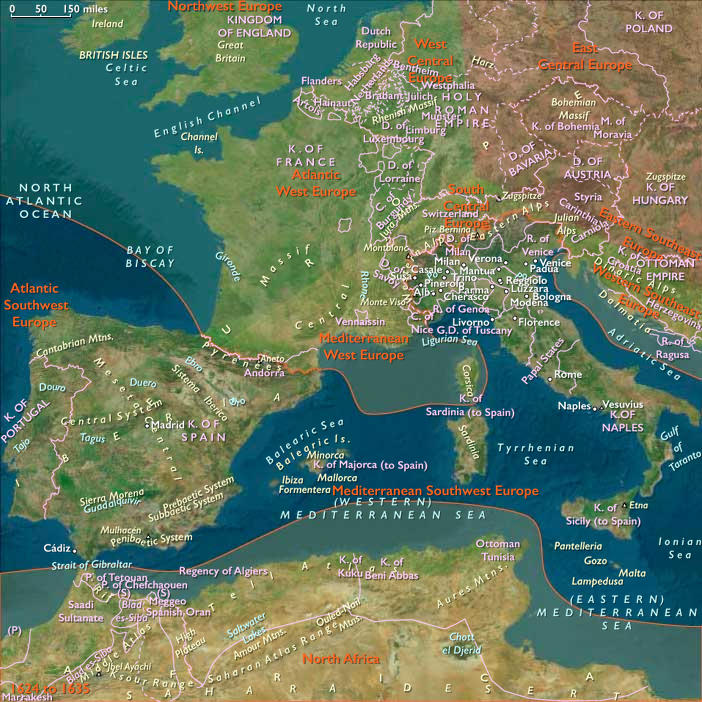
A wave of the plague had assaulted Venice in the summer of 1629, and over the next two years will kill nearly a third of the population.
Forty-six thousand people will die in the city, while in the lagoons the number is far higher, some ninety-four thousand.
Locations
Groups
Topics
Subjects
Regions
Subregions
Related Events
Filter results
Showing 10 events out of 32592 total
Swedish king Gustav II Adolf founds the Revalsche Gymnasium or Gymnasium Revaliense (Gymnasium of Reval) in Tallinn, Estonia, in 1631.
Today known as the Gustav Adolf Lyceum or Gustav Adolf Gymnasium (Estonian: Tallinna Gustav Adolfi Gümnaasium), it is one of the oldest extant secondary schools in Europe.
Philip Adolf had died on July 16, 1631, and the witch trials are put to an end when the city is taken by king Gustavus Adolphus of Sweden the same year.
Fakhr ad-Din II, secretly aided by the grand duke of Tuscany, has continued his opposition to the Porte, having bribed Ottoman officials at Constantinople to prevent military actions.
He dominates most of Syria, Lebanon, and Palestine by 1631.
Soldiers of the Dutch West India Company land a fleet of fifteen ships at the Castle of Elmina, its Portuguese garrison reinforced by two hundred African allies put in service of the governor Sottomayor by the local caciques.
The Dutch open the battle by bombarding the castle before marching on it but they are ambushed by the Portuguese and their African allies from hidden positions and are almost totally massacred.
Among the dead are the commander-in-chief and all his officers.
The Portuguese have very few casualties and take fifteen, fifteen drums and over on thousand muskets, pikes, pistols and dresses.
The Dutch ships fire over two thousand cannon balls at the castle, but they eventually withdraw.
This defeat, along with the defeats at Bahia and Puerto Rico, is the cause of what is to be a five year lull in Dutch attacks on Spanish and Portuguese colonies.
Repeated displays of the sacrament, as well as prayers and processions to churches dedicated to San Rocco and San Lorenzo Giustiniani, had failed to stem the epidemic.
It is also decided that the Senate will visit the church each year.
On November 21, the Feast of the Presentation of the Virgin, in a celebration known as the Festa della Madonna della Salute, the city's officials parade from San Marco to the Salute for a service in gratitude for deliverance from the plague.
This involves crossing the Grand Canal on a specially constructed pontoon bridge and is still a major event in Venice.
Venetians' desire to create a suitable monument at a place that allows for easy processional access from Piazza San Marco leads senators to select the present site from among eight potential locations.
The location is chosen partially due to its relationship to San Giorgio, San Marco and Il Redentore, with which it forms an arc.
Santa Maria della Salute, emblematic of the city's piety, is to stand adjacent to the rusticated single story customs house or Dogana da Mar, the emblem of its maritime commerce, and near the civic center of the city.
A dispute with the patriarch, owner of the church and seminary at the site, has been resolved, and razing of some of the buildings begins by 1631.
A competition is held to design the building.
Of the eleven submissions (including designs by Alessandro Varotari, Matteo Ignoli, and Berteo Belli), only two are chosen for the final round.
The architect Baldassare Longhena is selected to design the new church, which will finally be completed in 1681, the year before Longhena's death.
The other design to make it to the final round is by Antonio Smeraldi (il Fracao) and Zambattista Rubertini.
Of the proposals still extant, Belli's and Smeraldi's original plans are conventional counterreformation linear churches, resembling Palladio's Redentore and San Giorgio Maggiore, while Varotari's is a sketchy geometrical abstraction.
Longhena's proposal is a concrete architectural plan, detailing the structure and costs.
The Venetian Senate votes sixty-six in favor, twenty-nine against with two abstentions to authorize the designs of the twenty-six-year-year old Longhena.
His plan for the Salute, while novel in many ways, still shows the influence of Palladian classicism and the domes of Venice.
Olivares is well known for his passion for work.
Early on, Olivares would rise early, go to confession, wake Philip IV and discuss the day's events with him, before then working throughout the rest of the day, often until eleven o'clock at night.
Initially, Olivares would meet with him three times a day, although this declined over time until he met with the king only once a day.
While living a private life of 'spartan austerity' himself, Olivares is skillful in using the formal and elaborate protocol of the court as a way of controlling the ambitions of Philip's enemies and rivals.
Determined to attempt to improve the bureaucratic Castilian system of government, during the 1620s Olivares had begun to create juntas, smaller governmental committees, to increase the speed of decision making.
By the 1630s, these are increasingly packed with Olivares' own placemen, tasked to implement his policies.
Olivares places tight controls on the use of special royal favors to circumvent tight spending controls.
The result is a very particular combination of centralized power in the form of Olivares, and loose government executed by small committees.

French Protestant theologian and metaphysician Moses Amyraut, also known as Amyraldus, is perhaps most noted for his modifications to Calvinist theology regarding the nature of Christ's atonement, which is referred to as Amyraldism or Amyraldianism.
He publishes his Traité des religions in 1631, and from this year onward he is to be a foremost man in the French church.
Chosen to represent the provincial synod of Anjou, Touraine and Maine at the national synod held in 1631 at Charenton, he is appointed as orator to present to the king The Copy of their Complaints and Grievances for the Infractions and Violations of the Edict of Nantes.
The university of Saumur is to become the university of French Protestantism.
Amyraut has as many as a hundred students in attendance at his lectures.
One of these is William Penn, who will later go on to found the Pennsylvania Colony in America based in part on Amyraut's notions of religious freedom.
The royal goldsmith George Heriot had left around twenty-five thousand Pound Scots—equivalent to several tens of millions today—on his death in 1624 to found a "hospital" (at this time the name for this kind of charitable school) to care for the "puir, faitherless bairns" (Scots: poor, fatherless children) of Edinburgh.
The construction of Heriot's Hospital (as it is first called) had been started in 1628, just outside the city walls of Edinburgh.
Scottish master mason and architect William Wallace, who had served as King's Master Mason under James VI, is almost certainly the principal designer of the main building of the school, notable for its Anglo-Flemish style, which he has helped to popularize in Scotland.
After Wallace’s death in 1631, William Aytoun continues the work.