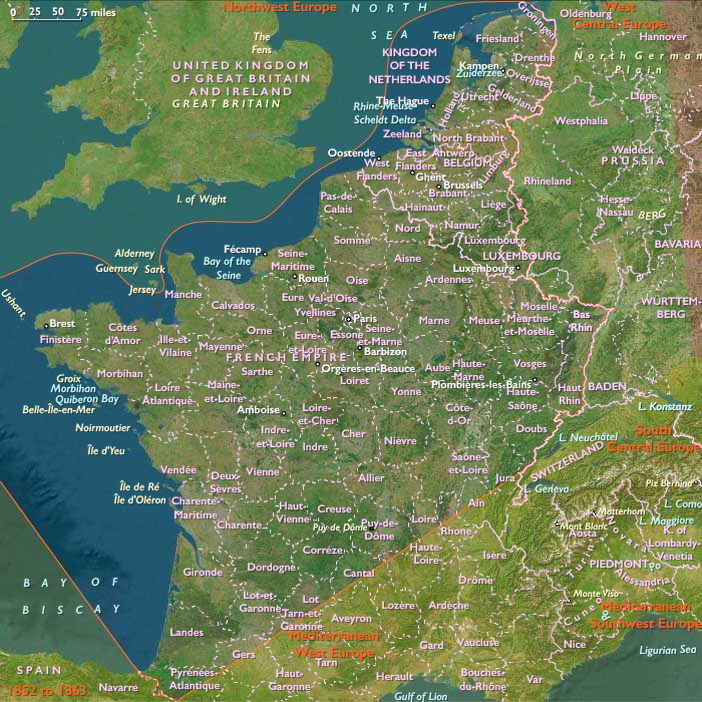
Abdelkader and his family and followers had…
October 1852 CE
Damp conditions in the castle led to deteriorating health as well as morale in the Emir and his followers, and his fate has become something a cause célèbre in certain circles.
Several high-profile figures, including Émile de Girardin and Victor Hugo, called for greater clarification over the Emir's situation; future prime minister Émile Ollivier has carried out a public opinion campaign to raise awareness over his fate.
There is also international pressure.
Lord Londonderry had visited Abdelkader in Amboise and subsequently wrote to then-President Louis-Napoléon Bonaparte (whom he had known during the latter's exile in England) to appeal for the Emir's release.
Louis-Napoleon Bonaparte (later the Emperor Napoleon III) is a relatively new president, having come to power in the Revolution of 1848 while Abdelkader was already imprisoned.
He is keen to make a break with several policies of the previous regime, and Abdelkader's cause is one of them.
Eventually, on October 16, 1852, Abdelkader is released by the President and given an annual pension of one hundred thousand francs on taking an oath never again to disturb Algeria.
He will now take up residence in Bursa, today's Turkey, moving in 1855 to Amara District in Damascus.
He will devote himself anew to theology and philosophy, and compose a philosophical treatise, of which a French translation will be published in 1858 under the title of Rappel à l'intelligent, avis à l'indifférent, and again in 1977 under the title of Lettre aux Français.
He will also write a book on the Arabian horse.
Locations
Regions
West Europe
View →Subregions