
Event
The majority of Iranians do not become…
The majority of Iranians do not become Muslim until the ninth century.
The Iranians are gradually integrated into the new community, although the conquerors, especially the Umayyads (the Muslim rulers whose dynasty succeeded Muhammad and rules from 661 to 750), tend to stress the primacy of Arabs among Muslims.
The Muslim conquerors had adopted the Sassanian coinage system and many Sassanian administrative practices, including the office of vizier, or minister, and the divan, a bureau or register for controlling state revenue and expenditure that becomes a characteristic of administration throughout Muslim lands.
Later caliphs adopted Iranian court ceremonial practices and the trappings of Sassanian monarchy.
Men of Iranian origin serve as administrators after the conquest, and Iranians contribute significantly to all branches of Islamic learning, including philology, literature, history, geography, jurisprudence, philosophy, medicine, and the sciences.
The Arabs are in control, however.
Islam, as the new state religion, imposes its own system of beliefs, laws, and social mores.
Landowners in regions that submit peacefully to Muslim rule keep their land, but crown land, land abandoned by fleeing owners, and land taken by conquest had passed into the hands of the new state.
This includes the rich lands of the Sawad, an alluvial plain in central and southern Iraq.
Arabic becomes the official language of the court in 696, although Persian continues to be widely used as the spoken language.
-
{# Image navigates to the detail page; the magnifying-glass chip is the only Fancybox lightbox trigger (kept a separate sibling — anchors can't nest). #}
 The Great Crossroads
World
-
{# Image navigates to the detail page; the magnifying-glass chip is the only Fancybox lightbox trigger (kept a separate sibling — anchors can't nest). #}
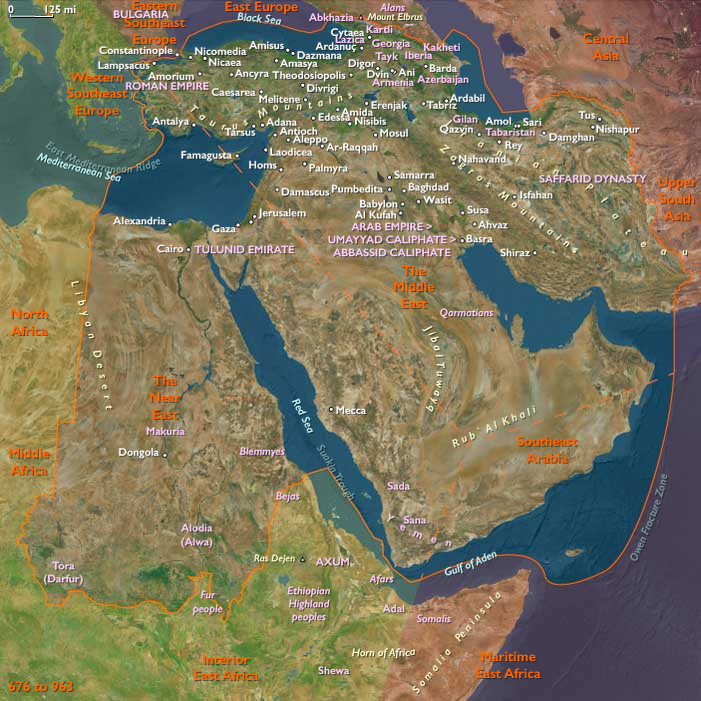 The Near and Middle East
Region
-
{# Image navigates to the detail page; the magnifying-glass chip is the only Fancybox lightbox trigger (kept a separate sibling — anchors can't nest). #}
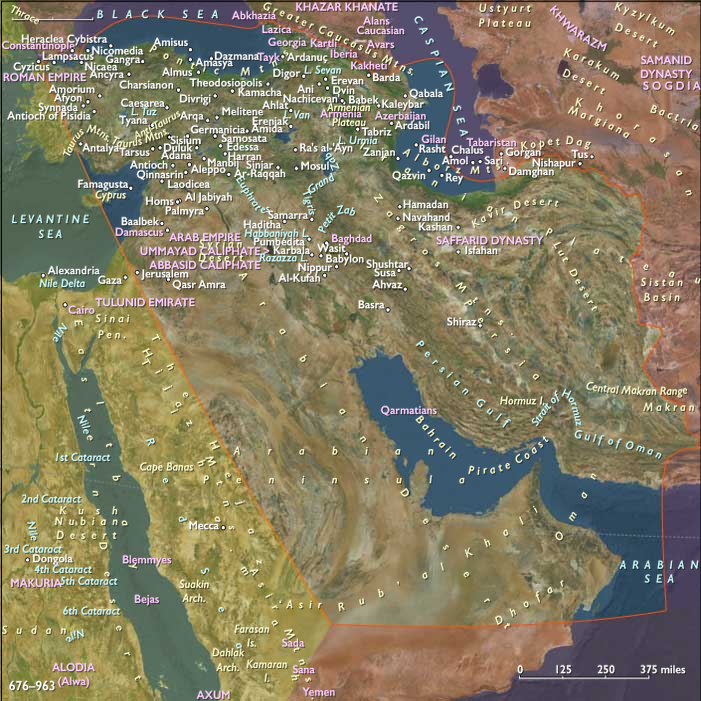 Middle East
Subregion
