
Adad-nirari III conquers Damascus in 804 BCE.
813 BCE to 802 BCE
Adad-nirari III conquers Damascus in 804 BCE.
Locations
Groups
Topics
Commodities
Subjects
Regions
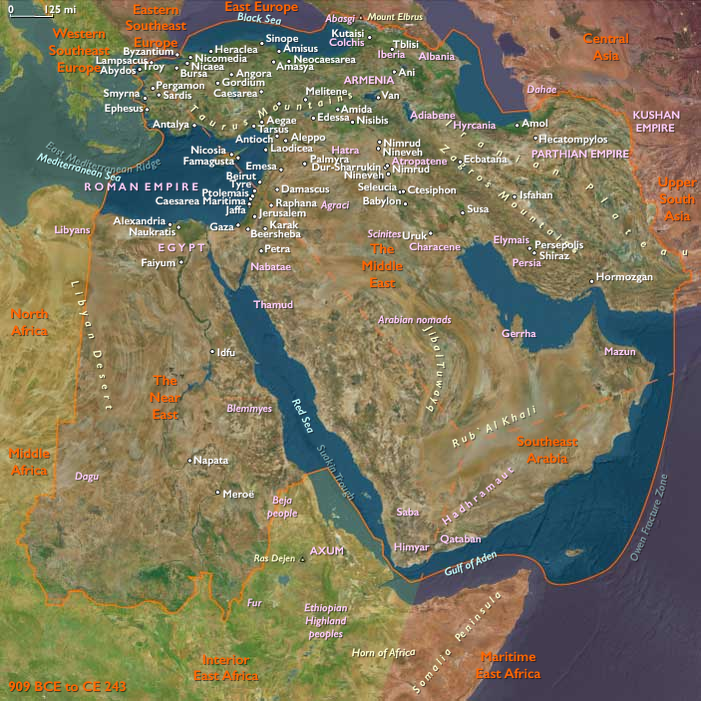
The Near and Middle East
View →Subregions
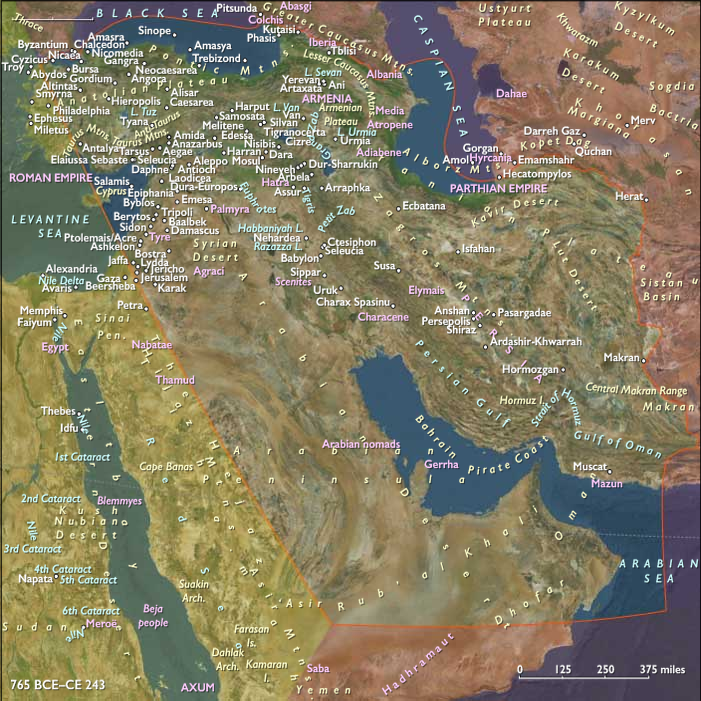
Middle East
View →Related Events
No active filters.
Showing 10 events out of 66569 total
The Middle East, 813 to 802 BCE: The Regency of Sammuramat and Reign of Adad-nirari III
The era 813 to 802 BCE marks a remarkable and transformative period for the Assyrian Empire, primarily under the rule of Adad-nirari III, who ascends to the throne in 811 BCE following the death of his father, Shamsi-Adad V. Due to his youth, the early part of his reign sees significant influence from his mother, Queen Sammuramat, who serves as regent from 810 to 805 BCE.
Sammuramat's regency is notable for her exceptional authority and effective governance, a rarity for women in ancient Mesopotamian history. Her prominence gives rise to the legendary figure of Semiramis, a deified queen mythologized in later traditions as a powerful conqueror and founder of cities, notably Babylon. According to legend, Semiramis was nurtured by doves, symbolizing divine favor and protection. This mythological Semiramis reportedly led extensive military campaigns into regions including Persia, Egypt, Libya, and Ethiopia, further highlighting the lasting impression of Sammuramat's historical regency.
Upon assuming direct control after Sammuramat's regency, Adad-nirari III continues to consolidate and expand the Assyrian Empire. In 804 BCE, he achieves a major military and strategic success with the conquest of Damascus, an influential city-state in the Levant. This conquest significantly enhances Assyria's territorial reach and solidifies its dominance over vital trade routes and regional politics.
Under Adad-nirari III, Assyrian administrative and military structures remain robust and efficient, enabling sustained expansion and control. Culturally, the empire continues to reflect and expand upon the sophisticated ceremonial traditions and elaborate artistic expressions characteristic of the previous era. The intricate craftsmanship in palace reliefs, clothing, and ceremonial artifacts underscore the empire’s wealth and the imperial power vested in its rulers.
Thus, the era from 813 to 802 BCE represents a vital period in Assyrian history, marked by the influential regency of Sammuramat and the subsequent assertive and expansionist reign of Adad-nirari III. Their combined leadership ensures Assyria's continued prominence and stability, significantly shaping the geopolitical and cultural landscape of the Middle East during this era.
Adad-nirari III succeeds his father Shamshi-Adad V as king of Assyria in 811 BCE.
Queen Sammuramat serves as regent for her son Adad-Nirari III from 810 to 805.
(Sammuramat is evidently the basis for the Ishtar-like, deified mythological Queen Semiramis, wife of Ninus, founder of Nineveh. Semiramis was abandoned by her mother, the fish goddess Derceto, and nurtured by doves. After Ninus died, Semiramis ruled in the place of their son Ninyus for many years. According to the legend, she founded Babylon and led successful campaigns against Persia, Egypt, Libya, and Ethiopia. When her son plotted against her, she disappeared in the shape of a dove.)
The Near East (813–802 BCE): Persistent Conflict and Dynastic Rivalries
Between 813 and 802 BCE, political fragmentation and military conflict continue to define the Near East, particularly in Egypt and Israel, shaping regional dynamics and altering alliances.
Egypt's Continuing Dynastic Rivalries
In Egypt, internal division persists and deepens. Shoshenq III maintains a tenuous hold over Lower Egypt from his stronghold in Memphis and the Delta, yet faces ongoing challenges from the rival Twenty-third Dynasty centered at Thebes. The claimant Pedubast I, asserting Libyan ancestry, continues to rule as Pharaoh in Upper Egypt, presiding over a complex network of alliances and rivalries.
Throughout this period, the descendants of Takelot II, notably Osorkon III, engage in fierce competition with both Shoshenq III and Pedubast I. Thebes, caught in the middle of these struggles, endures frequent political upheaval and periodic violence, highlighting the weakened and fragmented nature of Egyptian power during this phase of the Third Intermediate Period.
Israel under Pressure from Aram-Damascus
In the northern kingdom of Israel, King Jehoahaz struggles throughout his reign against the relentless aggression of Hazael, the powerful king of Aram-Damascus. Aramaean dominance severely restricts Israelite sovereignty, resulting in heavy territorial losses and deepening internal instability. Biblical accounts describe Jehoahaz’s rule as marked by constant military setbacks and diminished regional influence, reflecting the broader strategic ascendancy of Damascus in the region.
Jehoahaz’s efforts to defend and stabilize Israel yield little success. Consequently, Israel remains politically isolated and militarily weakened, struggling to maintain even its core territories against the encroaching Aramaeans.
Summary of the Era
The years 813–802 BCE in the Near East are characterized by persistent instability. Egypt continues to suffer intense dynastic rivalries, effectively fragmenting its political and territorial unity, while Israel, under Jehoahaz, endures continuous external threats and diminishing influence. This ongoing turbulence underscores the region’s fragility during this turbulent era, setting the stage for subsequent shifts in power and alliances.
Humans may have first begun riding the horse not long after domestication, possibly as early as 4000 BCE, though the evidence is disuputed.
The nomadic Scythians in the Eurasian Steppes are the probable developers of the saddle.
It is not known precisely when riders first began to use some sort of padding or protection, but a blanket attached by some form of surcingle or girth was probably the first "saddle," followed later by more elaborate padded designs.
The earliest saddles, simple pads attached with a surcingle, are seen by 800 BCE.
The Middle East, 801 to 790 BCE: The Destruction of Hasanlu and Urartian Expansion
The era 801 to 790 BCE witnesses significant turmoil and cultural shifts in the northern regions of the Middle East, notably marked by the violent destruction of the settlement at Hasanlu, an important Iron Age site in northwestern Iran. Hasanlu's Iron II culture had developed strong ties to Mesopotamia and northern Syria, reflecting robust trade networks and potential political influence from these major regional powers.
Around 800 BCE, Hasanlu is subjected to a devastating raid, most likely by forces from the rising kingdom of Urartu, located around Lake Van. This attack leaves the fortified settlement ravaged and abandoned. Archaeological findings provide stark evidence of the violence: over one hundred and fifty human victims, many displaying signs of mutilation and execution, have been uncovered amidst the ruins. Among these remains, twenty-one skeletons, possibly trapped looters, lie amidst the debris of a burned citadel, illustrating the chaotic and desperate final moments of the city's inhabitants.
A significant discovery from Hasanlu’s destruction is an elaborate gold bowl, which one of the victims was found clutching. The bowl, decorated with intricate mythical scenes in relief, indicates Hasanlu’s artisans' sophisticated craftsmanship and exposure to imported styles, notably from areas around the Caspian Sea. This artifact symbolizes the extensive cultural and trade connections Hasanlu enjoyed before its tragic end.
Following its destruction, Hasanlu’s High Mound becomes the site of an Urartian fortress, marking Urartu's expanding influence. A robust fortification wall, supplemented by evenly spaced defensive towers, is constructed around the site, signaling a strategic shift in regional power dynamics. Urartu, rising as a significant regional force, begins to assert itself more boldly against the traditional powers of Mesopotamia.
Thus, the era from 801 to 790 BCE is characterized by significant regional conflict and shifting political control, exemplified by the violent demise of Hasanlu and the ascendance of Urartu as a formidable presence in the geopolitics of the Middle East.
The Iron II culture of Hasanlu has close ties to Mesopotamia and northern Syria.
Some have suggested that this indicates the settlement had come under the control of a foreign power, or experienced an influx of new occupants, or perhaps made internal changes to its political system.
Raiding forces from, probably, Urartu ravage and burn the fortified settlement about 800, after which the site is abandoned.
Over one hundred and fifty human victims will be found by archaeologists where they had been slain.
Some victims were mutilated and distributions of other bodies and the wounds they received suggest mass executions.
Skeletal remains of twenty-one individuals—perhaps looters trapped in the fire—lie (for nearly twelve hundred years, until their discovery) among the debris of the burned citadel.
One skeleton still clutches a gold bowl adorned with mythical scenes in relief of religious worship.
The bowl, made from imported raw materials, is executed in a technique reminiscent of objects found near the Caspian Sea.
Its use of local stylistic elements combined with foreign motifs suggests that artisans at Hasanlu were exposed to imported objects and that its inhabitants actively engaged in trade.
Following Hasanlu's destruction, the High Mound is used as the site for an Urartian fortress.
A fortification wall with towers at regular intervals is constructed around the edges of the High Mound.
The Near East (801–790 BCE): Resurgence in Israel and Resolution in Egypt
Israel’s Revival Under Jeroboam II
In the northern kingdom of Israel, the era from 801 to 790 BCE is marked by the ascension and impactful reign of Jeroboam II, son of Jehoash. Though minimally detailed by the Deuteronomic historian, archaeological evidence and secondary historical sources depict Jeroboam II as a notably successful monarch. His reign initiates a significant territorial and economic revival, restoring Israel’s boundaries to their ancient extent and reclaiming territories previously lost to Aram-Damascus.
Under Jeroboam II, Israel experiences a marked period of economic prosperity. Increased trade, political stability, and internal development characterize this time, restoring Israel’s status as a major power in the region. Jeroboam II’s effective governance fosters a brief but influential resurgence of northern Israelite strength, temporarily reversing the decline experienced during previous reigns.
Resolution of Egypt’s Dynastic Rivalries
In Egypt, the prolonged period of dynastic conflict reaches a decisive turning point during the thirty-ninth year of Shoshenq III’s reign. After sustained internal warfare, Osorkon B (later known as Osorkon III) decisively defeats rival factions and consolidates power over Middle and Upper Egypt. His victory puts an end to the longstanding factional struggles that had fragmented the country, effectively stabilizing southern Egypt.
With this triumph, Osorkon III establishes a Libyan dynasty in Upper Egypt, initiating a line of succession that includes his successors Takelot III and Rudamun. This dynastic consolidation effectively partitions Egypt into clearly defined spheres of influence, with Shoshenq III’s rule confined to Lower Egypt, while Osorkon III’s newly founded dynasty firmly controls the south. This resolution brings relative stability, albeit in a divided Egypt, after decades of internal conflict.
Summary of the Era
The era 801–790 BCE is marked by contrasting developments: a notable resurgence of Israel under Jeroboam II, who restores stability and territorial expansion, and a decisive resolution of Egypt’s dynastic conflicts, culminating in the establishment of Osorkon III’s Libyan dynasty. These parallel developments reshape political alliances and regional dynamics, offering both kingdoms temporary reprieve and renewed strength in the Near East.
Israel's next king, Jeroboam II, although little mentioned by the Deuteronomic historian, appears to be a major monarch, reestablishing the northern kingdom's ancient boundaries and fostering a period of economic prosperity.
The two royal factions of Egypt squabble consistently and the conflict is only resolved in Year Thirty-Nine of Shoshenq III, when Osorkon B comprehensively defeats his enemies.
He proceeds to found the Upper Egyptian Libyan Dynasty of Osorkon III – Takelot III – Rudamun.
The Greek alphabet emerges in the late ninth century BCE or early eighth century BCE.
Another, unrelated writing system, Linear B, had been in use to write the Greek language during the earlier Mycenaean period, but the two systems are separated from each other by a hiatus of several centuries, the so-called Greek Dark Ages, which end around 800 BCE.
The Greeks have adopted the alphabet from the earlier Phoenician alphabet, a member of the family of closely related West Semitic scripts.
The most notable change made in adapting the Phoenician system to Greek is the introduction of vowel letters.
According to a definition used by some modern authors, this feature makes Greek the first "alphabet" in the narrow sense, as distinguished from the purely consonantal alphabets of the Semitic type, which according to this terminology are called "abjads".