Public executions are considered a spectator sport…
July 1781 CE
Public executions are considered a spectator sport in the eighteenth century, and when individuals of high rank are involved the attraction is irresistible.
It is not just the lower orders who turn up to witness these occasions (see the diaries of George Selwyn).
François Henri de la Motte, arrested in January 1781 on suspicion of being a spy, has been held for six months in the Tower of London.
At an Old Bailey trial on July 23 he had been found guilty of running an operation that sent secret naval intelligence to France—a country that supports the rebellious American colonists, and with which Great Britain has been at war since 1778.
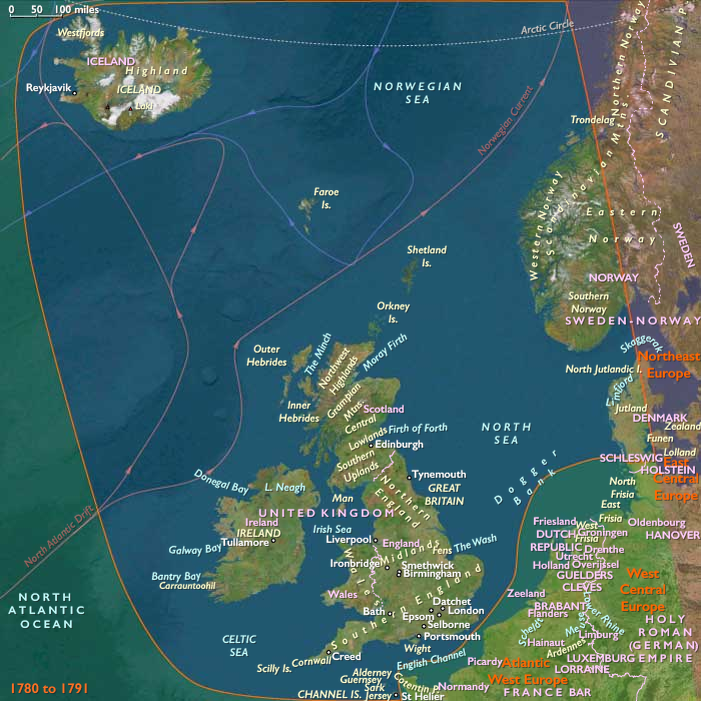
Specifically, the intelligence concerned British fleet dispositions at Portsmouth and other British ports.
In July 1781 the War of American Independence is not over (though it will be within a few months) and the navies of Great Britain and France are still fighting each other not only in the North Atlantic but as far afield as the Indian Ocean.
What had sealed de la Motte's fate was the damning testimony of a former accomplice, Henry Lutterloh, who was the chief prosecution witness.
Having been found guilty by the jury, the terrible sentence pronounced by the judge was that the prisoner be hanged, drawn and quartered.
A crowd of more than eighty thousand people witness de la Motte's execution at Tyburn.
On this occasion people from all walks of life turn up to witness the edifying prospect of a handsome gentleman of rank, elegantly dressed, and in the prime of life, being ceremoniously butchered in public—"pour décourager les autres", French for "to discourage others".
In fact de la Motte is spared some of the gruesome refinements—after hanging for nearly an hour, he is taken down and his heart cut out and burned, but he is not quartered, nor subjected to the refinements that will be visited on David Tyrie, a Scottish spy, the following year. (Tyrie, whose trial will be held at Winchester, will also be found guilty of sending naval intelligence to the French. He will be hanged for twenty-two minutes, following which he will be beheaded and his heart cut out and burned. He will then be then emasculated, quartered, and his body parts put into a coffin and buried in the pebbles at the seaside.
De la Motte's life and execution will resonate in the imagination of writers like Charles Dickens and W. M. Thackeray.
The drama and language of the trial scene of Charles Darnay in A Tale of Two Cities is very close to that of de la Motte's trial, with Dickens emphasizing the grotesqueness and the gruesomeness of the proceedings in his inimitable manner.
As for Thackeray, in his last, unfinished novel, Denis Duval, we find de la Motte and his sometime accomplice, Henry Lutterloh, figuring there as leading characters.
Thackeray portrays de la Motte as a tortured, demonic figure, which is not at all how he comes across in contemporary reports in the press.
Locations
Groups
Topics
Regions
North Europe
View →Subregions