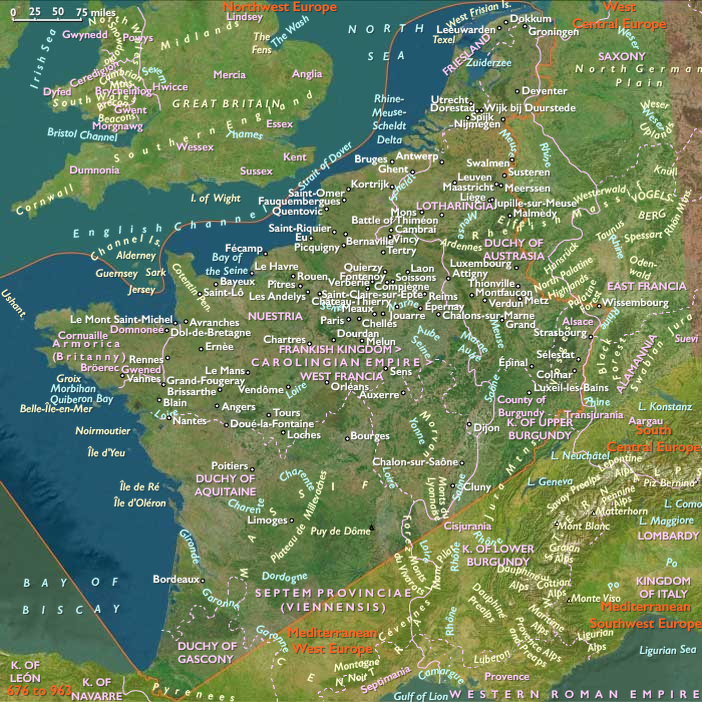
The Emergence of the Dutch-French Language Boundary…
820 CE to 963 CE
The Emergence of the Dutch-French Language Boundary (9th Century)
As the Carolingian Empire begins to fragment in the 9th century, a widening cultural and linguistic divide develops between the Franks who remain in their northern homeland—in what is now Flanders and the southern Netherlands—and those who assimilate into the Romance-speaking populations further south.
The Evolution of Old Frankish into Old Dutch
- The Franks who remained in the north continue to speak Old Frankish, which by the 9th century evolves into Old Low Franconian, the earliest form of Old Dutch.
- The Franks who settled in West Francia (modern France) gradually adopt Gallo-Roman Latin, giving rise to Old French.
The Formation of a Linguistic Frontier
Over time, a Dutch-French language boundary emerges, marking a clear linguistic divide between the Germanic and Romance-speaking populations. This boundary:
- Follows a rough east-west line, still reflected in the modern-day linguistic border between Dutch-speaking Flanders and French-speaking Wallonia in Belgium.
- Becomes a cultural and political divide, shaping regional identities and administrative divisions in the Low Countries and northern France.
- Remains stable for centuries, despite political changes, consolidating two distinct linguistic and cultural zones in medieval and modern Europe.
A Lasting Impact
The Dutch-French linguistic boundary, formed during the 9th century, persists to the present day, influencing political, cultural, and national identities in Belgium, the Netherlands, and northern France. It stands as one of the oldest and most enduring linguistic frontiers in Western Europe.
Groups
Topics
Subjects
Regions
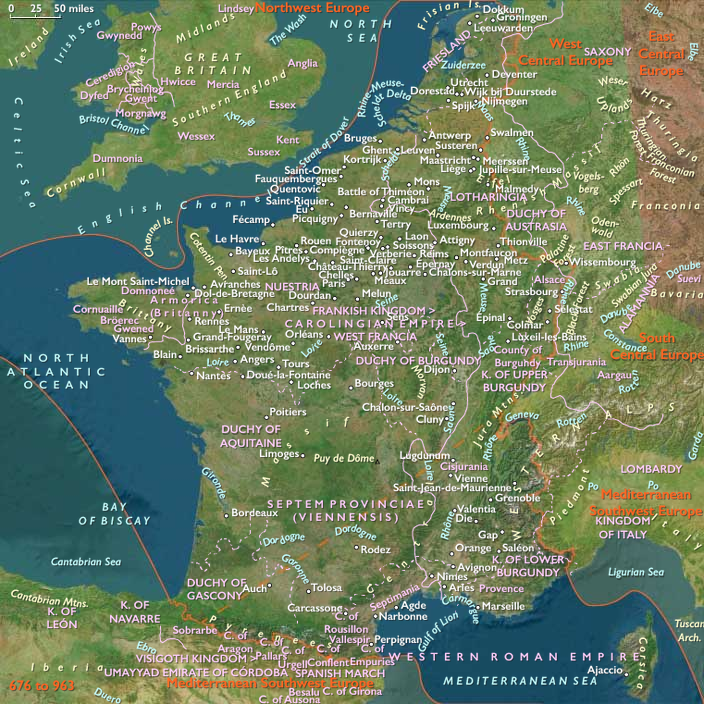
West Europe
View →Subregions