
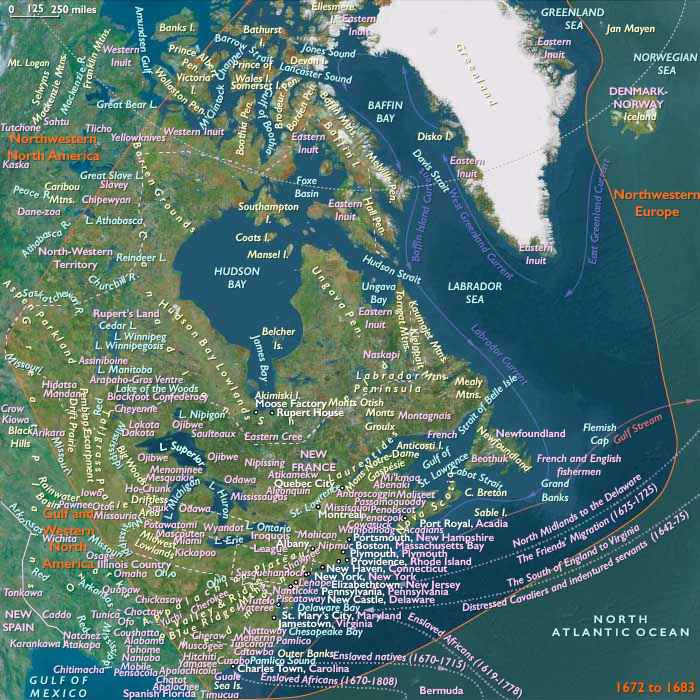
Successful English settlement on the eastern coast…
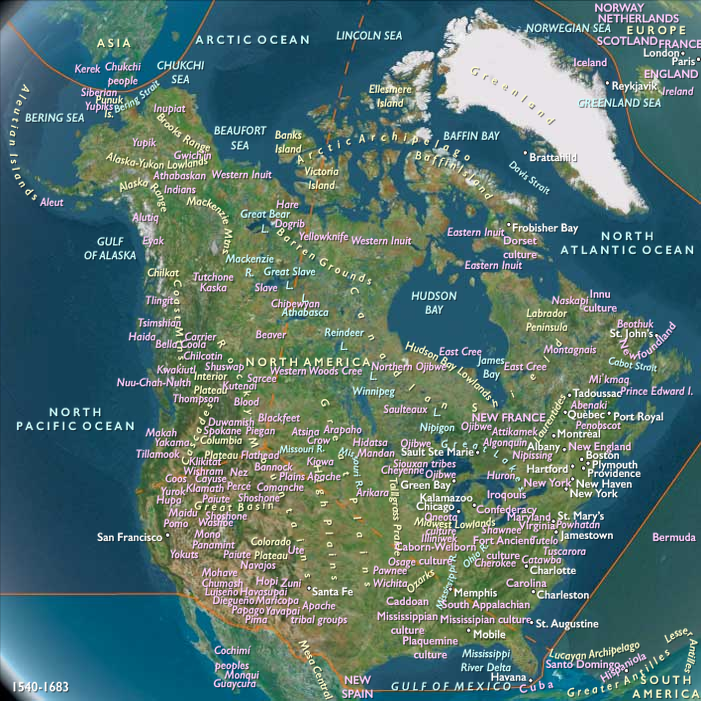
1540 CE to 1683 CE
Many settlers are dissenting Christian groups who come seeking religious freedom.
The continent's first elected legislative assembly, Virginia's House of Burgesses, created in 1619, the Mayflower Compact, signed by the Pilgrims before disembarking, and the Fundamental Orders of Connecticut, establish precedents for the pattern of representative self-government and constitutionalism that will develop throughout the American colonies.
Groups
Regions
Northern North America
View →Subregions
Northeastern North America
View →Related Events
Showing 10 events out of 50 total
Britain dispatches from Ireland two regiments under General Braddock, for whom Washington serves as aide-de-camp, in 1755.
The French and their native allies attack the Redcoats as they approach Fort Duquesne, initiating what is called the French and Indian War.
Braddock and most of his officers die in the battle, and Washington leads the survivors back to Virginia.
Britain in the same year deports en masse the French-speaking Acadians of Nova Scotia to the American colonies, because the Acadians are not observing the neutrality mandated by treaty.
The British disperse about seven thousand individuals, of a total population of eight thousand, among various colonial centers.
Many of these involuntary transplants congregate in Louisiana, becoming the ancestors of the modern Cajuns (from Acadians).
Lewis returns to Fort Cumberland on August 26 with the Acadian male prisoners.
The fate of the women and children of the region is unknown.
The British have chosen to destroy these villages first in the expulsion because they are the gateway Acadians use to provide cattle and produce to Louisbourg.
To this end, Willard assembles the men of Tatamagouche in an Acadian home.
He ensures that all the guns in the village are confiscated, then notifies the Acadian men that they are being taken prisoner.
Willard immediately begins to destroy the shipments of Acadian cattle and produce that are on vessels to be sent to Louisbourg.
Lewis burns twelve homes and the chapel on August 16; Willard continues to burn four houses and several barns in the early morning of August 17.
Under the direction of Colonel Robert Monckton, on August 10, Lieutenant-Colonel John Winslow seizes four hundred unsuspecting Acadian men who are at Fort Cumberland (formerly Fort Beauséjour).
The number of prisoners is one third of the men of the region; many of the others flee the region.
The prisoners are kept in the fort until transports arrived to deport them.
Their wives and children join them upon departure.
During the Bay of Fundy Campaign on August 28, Monckton sends Major Joseph Frye with an expedition of two hundred provincial militia from Fort Cumberland in two armed sloops, with instructions to clear Acadians settlements on the Petitcodiac River.
After setting the buildings on fire at Shepody, New Brunswick, they begin moving up the river, torching settlements and taking prisoners along the way.
Lewis discovers that the rest of Cobequid is vacant.
Most of those in the region, such as Noël Doiron, had already vacated their farms over the previous five years and made their way to Ile Saint-Jean (Prince Edward Island).
From September 23rd to 29th, Lewis lays waste to the countryside with fire.
Winslow informs them that all but their personal goods are to be forfeited to the Crown, and that they and their families are to be deported as soon as ships arrive to take them away.
The wives are ordered to feed and clothe both the prisoners and the troops.
Six days after the initial imprisonment, Winslow, fearing Acadian rebellion, moves two hundred and thirty prisoners on board ships to await deportation.