
The De Brus family had gained ownership…
1201 CE
The De Brus family had gained ownership of the lands surrounding Hartlepool, located on the North Sea about twenty-five miles (forty kilometers) southeast of modern Newcastle upon Tyne, after the Norman conquest of 106.
William the Conqueror had built Durham Castle and brought stability to the area, and the villages were first mentioned in records in 1153 when Robert de Brus, first Lord of Annandale, became Lord of Hartness.
The town's first charter was received before 1185, for which it gained its first mayor, an annual two-week fair and a weekly market.
Hartlepool has grown into an important (though still small) town, gaining a market by the beginning of the thirteenth century.
A major part of the reason for growth is that its harbor has been improved to serve as the official port of the County palatine of Durham.
Locations
Regions
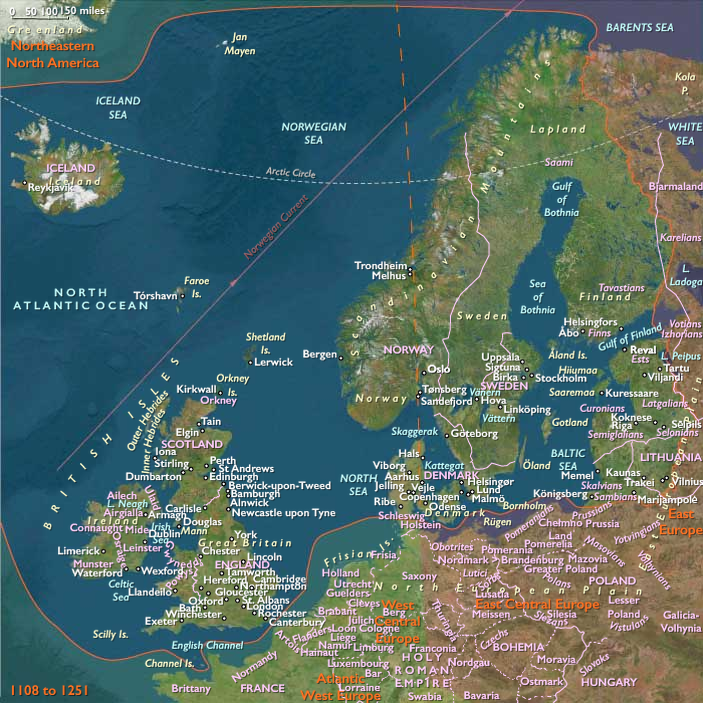
North Europe
View →Subregions

Northwest Europe
View →Related Events
No active filters.
Showing 10 events out of 47697 total
Bishop Albert I of Livonia, who had landed at the mouth of the Western Dvina (Daugava) on an arm of the Baltic Sea two years earlier with twenty three ships carrying fifteen hundred crusaders, …
…founds Riga in 1201, making it the seat of his bishopric and founds here the Brothers of the Sword.
Philip of Swabia, assisted in the German civil war that began in 1198 by southern Germans and by France, clashes with the Welf Otto of Brunswick, aided by northern Germans, the archbishop of Cologne, and the English.
Philip’s pro-Hohenstaufen, anti-Welf faction becomes known as the Waiblingens, from the name of the Hohenstaufen castle.
The new pope, Innocent III, maneuvers behind the scenes, pretending neutrality until Otto in 1201 agrees—insincerely—to donate Italian lands to the papacy.
Alexios Angelos, the son of the deposed and blinded Emperor Isaac II Angelos, makes his way in 1201 to Germany, where he works to bring about the diversion of the Fourth Crusade to Constantinople in order to restore his father to power.
The brother-in-law of the Hohenstaufen lord Philip of Swabia, Alexios entreats the crusaders to help him remove from the throne his uncle Alexios III in exchange for promises of funds, supplies, and troops to conquer Egypt, the maintenance of five hundred Western knights in the Holy Land, and submission of the Greek church to Rome.
The leadership of the coalescent Fourth Crusade passes after the death of Theobald of Champagne to Boniface of Montferrat, cousin to Philip of Swabia, who, like Philip, has married into the Greek imperial family, and brother to Conrad, the momentarily reigning King of Jerusalem, who had been the brother-in-law of Emperor Isaac.
Kaloyan has pursued his predecessors' aggressive policy against the Empire to the point of making an alliance with Ivanko, who had entered imperial service in 1196 and had become governor of Philippopolis (Plovdiv).
Another ally of Kaloyan is Dobromir Hriz (Chrysos), who governs the area of Strumica.
The coalition is quickly dissolved, as the imperial forces overcome both Ivanko and Dobromir Hriz.
Nevertheless, …
…Kaloyan conquers from the Empire Konstanteia (Simeonovgrad) in Thrace and …
…Varna in 1201, and will take most of Slavic Macedonia in 1202.
Alexios Palaiologos is instrumental in the suppression of the attempted coup by John Komnenos the Fat in July 1201.
After the rebels had seized control of most of the Great Palace, Alexios is sent by the emperor with troops and boats from the Blachernae to the eastern shore of the city.
Here they meet up with the Great Palace's guard, and clear the palace and the Hippodrome of the supporters of the usurper, who is caught and beheaded.
Alexios Mourtzouphlos is likely put in prison for his role in this affair (he is known to have been in prison in 1203), and the two Komnenos brothers, Alexios and David, seem to have fled the capital immediately after the coup's failure.
Alexios is injured in February 1201 or 1202 when the imperial tent collapses during an earthquake, but in the same summer he leads the campaign that subdues the rebellion of governor John Spyridonakes in eastern Macedonia, forcing the latter to flee to Bulgaria.
The Cathedral of Rouen: A History of Destruction and Rebuilding (4th–13th Century)
The Cathedral of Rouen, one of the most important religious centers in Normandy, has a long and turbulent history, marked by destruction, Viking raids, fires, and successive reconstructions. Originally founded as a Christian church in the late 4th century, it evolved into a major cathedral complex, which was expanded, rebuilt, and restored numerous times before taking its present Gothic form.
Early History and Viking Destruction (4th–9th Century)
- A church already existed on the site in the late 4th century, and like the cathedral at Poitiers, it became an episcopal seat.
- The cathedral was enlarged by St. Ouen in 650, reflecting Rouen’s growing importance as a religious center.
- Charlemagne visited Rouen in 769, reinforcing its status within the Frankish realm.
- However, during the Viking raids of the 9th century, the original cathedral was completely destroyed.
The Norman Rebuilding and Expansion (10th–11th Century)
- After the establishment of the Duchy of Normandy, Rollo, the Viking founder of Normandy, was baptized at the cathedral in 915 and buried there in 931.
- Duke Richard I expanded the cathedral in 950, continuing the Christianization of Norman rulers.
- Saint Romain’s Tower was added in 1035, marking the first major Romanesque reconstruction.
- Archbishop Robert II's Romanesque cathedral was consecrated in 1065, just before the Norman Conquest of England.
Gothic Reconstruction and Fires (12th–13th Century)
- The cathedral was struck by lightning in 1110, necessitating repairs.
- The transition to Early Gothic architecture began in the 12th century, with:
- Saint Romain’s Tower receiving Gothic modifications.
- The front-side porches reconstructed in the new style.
- Part of the nave rebuilt with Gothic elements.
- In 1200, a devastating fire destroyed large parts of the cathedral, leading to another major reconstruction effort.
Significance and Ongoing Reconstruction
- The rebuilding after the 1200 fire paved the way for the later High Gothic style, culminating in the monumental cathedral that stands today.
- Despite multiple disasters, Rouen Cathedral remained a symbol of Norman power and religious authority, serving as the burial place of Norman dukes and later, French royalty.
- It became a blueprint for Gothic architecture in Normandy, influencing churches throughout northern France.
The destruction and repeated reconstruction of Rouen Cathedral reflect both the instability of medieval Normandy and the determination to preserve Rouen’s religious and cultural identity. Its continued expansion after 1200 marked a turning point, transforming it into one of the most majestic Gothic cathedrals of medieval Europe.
The Jews of Worms take up arms to fight alongside the city's non-Jewish residents against an attack during the German civil war that had begun in 1197.
Jews at this time are still permitted to bear arms in various cities in Germany (although this privilege will soon be abolished).