
The Jewish community in Alexandria, seeing their…
39 CE
The Jewish community in Alexandria, seeing their interests threatened after the pogrom against them, sends an embassy to the emperor Caligula in 39 CE, asking him to reassert Jewish rights granted by the Ptolemies and confirmed by the emperor Augustus, including exemption from the duty of worshiping the emperor.
People
Commodities
Subjects
Regions
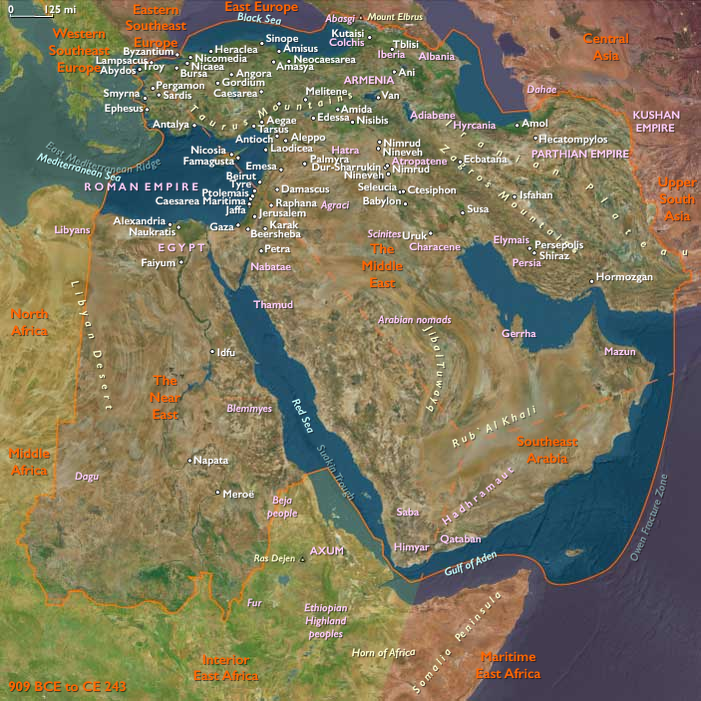
The Near and Middle East
View →Subregions
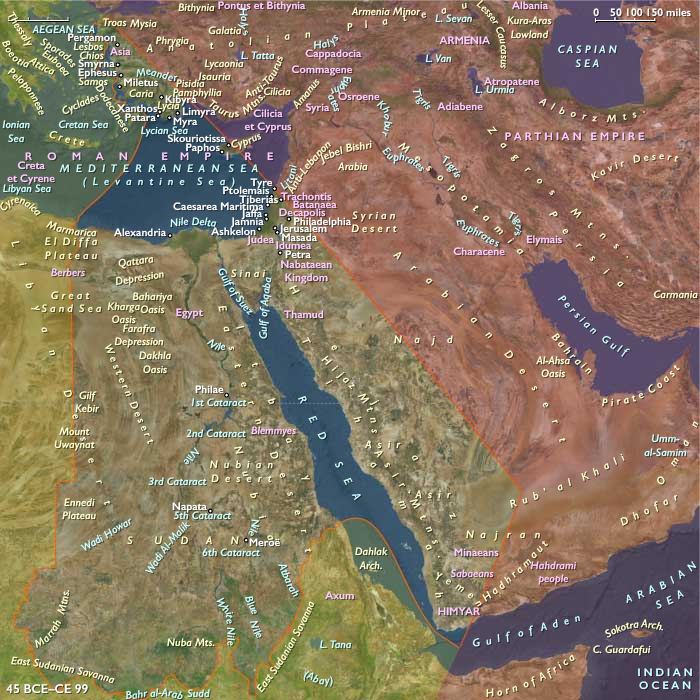
Near East
View →Related Events
No active filters.
Showing 10 events out of 61861 total
The Trung sisters, soon to become famous as rebel leaders against Chinese and eventually regarded as national heroines of Vietnam, had been born into a military family in a rural Vietnamese village.
Their father was a prefect of Mê Linh, a rural district (huyện) of present Hanoi; therefore the sisters had grown up in a house well-versed in the martial arts.
They have also witnessed the cruel treatment of the Viets by their Chinese overlords.
The Trưng sisters have spent much time studying the art of warfare, as well as learning fighting skills.
When a neighboring prefect came to visit Mê Linh, he had brought with him his son, Thi Sách, who met and fell in love with Trưng Trắc during the visit, and they were soon married.
With Chinese rule over the region of resent northern Vietnam growing extremely exacting, and the policy of forcible assimilation into the Chinese mold, Thi Sách had taken a stand against the Chinese, conspiring with other nobles to throw off the yoke of the Han dynasty, whose bureaucratic rule threatens indigenous Vietnamese feudalism.
The response of the local Chinese official was to execute him as a warning to all those who contemplate rebellion.
His death spurs his wife to take up his cause and the flames of insurrection spread.
After successfully repelling a small Chinese unit from their village in CE 39, Trưng Trắc and Trưng Nhị had assembled a large army.
Within months, they have taken back many (about 65) citadels from the Chinese, and have liberated Nam Việt.
They become queens of the country, and manage to resist subsequent Chinese attacks on Nam Việt for over two years.
Paul's conversion can be dated to 31-36 by his reference to it in one of his letters.
His conversion (or metanoia) according to the Acts of the Apostles took place on the road to Damascus, where he claimed to have experienced a vision of the resurrected Jesus, after which he was temporarily blinded. [Acts 9:1-31] [22:1-22] [26:9-24]
Luke, the author of Acts of the Apostles, likely learned of his conversion from Paul, from the church in Jerusalem, or from the church in Antioch.
In the opening verses of Romans 1, Paul provides a litany of his own apostolic claim and his post-conversion convictions about the risen Christ.
Paul's writings give some insight into his thinking regarding his relationship with Judaism.
He is strongly critical both theologically and empirically of claims of moral or lineal superiority [2:16-26] of Jews while conversely strongly sustaining the notion of a special place for the Children of Israel.
There are ongoing debates among biblical scholars as to whether Paul understood himself as commissioned to take the gospel to the Gentiles at the moment of his conversion.
After his conversion, Paul goes to Damascus, where Acts states he was healed of his blindness and baptized by Ananias of Damascus.
Paul says that it was in Damascus that he barely escaped death [2Cor. 11:32].
Paul also says that he then went first to Arabia, and then came back to Damascus. [Gal. 1:17] Paul's trip to Arabia is not mentioned anywhere else in the Bible, and some suppose he actually traveled to Mount Sinai for meditations in the desert.
He describes in Galatians how three years after his conversion he went to Jerusalem.
There he met James and stayed with Simon Peter for fifteen days. [Gal. 1:13-24].
Paul asserts that he received the Gospel not from any person, but by the revelation of Jesus Christ. [Gal. 1:11-12]
Paul claims almost total independence from the Jerusalem community and yet appears eager to bring material support to Jerusalem from the various budding Gentile churches that he has planted.
In his writings, Paul persistently uses the persecutions he claims to have endured, in terms of physical beatings and verbal assaults, to claim proximity and union with Jesus and as a validation of his teaching.
Antipas has unsuccessfully sought from Caligula the title of king.
Herodias, envious of her brother Agrippa I's success, persuades her husband to denounce him before the Emperor, but the intended victim, who is Caligula's close friend, anticipates Antipas and levies charges, partially true, against him.
Antipas confesses to planning a rebellion against Roman rule with the help of Parthia.
Caligula banishes Antipas to Gaul, where Herodias accompanies him, and her brother adds the tetrarchy of Galilee and Perea to his domains.
Caligula performs a spectacular stunt in 39 CE by ordering a temporary floating bridge to be built using ships as pontoons, stretching for over two miles from the resort of Baiae to ...
...the neighboring port of Puteoli.
It is said that the bridge is to rival that of Persian King Xerxes' crossing of the Hellespont.
Caligula, a man who cannot swim, then proceeds to ride his favorite horse, Incitatus, across, wearing the breastplate of Alexander the Great.
This act is in defiance of a prediction by Tiberius's soothsayer Thrasyllus of Mendes that Caligula had "no more chance of becoming emperor than of riding a horse across the Bay of Baiae".
Caligula's political payments for support, generosity and extravagance have exhausted the state's treasury.
Ancient historians state that Caligula began falsely accusing, fining and even killing individuals for the purpose of seizing their estates.
Historians describe a number of other desperate measures by Caligula.
In order to gain funds, Caligula asks the public to lend the state money.
Caligula levies taxes on lawsuits, marriage and prostitution, and begins auctioning the lives of the gladiators at shows.
Wills that left items to Tiberius are reinterpreted to leave the items instead to Caligula.
Centurions who have acquired property during plundering are forced to turn over spoils to the state.
The current and past highway commissioners are accused of incompetence and embezzlement and forced to repay money.
Despite financial difficulties, Caligula embarks on a number of construction projects: some for the public good, others for himself.
Josephus describes Caligula's greatest contribution as the improvement of the harbors at Rhegium and Sicily, thereby allowing grain imports from Egypt to increase.
Caligula completes the temple of Augustus and the Theater of Pompey and begins an amphitheater beside the Saepta.
He has the imperial palace expanded.
He begins the aqueducts Aqua Claudia and Anio Novus, which Pliny the Elder considered engineering marvels.
He builds a large racetrack known as the circus of Gaius and Nero and had an Egyptian obelisk (now known as the Vatican Obelisk) transported by sea and erected in the middle of Rome.
At Syracuse, he repairs the city walls and the temples of the gods.
He has new roads built and pushes to keep roads in good condition.
He has plans to rebuild the palace of Polycrates at Samos, to finish the temple of Didymaean Apollo at Ephesus and to found a city high up in the Alps.
He plans to dig a canal through the Isthmus in Greece and sends a chief centurion to survey the work.
A brief famine of an unknown size occurs, perhaps caused by this financial crisis, but according to Suetonius a result of Caligula's seizure of public carriages, according to Seneca because grain imports were disturbed by Caligula using boats for the pontoon bridge.
Relations between Caligula and the Roman Senate deteriorate; although the subject of their disagreement is unknown, a number of factors have aggravated this feud.
The Senate had become accustomed to ruling without an emperor between the departure of Tiberius for Capri in CE 26 and Caligula's accession.
Additionally, Tiberius's treason trials had eliminated a number of pro-Julian senators such as Asinius Gallus.
Caligula reviews Tiberius's records of treason trials and decides that numerous senators, based on their actions during these trials, are not trustworthy.
He orders a new set of investigations and trials.
He replaces the consul and has several senators put to death.
Suetonius reports that other senators were degraded by being forced to wait on him and run beside his chariot.
Soon after his break with the Senate, Caligula is met with a number of additional conspiracies against him.
A conspiracy involving his brother-in-law Lepidus is foiled in late 39, after Caligula makes public letters by his sisters Agrippina the Younger and Julia Livilla that detail an adulterous affair with Lepidus and a plot against the emperor.
Lepidus is executed and Caligula's sisters are exiled.
Agrippina is given the bones of Lepidus in an urn, and she carries them to Rome.
Caligula sends three daggers to the Temple of Mars the Avenger to celebrate the death.
In the Senate, Vespasian makes a motion that the remains of Lepidus be thrown away instead of buried.
The motion is carried and Lepidus is not given a proper burial.
Soon afterwards, the governor of Germany, Gnaeus Cornelius Lentulus Gaetulicus, is executed for connections to a conspiracy.
Caligula has two large ships constructed for himself, which will be recovered from the bottom of Lake Nemi during the dictatorship of Benito Mussolini.
The ships are among the largest vessels in the ancient world.
The smaller ship is designed as a temple dedicated to Diana.
The larger ship is essentially an elaborate floating palace that counts marble floors and plumbing among its amenities.
Thirteen years after being raised, the ships were burned during an attack in the Second World War, and almost nothing remains of the hulls, though many archaeological treasures remain intact in the museum at Lake Nemi and in the Museo Nazionale Romano (Palazzo Massimo) at Rome.
Han China dispatches General Ma Yuan to lead an army to strike down the Yue rebellion of the Trung sister in the region of present Vietnam.
The Han army fully suppresses the uprising in 43 and regains complete control.
The Trung sisters are captured and beheaded.
Savaria (present Szombathely), founded as the Pannonian capital in CE 45 by the Roman emperor Claudius at the intersection of two Roman roads (still extant), is made a Roman colony under the name of Colonia Claudia Savariensum (Claudius' Colony of Savarians).
The first city in the region of present Hungary, it lies close to the important "Amber Road" trade route.
Scarbantia (present Sopron) and other cities in what is today Hungary are made municipia (self-governing communities).