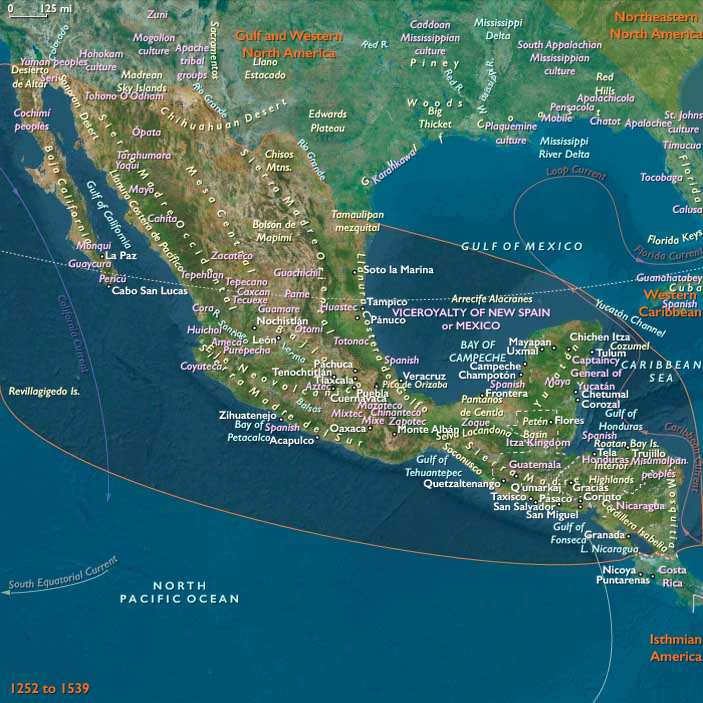
Agricultural settlements dated to about 500 BCE,…
1531 CE
Agricultural settlements dated to about 500 BCE, the Teotihuacan era, have been found in the San Juan del Río and Huimilpan areas of present Querétaro state.
The ancient city had interest and influence in the area because of its agriculture, but did not dominate it.
After the fall of this city, the Querétero area had its highest rate of development of both agriculture and social structure.
The area was inhabited early on by a number of ethnic groups, including the Otomi, Toltecs, Chichimecas, Purépechas and Mexicas.
In the tenth century, the area had experienced population shifts that did not stabilize until the twelfth century.
Much of this migration involved movement south from the Querétaro area into the Valley of Mexico.
By the end of the twelfth century, those who remained were mostly in hunter-gatherer communities and small agricultural settlements.
The region’s agriculture and minerals continued to attract the interest of more powerful neighbors.
In the fifteenth century, both the Aztec Empire and Purépecha Empire had had strong influence parts of the state, especially in the south, but the area had never been incorporated completely into either empire.
The Aztec’s interest in the area was mostly to use it as a bulwark against marauding northern Chichimeca tribes, and it never became a tributary state.
During this time, a number of new peoples entered the state, most likely from the north, primarily the Pames and their close relatives, the Chichimeca Jonaz.
The first group practiced agriculture in the valleys and the latter in the mountain areas.
When the Spanish conquered the Aztec Empire in the early sixteenth century, the largest indigenous group in the state was the Otomi, many of whom were living more or less under Purépecha rule.
This population has increased with Otomi refugees from Aztec lands fleeing the Spanish.
Another significant group is the Chichimecas.
With the fall of Tenochtitlán, then the Purépecha Empire, the Spanish have gained some control over the southern portion of the state.
However, the area is still very independent, filled with peoples who live in small isolated villages or nomadically.
There are no major cities, nor large societies here or to the north.
The conquest and colonization of Querétaro begins with the Spanish settlements at San Juan del Río, Querétaro and Huimilpan between 1529 and 1531.
Conquistador Herán Pérez de Bocanegra joins forces with a local Otomi lord from Jilotepec named Conín, also known as Fernando de Tapia, to enter Otomi areas in what is now the city of Querétaro.
There is only one major battle as part of the conquest in 1531.
The Spanish and their Indian allies are battling the local Otomi and Chichimecas at a hill now known as Sangremal, which is at this time called Ynlotepeque, and considered sacred in pre-Hispanic times.
Chronicles of this event, such as those written by Friar Isidro Félix de Espinoza, state that the natives were at the point of winning when a total eclipse of the sun occurred.
This supposedly scared the natives and the Spanish claimed to have seen an image of Saint James (the patron saint of Spain) riding a white horse carrying a rose-colored cross.
This event caused the natives to surrender.
This event is why the city is called Santiago (Saint James) de Querétaro, with James as patron saint.
A stone cross imitating the one the Spanish supposedly saw is erected on the hill, which later will be accompanied by a church and monastery.
Locations
Groups
Commodities
Subjects
Regions
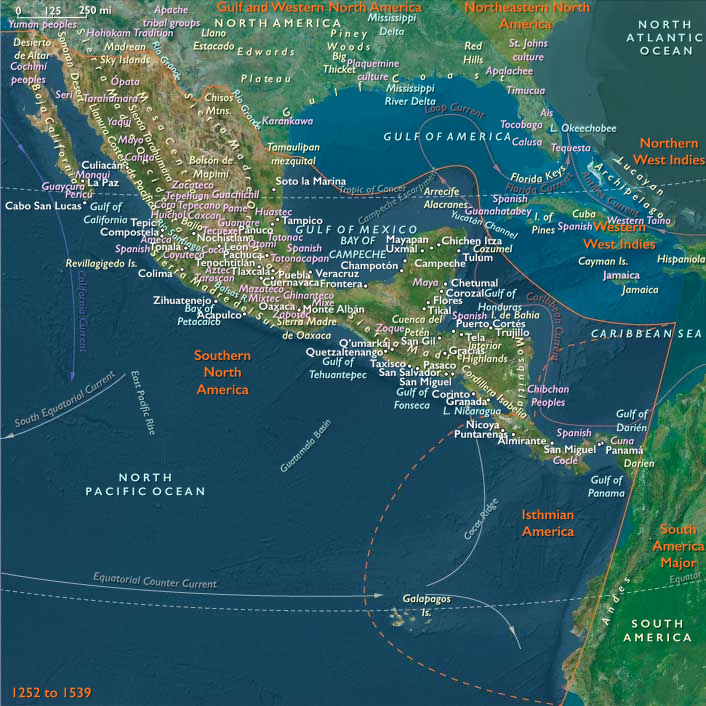
Middle America
View →Subregions