
Akbar formally makes Agra his imperial capital…
1566 CE
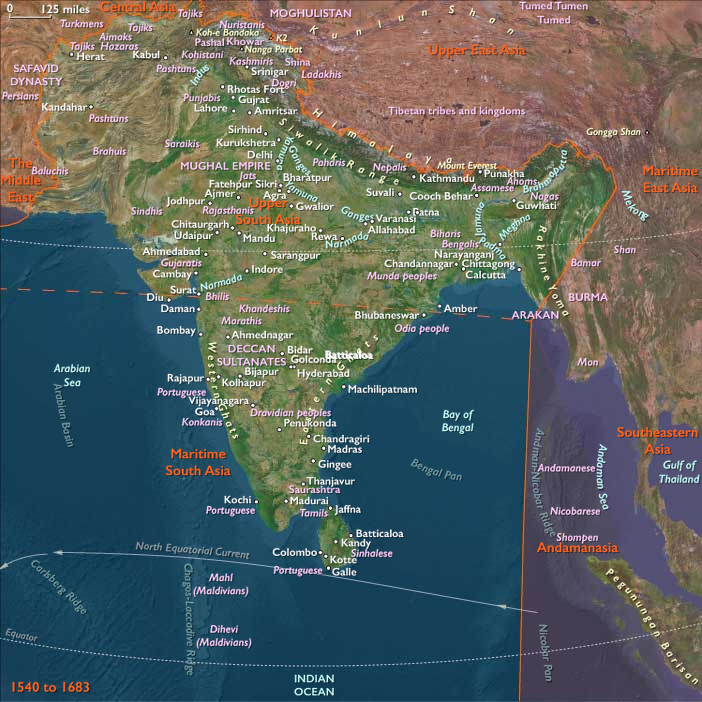
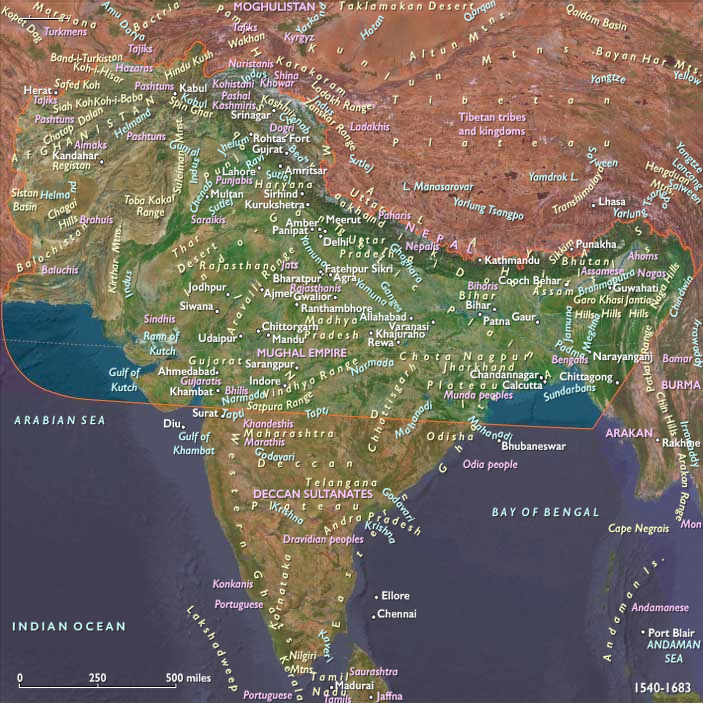
Akbar formally makes Agra his imperial capital in 1566.
Locations
Groups
Regions
South Asia
View →Subregions
Upper South Asia
View →Related Events
No active filters.
Showing 10 events out of 35630 total
Kano Eitoku, official painter to Nobunaga and Hideyoshi, develops an opulent style of mural painting that makes lavish use of gold leaf and bold decorative forms.
Eitoku executes these works, such as his 1566 screen series of birds and flowers of the four seasons for the Jukoin temple at Daitoku-ji, Kyoto, on large-scale screens and sliding doors for the castles of his patrons.
Giuseppe Arcimboldo, court painter to Maximilian II, executes a portrait in 1566 of a jurist, thought to be Geneva’s late theocrat Jean Calvin, in the grotesque style for which he has become famous: portrait heads made entirely of such objects as fruits, vegetables, flowers, fish, and books.
Ottoman sultan Suleiman in 1566 formally declares Transylvania an autonomous principality under his own suzerainty.
Transylvania enters a period of broad autonomy, although it remains a vassal state of the Sublime Porte (as the Ottoman government is called).
As a vassal, the principality pays the Porte an annual tribute and provides military assistance; in return, the Ottomans pledge to protect Transylvania from external threat.
Vijayanagar's reigning raja and Rama Raya's brother Tirumala Deva Raya retire with much of the royal treasure to Penukonda, nearly two hundred miles (three hundred and twenty kilometers) northwest of Madras.
The Battle of Talikota has not resulted in the destruction of the kingdom of Vijayanagar, although the capital city will never fully recover from the ravages it has suffered.
Tirumala attempts to rebuild the army, but ...
...much of the south and southeast is lost as the Nayakas of Madura, ...
...Tanjore (Thanjavur), and ...
...Jinji effectively assert their independence.
There is fighting on Bosnia's borders in 1566 during Suleiman’s final Hungarian campaign.
The Aegean island of Náxos has flourished since 1207 as a Venetian Duchy.
The last Latin Christian duke, Jacopo IV Crispo, had already been paying tribute to the Ottoman Sultan when Selim II deposes him in 1566.
The Sultan's appointed representative, the last Duke of the Archipelago (1566-79) is a Portuguese Jew (Marrano), Joseph Nasi, the nephew of the wealthy philanthropist Gracia Mendes Nasi.
Joseph Nasi is married to his cousin, Doña Reyna Nasi, the heiress of the House of Mendes (which had taken refuge with its wealth in Portugal after the Alhambra decree of expulsion in 1492, then removed to Antwerp; following the death of the last of the Nasi-Mendes brothers, Gracia had eventually been forced to flee to then Venice, and finally Constantinople).
Heinrich Bullinger, the successor of the reformer Huldrych Zwingli as the chief pastor at Zürich, writes the second Helvetic Confession in 1566.