
Albrecht Dürer, now fifty, had developed a…
1521 CE
Albrecht Dürer, now fifty, had developed a fever in Zeeland in 1521 during the course of his extensive tour of the Netherlands and returns to Nuremberg, the effect still lingering.
People
Groups
Topics
Subjects
Regions
Central Europe
View →Subregions
East Central Europe
View →Related Events
No active filters.
Showing 10 events out of 38741 total
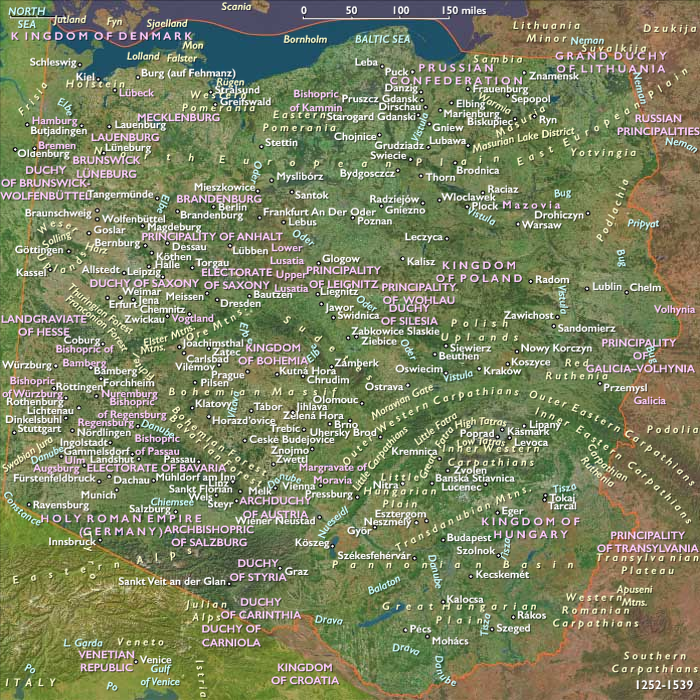
Grand Prince Vasili III of Russia had captured and imprisoned in Moscow the Grand Prince of Ryazan, Ivan V, because of his relations with the Crimean Khan Mehmed I Giray.
In 1521, Prince Ivan flees into the Grand Duchy of Lithuania.
After this, in 1521, the Ryazan Principality is merged with Muscovy.
The loss of Smolensk has been an important injury inflicted by Russia on Lithuania in the course of the Russo-Lithuanian Wars.
Moscow obtains an armistice from Poland-Lithuania in 1521 allowing Smolensk to remain under Russian control.
Only the exigencies currently experienced by Sigismund compel him to acquiesce.
Vasili receives an emissary of the neighboring Iranian Safavid Empire in 1521, sent by Shah Ismail, whose ambitions are to construct an Irano-Russian alliance against the common enemy, the Ottoman Empire.
Mehmed I Giray, son of Meñli I Giray, had inherited power over the Crimean Tatars after his father's death in 1515.
In 1520, he had signed a temporary alliance with Sigismund, King of Poland and Grand Duke of Lithuania, against Muscovy.
The Russians have managed to briefly occupy the city of Kazan several times.
In 1521, Mehmed I Giray takes Kazan, where he puts his brother, Sahib I Giray (future Khan of Crimea, also) in power.
Leading a large Tatar army, the brothers defeat Vasili III near Moscow.
Tula had been a minor fortress at the border of the Principality of Ryazan in the Middle Age.
As soon as it passed to the Grand Duchy of Moscow, a brick citadel, or kremlin, had been constructed in 1514–1521.
The Crimean Tatars renew their attacks on Tula in 1521.
Melanchthon, working with Luther in leading the Reformation, offers a systematic presentation of Lutheran teachings in his important Loci communes rerum theologicarum (“Commonplaces of Theology”), published in 1521).
Austrian painter Wolf Huber was born in Feldkirch, Vorarlberg, but by 1515 was living in Passau.
His relationship with other painters of that name living in Feldkirch is unknown, although it is widely believed that he was related to Hans Huber.
Huber's birth date has been estimated at around 1485 on the basis of several works, dated between 1510-1515, which show him to have been a well-established and mature artist by that date.
A draftsman and printmaker of the Danube school, Huber produces visionary, personal interpretations of figure and landscape, exemplified by his fragmentary and undated St. Anne Altarpiece, Lamentation, and Wings, for the Church of St. Nikolaus in Feldkirch.
Nothing is known of Huber's training, although he likely worked in a family workshop before setting out as a journeyman painter.
He likely visited northern Italy, as much of his work shows a thorough grounding in the stylistic techniques of the Italian Renaissance.
Drawings of local subjects reveal that he visited the Salzkammergut at least once.
After his relocation to Passau, Huber had in 1517 become court painter to the Duke of Bavaria, who will administer the local diocese until 1540.
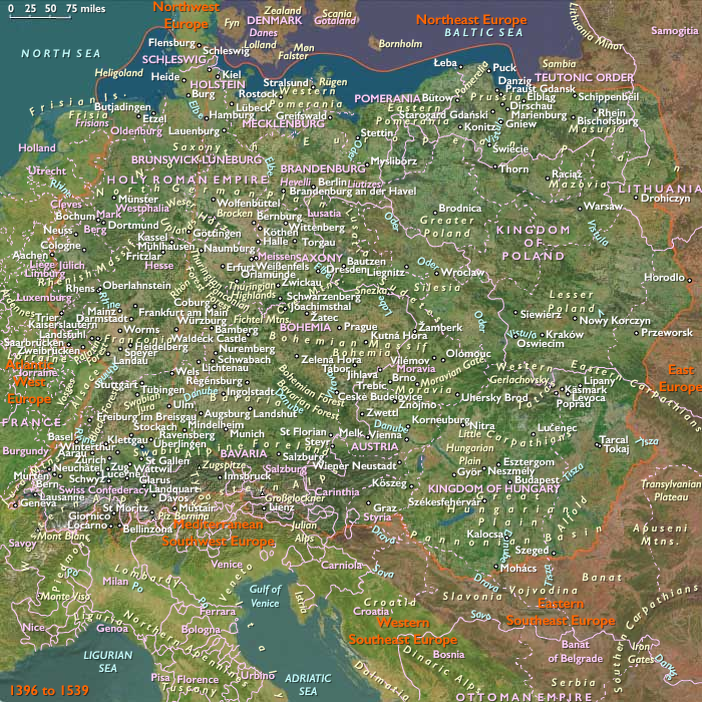
Hungary’s sickly and frivolous King Louis II, on ascending to the thrones of Hungary and Bohemia, had been adopted by Holy Roman Emperor Maximilian I.
When Maximilian died in 1519, Louis had been raised by his legal guardian, his cousin George of Brandenburg.
Louis is declared of age in 1521, but remains under control of the Hungarian magnates.
At the Hungarian court there are two parties arrayed against each other: the Magyar party under the leadership of John Zápolya, Voivode of Transylvania, and the German party under the leadership of George of Brandenburg, whose authority has been increased by the acquisition of the duchies of Ratibor and Oppeln by hereditary treaties with their respective dukes and of the territories of Oderberg, Beuthen, and Tarnowitz as pledges from the king, who cannot redeem his debts.
George makes made an arrangement with Petar Keglević, who is captain of Jajce, in 1521 and pulls back from Hungary and Croatia; this arrangement, which will be accepted by Louis II in 1526, will not be not accepted by Holy Roman Emperor Ferdinand I until 1559.
The Hungarians have long opposed Ottoman expansion in southeastern Europe, but the fall of Nándorfehérvár (present-day Belgrade, Serbia) and Szabács (now Šabac, Serbia) in 1521 means that most of southern Hungary is left indefensible.
The strongest nobles are so busy oppressing the peasants and quarreling with the gentry class in the parliament that they fail to heed the agonized calls of King Louis against the Turks.
Süleyman begins his reign with campaigns against the Christian powers in central Europe and the Mediterranean.
The weak southeastern European enemies of Süleyman's predecessors has been replaced by the powerful Habsburg dynasty, which is bolstered by the appeals of the pope throughout Europe against the menace of Islam.
Süleyman's main European ally is France, which seeks to use Ottoman pressure in the south to lessen the pressure of the Habsburgs on its eastern frontiers.
Hungary has suffered political, economic, and military decline during the regime of Vladislav (Ulászló II) Jagiello (reigned 1490–1516) and the regency in the name of his son Louis II.
When the young king is declared of age to rule on Dec. 11, 1521, Süleyman demands tribute.
When Louis refuses to pay, insulting the Turkish ambassador for good measure, the Turks advance toward Hungary, capturing the fortresses of Sabac and …