
Alexander Jannaeus, whose reign over Judea is…
93 BCE
Alexander Jannaeus, whose reign over Judea is long and largely filled with wars, imposes his rule rigorously over an increasingly large area, including both the cities of the coast and the area east of the Jordan River.
Still more clearly than Hyrcanus I, he attests the change in direction and aim of the Hasmonean house.
He is the bitter enemy of the Pharisees, he hires Greek mercenaries, his coins bear Greek as well as Hebrew legends, and his title on them is simply “King Alexander”.
During the Hasmonean period, the Sadducees and Pharisees functione primarily as political parties.
The Sadducees, are avid supporters of Jannaeus.
The Pharisaic opposition to Jannaeus had continued with his marriage to his brother’s widow, which is forbidden by Torah law.
Furthermore, Jannaeus has established himself as a ruler concerned mainly with conquests rather than his religious obligations.
Although the Pharisees had opposed the wars of expansion of the Hasmoneans and the forced conversions of the Idumeans, the political rift between them became wider when Pharisees demanded that the Hasmonean king choose between being king and being High Priest.
In response, the king openly sided with the Sadducees by adopting their rites in the Temple.
One year during the Jewish holiday of Sukkot, Jannaeus, while officiating as the High Priest (Kohen Gadol) at the Temple in Jerusalem, had demonstrated his support of the Sadducees by denying the law of the water libation.
The crowd had responded with shock at his mockery and showed their displeasure by pelting Alexander with the etrogim (citrons) that they were holding in their hands.
Unwittingly, the crowd had played right into Alexander's hands: he had intended to incite the people to riot and his soldiers fell upon the crowd at his command.
The soldiers killed more than six thousand people in the Temple courtyard.
This incident during Tabernacles was a major factor leading up to the Judean Civil War by igniting popular opponents of Jannaeus.
A Qumran document sheds further light on another opponent of Jannaeus.
The scroll 4Q390 was written by an adversary of Jannaeus seeking popular support to overthrow the Hasmonean King.
The author called for an end to the dispute between Jannaeus and the Pharisees.
According to the author, the only acceptable solution was an end to the Hasmonean Priesthood and secular control.
The Judean Civil War initially began after the conquest of Gaza by Jannaeus.
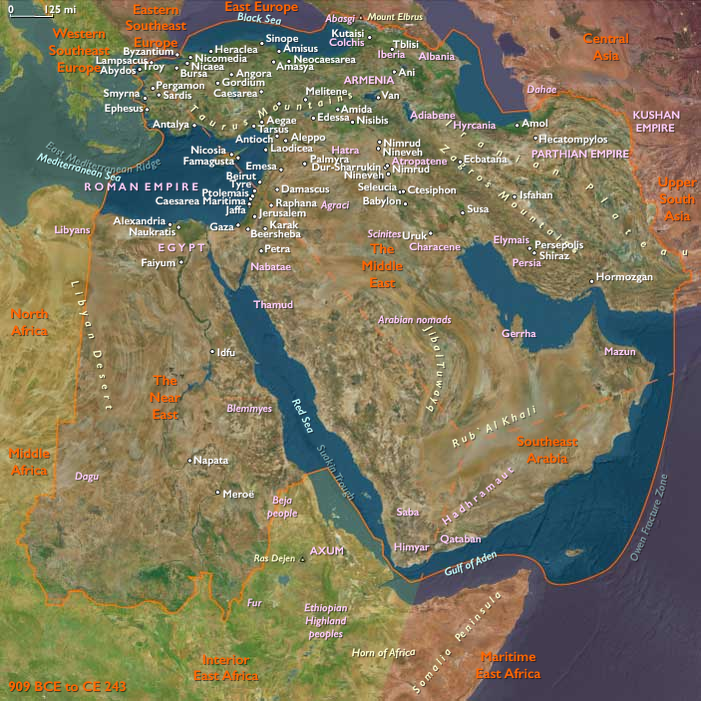
Due to Jannaeus’ victory at Gaza, the Nabatean kingdom no longer controls their trade routes to Rome and Damascus.
Therefore Nabatean king Obodas I launches an attack on the Hasmonean state in the Golan.
Potentially, the war with the Nabateans is the last straw against a warmongering king and an incompetent High Priest.
After Defeated in battle against Obadas, Jannaeus returns to fierce Jewish opposition in Jerusalem.
A civil war breaks out between Pharisaic-supported Jewish rebels and Jannaeus.
Groups
Topics
Commodities
Subjects
Regions
The Near and Middle East
View →Subregions
