
Ali Bey flees to Acre to shelter …
Years: 1771 - 1771
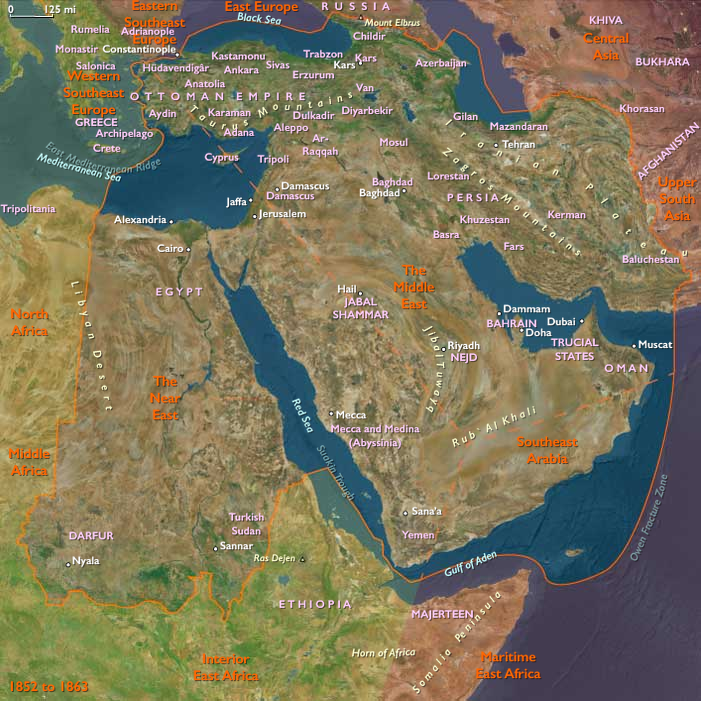
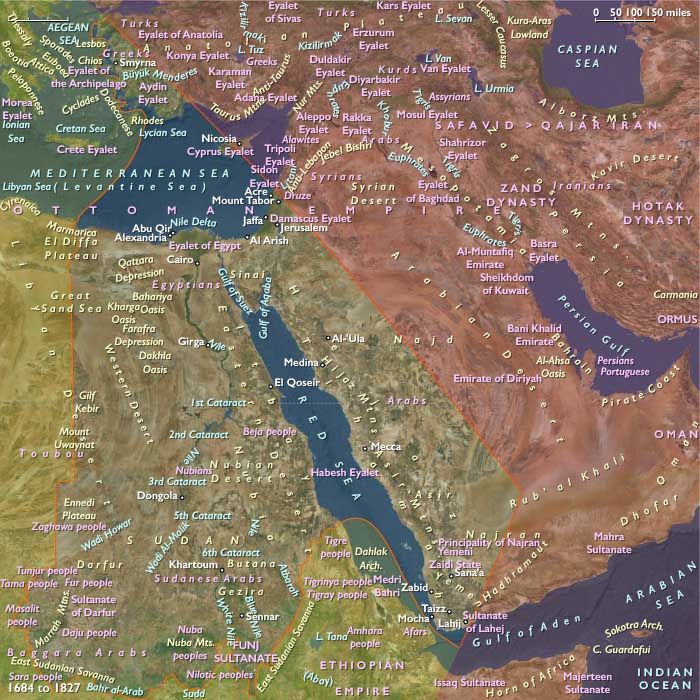
Ali Bey flees to Acre to shelter under Daher's protection when Abu al-Dhahab and his mutinous troops return from Syria to Egypt.
Locations
People
Groups
- Austria, Archduchy of
- Crimean Khanate
- Ottoman Empire
- Egypt, Ottoman eyalet of
- Polish-Lithuanian Commonwealth (Commonwealth of the Two Nations)
- Habsburg Monarchy, or Empire
- Russian Empire
Topics
Commodoties
Subjects
Regions
Subregions
Related Events
Filter results
Showing 10 events out of 25937 total
The city of Chengde in Hebei had been chosen by the Kangxi Emperor in 1703 as the location for his summer residence.
Constructed throughout the eighteenth century, the Mountain Resort has been used by both the Yongzheng and Qianlong emperors.
Since the seat of government follows the emperor, Chengde is a political center of the Chinese empire during these times.
The elaborate Mountain Resort features large parks with lakes, pagodas, and palaces ringed by a wall.
Outside the wall are the Eight Outer Temples, built in varying architectural styles drawn from throughout China.
The best-known of these is the Putuo Zongcheng Temple, on which construction is completed in 1771, during the reign of the Qianlong Emperor.
Built to resemble the Potala Palace in Lhasa, Tibet, it represents a fusion of Chinese and Tibetan architectural styles.
The temple complex covers a surface area of some 220,000 square meters, making it one of the largest in China.
Many of its halls and pavilions are adorned with copper and gold tiled roofs, adding to the splendor of the site.
Emperor Go-Momozono, who had become Crown Prince in 1768, had been ceded the throne in January 1771 by his aunt, Empress Go-Sakuramachi.
The Emperor has always been sickly, and in 1779, he dies at the age of just twenty-two.
Because his only child is a daughter, Princess Yoshiko, the dying emperor had hurriedly adopted a son from the Kan'in branch of the Imperial Family who becomes Emperor Kōkaku.
Approximately five-sixths of the Torghut tribe had followed Ubashi Khan.
Most of the Khoshuts, Choros and Khoits had also accompanied the Torghuts on their journey to Dzungaria.
The Dörbet tribe, by contrast, had elected not to go at all.
The Kalmyks who resettle in Qing territory became known as Torghuts.
While the first phase of their movement becomes the Old Torghuts, the Qing call the later Torghut immigrants "New Torghut".
The size of the departing group has been variously estimated between one hundred and fifty thousand and four hundred thousand people, with perhaps as many as six million animals (cattle, sheep, horses, camels and dogs).
Beset by raids, thirst and starvation, approximately eighty-five thousand survivors make it to Dzungaria, where they settle near the Ejin River with the permission of the Qing Manchu Emperor.
The Torghuts are coerced by the Qing into giving up their nomadic lifestyle and to take up sedentary agriculture instead as part of a deliberate policy by the Qing to enfeeble them.
They prove to be incompetent farmers and they become destitute, selling their children into slavery, engaging in prostitution, and stealing, according to the Manchu Qi-yi-shi.
Child slaves are in demand on the Central Asian slave market, and Torghut children are sold into this slave trade.
The Tsarist government has also gradually chipped away at the autonomy of the Kalmyk Khanate.
These policies, for instance, have encouraged the establishment of Russian and German settlements on pastures the Kalmyks use to roam and feed their livestock.
In addition, the Tsarist government had imposed a council on the Kalmyk Khan, thereby diluting his authority, while continuing to expect the Kalmyk Khan to provide cavalry units to fight on behalf of Russia.
The Russian Orthodox church, by contrast, has pressured many Kalmyks to adopt Orthodoxy.
By the mid-seventeenth century, Kalmyks are increasingly disillusioned with settler encroachment and interference in their internal affairs.
In the winter of 1770-1771, Ubashi Khan, the great-grandson Ayuka Khan and the last Kalmyk Khan, decides to return his people to their ancestral homeland, Dzungaria, now under control of the Qing dynasty.
The Dalai Lama is contacted to request his blessing and to set the date of departure.
After consulting the astrological chart, the Dalai Lama sets the return date, but at the moment of departure, the weakening of the ice on the Volga River permits only those Kalmyks who roam on the left or eastern bank to leave.
Those on the right bank are forced to stay behind.
Catherine the Great, after failing to stop the flight, abolishes the Kalmyk Khanate, transferring all governmental powers to the Governor of Astrakhan.
The title of Khan is abolished.
The highest native governing office remaining is the Vice-Khan, who also is recognized by the government as the highest ranking Kalmyk prince.
By appointing the Vice-Khan, the Tsarist government is now permanently the decisive force in Kalmyk government and affairs.
Scheele obtains hydrofluoric acid in 1771 in an impure state by heating fluorspar, now known to be a compound of fluorine, with concentrated sulfuric acid in a glass retort, which is greatly corroded by the product.
Subsequent experiments with the substance employ vessels made of metal.
The Wiener Börse, also known as the Vienna Stock Exchange, one of the world's oldest exchanges, is founded in 1771 during the reign of Empress Maria Theresa of Austria in order to provide a market for state issued bonds.
Daher al-Omar, the Arab-Bedouin ruler of the Galilee district of the southern Levant, has helped Ali Bey al-Kabir, the Mamluk usurper of Egypt, by blocking an Ottoman force heading south to suppress the rebellion in Egypt.
Ali Bey had sent a force of thirty thousand that conquers most of Palestine and Damascus from November 1770 to June 1771, his occupation of Syria reconstituting, if temporarily, the Mamluk state that had disappeared in 1517.
After the troops arrive at Damascus (with help from Daher) in 1771, the Egyptian commander of the troops, Abu al-Dhahab, refuses to continue fighting against the Ottomans, and turns against Ali Bey.
The Russian fleet provides critical aid in the battle of Sidon and it bombards and occupies Beirut.
The Russians surrender Beirut to the pro-Ottoman emir of Mount Lebanon, Yusuf al-Shihab, only after being paid a large ransom.
His father György Küzmics (1703–1769) was a tailor.
From 1733 to 1747 he went to school in Sopron and in Győr, and studied at the lyceum in Pozsony (now Bratislava).
He later became a Lutheran pastor and teacher in the Slovene-speaking towns of Nemescsó (1751–1755) and Surd (1755–1779), in what is today Zala County, but was then part of Somogy, an area where many Slovene families settled in the seventeenth and eighteenth centuries.
He also writes cathechisms and schoolbooks, and he translates the New Testament into Prekmurje Slovene.
The translated text, Nouvi zakon ali testamentom, is published in the German town of Halle in 1771.
Years: 1771 - 1771
Locations
People
Groups
- Austria, Archduchy of
- Crimean Khanate
- Ottoman Empire
- Egypt, Ottoman eyalet of
- Polish-Lithuanian Commonwealth (Commonwealth of the Two Nations)
- Habsburg Monarchy, or Empire
- Russian Empire
