
Alp Arslan defeats Qutalmish for the throne …
Years: 1064 - 1064
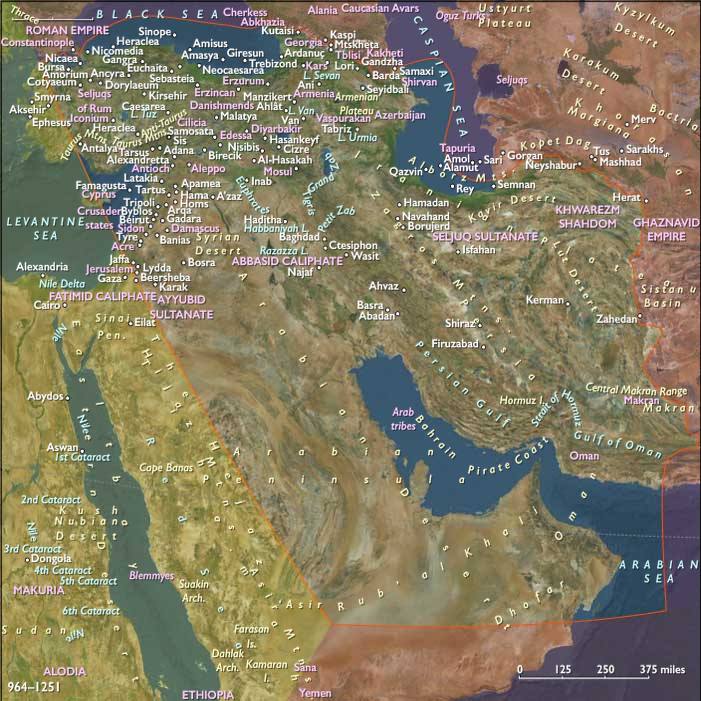
Alp Arslan defeats Qutalmish for the throne and succeeds on April 27, 1064, as the second sultan of Great Seljuq, thus becoming sole monarch of Persia from the river Oxus to the Tigris.
Alp Arslan successfully fights off the challenge of the Ghaznavids of Afghanistan and other dynasties that have arisen after the decline of the Abbasid caliphate.
In consolidating his empire and subduing contending factions, Arslan is ably assisted by Nizam al-Mulk, his vizier, and one of the most eminent statesmen in early Muslim history.
With peace and security established in his dominions, Arslan convokes an assembly of the states and declares his son Malik Shah I his heir and successor.
After restoring unity to Iran and Iraq, he asserts his authority to the borders of Fatimid Egypt and Greek Anatolia.
Born outside the traditional Muslim countries that he is later to govern, Alp Arslan leaves their administration to his vizier, Nizam al-Mulk.
Alp-Arslan decides to go to Egypt to crush the Isma'ili Fatimid Shi'a heresy, which the 'Abbasid Sunnite caliphate at Baghdad, whose protector he is, will not accept.
On the other hand, he is aware of the necessity of keeping his influence over the Turkmens, which is essential to his military strength.
The Turkmens are interested above all in the success of the holy war against the infidels and in raids on Christian territory.
With the hope of capturing Caesarea Mazaca, the capital of Cappadocia, he places himself at the head of the Turkish cavalry, crosses the Euphrates, and enters and invades the city.
Along with Nizam al-Mulk, he then marches into Armenia and Georgia.
Locations
People
Groups
- Persian people
- Armenian people
- Oghuz Turks
- Islam
- Armeniac Theme
- Muslims, Sunni
- Abbasid Caliphate (Baghdad)
- Mazyadid (Al-Mazeedi) state of Iraq
- Ghaznavids
- Turkmen people
- Fatimid Caliphate
- 'Uqaylid Dynasty of Mosul
- Georgia, (Bagratid) Kingdom of
- Mirdasid dynasty
- Armenia, Principalities of
- Seljuq Empire (Isfahan)
- Christians, Eastern Orthodox
- Roman Empire, Eastern: Doukid dynasty
Topics
Commodoties
Subjects
Regions

Subregions
Years: 1064 - 1064
Locations
People
Groups
- Persian people
- Armenian people
- Oghuz Turks
- Islam
- Armeniac Theme
- Muslims, Sunni
- Abbasid Caliphate (Baghdad)
- Mazyadid (Al-Mazeedi) state of Iraq
- Ghaznavids
- Turkmen people
- Fatimid Caliphate
- 'Uqaylid Dynasty of Mosul
- Georgia, (Bagratid) Kingdom of
- Mirdasid dynasty
- Armenia, Principalities of
- Seljuq Empire (Isfahan)
- Christians, Eastern Orthodox
- Roman Empire, Eastern: Doukid dynasty
Topics
Commodoties
Subjects
Regions
Subregions