
Near East (532–675 CE): Rise and Expansion …
Years: 532 - 675
Near East (532–675 CE): Rise and Expansion of Islam
The Near East from 532 to 675 CE experiences profound transformations, primarily driven by the emergence and rapid expansion of Islam, a new monotheistic faith that challenges and reshapes the region's religious, political, and social landscapes.
Early Byzantine Context and Christian Developments
The period begins with Christian glorification continuing under Byzantine emperor Justinian (527–565 CE), who rebuilds the Church of the Resurrection (Holy Sepulchre) in Jerusalem and establishes many churches, monasteries, and hospices. Christianity spreads into Nubia around 540 CE, notably through Monophysite missionaries sent by Empress Theodora, creating strong ecclesiastical links with Coptic Christianity in Egypt.
In 541 CE, the Plague of Justinian, first reported by historian Procopius from Pelusium near Suez, severely affects the region, contributing to the weakening of Byzantine rule.
Prelude to Islamic Expansion
Arabia experiences significant changes with the Great Dam of Marib in Yemen suffering catastrophic breaches in 570 or 575 CE, leading to large-scale migrations and signaling the decline of South Arabian kingdoms. In 570 CE, the Prophet Muhammad is born in Mecca, marking a pivotal turning point in Arabian history.
King Khosrow I of Persia intervenes in South Arabia around this period, establishing control over Yemen and challenging Byzantine influence in the Red Sea region.
Birth and Rapid Spread of Islam
In 610 CE, Muhammad begins preaching a monotheistic faith, Islam, based on revelations compiled into the Quran, a sacred text believed by Muslims to be the verbatim word of God. Central tenets include the Five Pillars of Islam—the shahada (declaration of faith), prayer (salat), almsgiving (zakat), fasting (sawm), and pilgrimage to Mecca (hajj).
Muhammad's teachings quickly gain followers, leading to the establishment of a unified Islamic state. After his death in 632 CE, his successors, known as caliphs, expand Islamic authority across Arabia and beyond.
Islamic Conquests and Administration
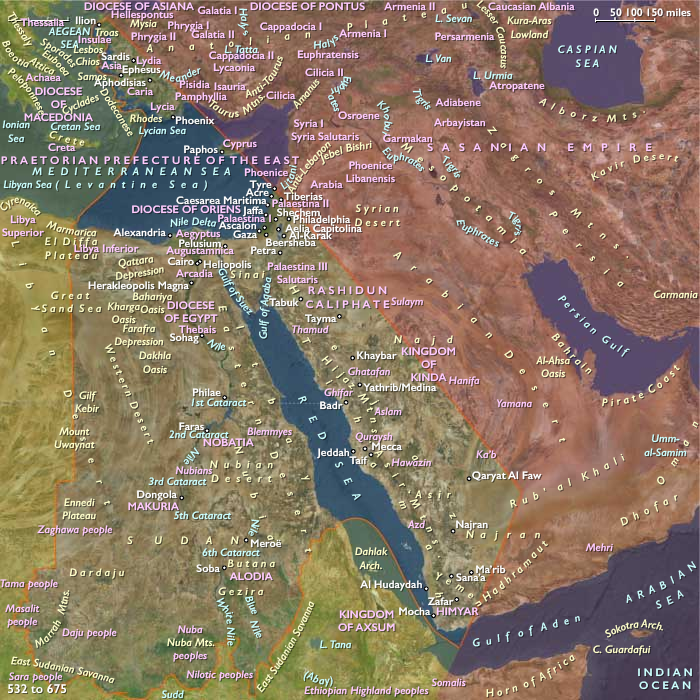
The Rashidun Caliphate rapidly expands into Syria, Palestine, Egypt, and Persia. In 636 CE, under General Khalid ibn al-Walid, the Arabs decisively defeat Byzantine forces at the Battle of Yarmouk, leading to the capture of Jerusalem in 638 CE. Caliph Umar designates Jerusalem as the third holiest city in Islam, after Mecca and Medina.
Islamic forces, under Amr ibn al-As, invade Egypt in 639 CE, capturing the fortress of Babylon (Bab al-Yun) in 641 CE. Alexandria surrenders in 641 CE, and the Arabs establish a new capital at Al-Fustat (present-day Old Cairo). Under Arab rule, Coptic Christians enjoy religious autonomy, marking a stark contrast with previous Byzantine persecution.
Islamic armies enter Nubia in 642 and again in 652 CE, but the resilient Nubians force them to withdraw after an armistice. Subsequent treaties establish peaceful relations, facilitating trade and intermarriage, contributing gradually to the region's arabization.
Societal Transformation and Religious Integration
Islamic rule introduces sharia (Islamic law), governing spiritual, ethical, and social aspects of life, and defines relationships with non-Muslim communities under the dhimmi system, permitting religious freedom in exchange for taxes and political allegiance.
The conquest significantly reshapes the linguistic and cultural identity of the region. Arabic gradually supplants Greek, Aramaic, and Coptic languages, embedding Islamic culture deeply into the societal fabric.
Consolidation under the Umayyads
After the First Islamic Civil War (Fitna), Mu'awiya I founds the Umayyad Caliphate in 661 CE, establishing its capital in Damascus. Under Umayyad rule, Islamic influence extends further into North Africa, establishing the city of Kairouan in 670 CE and initiating naval confrontations with Byzantium, including early raids on Constantinople from 668 to 674 CE.
Legacy of the Age
The period 532 to 675 CE fundamentally reshapes the Near East, transforming it into a predominantly Islamic region and laying the groundwork for the expansive Islamic civilization that profoundly influences subsequent historical, religious, and cultural developments across the Mediterranean, Africa, and beyond.
People
- 'Amr ibn al-'As
- Justinian I
- Khalid bn al-Walid
- Khosrau I
- Muawiyah I
- Muhammad
- Procopius
- Theodora
- Umar
Groups
- Nubians
- Arab people
- Yemen, Classical
- Egypt (Roman province)
- Christianity, Nicene
- Egypt, Diocese of
- Christians, Monophysite
- Coptic Orthodox Church of Alexandria
- Greeks, Medieval (Byzantines)
- Egypt, Eastern Roman (Byzantine)
- Islam
- Rashidun Caliphate
- Egypt in the Middle Ages
- Umayyad Caliphate (Damascus)
Topics
- Plague of Justinian
- Arab-Byzantine Wars
- Byzantine-Muslim War of 633-42
- Yarmouk, Battle of
- Muslim Conquest of Egypt
- Fitna, First, or First Islamic Civil War
Subjects
Regions
Subregions
Related Events
Showing 10 events out of 58080 total
Years: 532 - 675
People
- 'Amr ibn al-'As
- Justinian I
- Khalid bn al-Walid
- Khosrau I
- Muawiyah I
- Muhammad
- Procopius
- Theodora
- Umar
Groups
- Nubians
- Arab people
- Yemen, Classical
- Egypt (Roman province)
- Christianity, Nicene
- Egypt, Diocese of
- Christians, Monophysite
- Coptic Orthodox Church of Alexandria
- Greeks, Medieval (Byzantines)
- Egypt, Eastern Roman (Byzantine)
- Islam
- Rashidun Caliphate
- Egypt in the Middle Ages
- Umayyad Caliphate (Damascus)
Topics
- Plague of Justinian
- Arab-Byzantine Wars
- Byzantine-Muslim War of 633-42
- Yarmouk, Battle of
- Muslim Conquest of Egypt
- Fitna, First, or First Islamic Civil War
Subjects
Regions
Subregions