
Amsterdam, with the Netherlands freed from Spanish…
1605 CE
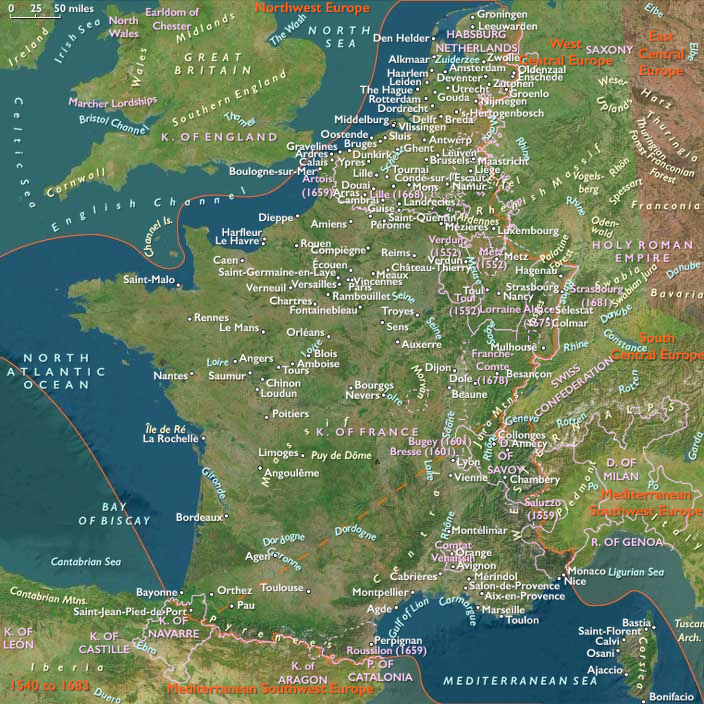
Amsterdam, with the Netherlands freed from Spanish rule, has become a particularly important center for the Marranos, who by the beginning of the seventeenth century are firmly established in Holland and have returned to the faith that they had had to abandon.
Regions
West Europe
View →Subregions

Atlantic West Europe
View →Related Events
No active filters.
Showing 10 events out of 33752 total
The Dutch East India Company in Bantam dispatches Dutch navigator Willem Janszoon, or Jansz, to investigate New Guinea’s potential in gold and spices in 1605.
Janszoon, of whose early life nothing is known, is first recorded as entering into the service of the Oude compagnie, one of the predecessors of the Dutch East India Company (VOC), as a mate aboard the Hollandia, part of the second fleet dispatched by the Dutch to the Dutch East Indies in 1598.
On May 5, 1601, he had again sailed for the East Indies as master of the Lam, one of three ships in the fleet of Joris van Spilbergen.
Janszoon had sailed from the Netherlands for the East Indies for the third time on December 18, 1603, as captain of the Duyfken (or Duijfken, meaning “Little Dove”), one of twelve ships of the great fleet of Steven van der Hagen.
Once in the Indies, Janszoon had been sent to search for other outlets of trade, particularly in “the great land of New Guinea and other East and Southlands.”
Ekathosarot succeeds his brother Naresuan, who has died during his campaigns to subjugate the Shans in 1605.
Coincident with Ekathosarot’s accession, the Ayutthaya kingdom has reached the maximum extent.
However, immediately after the coronation, the Burmese principality of Lanna, an Ayuttayan tributary for the past several years, breaks away from Siamese control.
Chodkiewicz, despite his small forces and limited supplies, more than holds his own against the Swedes.
He has instituted a new form of warfare based upon his use of the elite hussar cavalry and consequently the Swedes are repeatedly defeated in the open field.
First the Poles attack Swedish cavalry, after which they usually attack the demoralized Swedish infantry, which is unable to retreat at all, and the Poles usually annihilate whole formations of this infantry.
The Swedes again spend large sums of money in 1605 to conscript a new massive army.
The Riksdag spends much cash on conscripting new formations.
Moreover, Russian tsar Boris Godunov has given the Swedes much financial help, likely attempting to keep both Sweden and the Commonwealth busy during the Time of Troubles.
The Swedes are able to hire large numbers of mercenaries, as well as hiring many siege engineers from all over Europe.
Bocskay, a devout Protestant, seeks Turkish aid, and his army of wild herdsmen (hajduks) helps the Turkish armies in driving Basta and the Habsburg forces out of Transylvania.
As a reward, ...
...the Hungarian Diet in 1605 elects Bocskay prince of Transylvania.
The Ottomans seize Esztergom, ...
...Visegrad, ...
...Veszprem, and ...
...Palota in 1605, regaining territories lost through 1595.
Bocskay is recognized as prince of Transylvania by the fifteen-year-old sultan Ahmed, who sends him a magnificent jeweled crown made in Persia.
Although Bocskay refuses to assume the title of king, he makes skillful use of the Turkish alliance.
The ailing emperor, faced with the possible loss of Hungary and strongly urged by his brother the archduke Matthias, enters into negotiations with Bocskay.