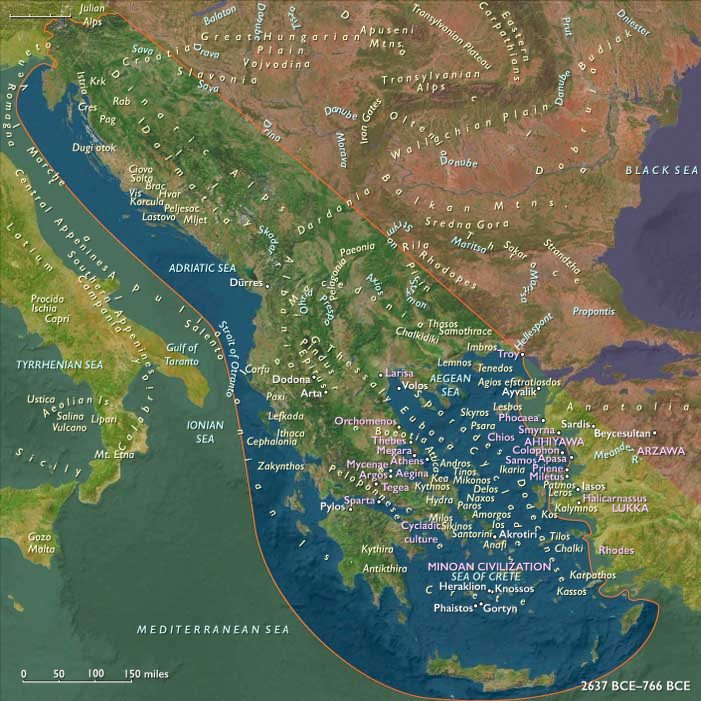
An augmentation of the Mycenaean systems of…
1197 BCE to 1054 BCE
An augmentation of the Mycenaean systems of defense, a sign of increasing insecurity, can be seen by LH III B2, dated at 1230 BCE.
This does not seem to have been a period of crisis, as these levels have yielded archaeological material that indicating a degree of wealth equivalent to that of previous periods.
The end of this period, to 1190 BCE, has nevertheless been marked by a number of destructions in the greater part of the Mycenaean sites on mainland Greece.
Mycenaean dominance collapses during the early twelfth century.
Within a short time, all the palaces of southern Greece are burned, including that at Mycenae, as a part of the general Bronze Age collapse, although Athens’s Acropolis and Thebes’s Cadmeia escape destruction.
This is traditionally attributed to a Dorian invasion of Greeks from the north, although some historians now doubt that such an invasion took place.
Displaced populations escape to former colonies of the Mycenaeans in Anatolia and elsewhere, where they come to speak the Ionic dialect.
A further theory, mentioned by Egyptian hieroglyphs, is that the destruction of the palaces is related to the attacks of the mysterious Sea Peoples who destroyed the Hittite Empire and then successively attacked the Nineteenth and Twentieth dynasties of Egypt.
Other theories have been that a drought caused the Mycenaean decline; there climatological evidence for this rests largely on eighteen years of arrested global tree growth from 1158 to 1140 BCE, possibly caused by the Hekla 3 eruption of the Hekla volcano in Iceland.
Amos Nur argues that earthquakes played a major role in the destruction of Mycenae and many other cities at the end of the Bronze Age.
However, no conclusive evidence has been brought forward to confirm any theory of why the Mycenaean citadel and others around it fell at this time.
Mycenae had, in the thirteenth century, been the probable capital of a miniature empire controlling most of the Aegean.
Shortly before or after the events associated with the Trojan War, the Mycenaeans themselves may have been overwhelmed by the first wave of Achaeans, as Homer calls them, to invade from the north and settle in their lands.
The Dorians, the last wave of Greeks to enter the Peloponnesus, are other possible agents of destruction, but they apparently arrived more than a century after the destruction of the palaces.
Alternative agents are predatory raiders such as the Sea Peoples, who might, with concomitant drought and consequent famine, have created a vacuum that the Dorians afterward filled.
Some scholars propose wars between the Mycenaean states as the basis for the destructions, in the wake of which Mycenaean refugees from the Peloponnesus migrate to the Cyclades, to Crete, and to Cyprus.
At the same time, barbarous peoples from beyond the northern frontiers of the Mycenaean world evidently begin to settle in the southern parts of Greece in the twelfth century BCE, introducing new burial customs and fashions in dress.
Mixing with remnants of the indigenous population and adopting some of the Mycenaean civilization while introducing new gods, they replace the Minoan-Mycenaean nature gods with such Aryan deities as Zeus, Hermes, and Apollo.
Greece and Greek legend calls this invasion “the return of the Heraclids,” as the first of three Dorian tribes—Hylleis, Dymanes, and Pamphyloi—were traditionally ruled by Heracles’s son Hyllus.
The Dorians settle in Crete and in much of the Peloponnesus, principally Messenia, Laconia, and the Argolid.
Greek artisans begin designing a variety of decorative furniture from native olive, yew, and cedar wood turned, carved, painted, and inlaid with precious stones.
Cast bronze legs in animal form are applied to chairs and tables whose forms are low and curvilinear.
Whatever the cause of Mycenae’s collapse by the LH IIIC period (whose latest phase is also termed "Submycenaean"), Mycenae is no longer a major power.
Pottery and decorative styles are changing rapidly as art and artisanry decline.
Although the settlement is much reduced in size, the citadel remains occupied, but will never regain its earlier importance.
Although some sites, such as Mycenae and Tiryns, are reoccupied, but on a much smaller scale; others, like Pylos, disappear forever. (The precise circumstances of these events are unknown, but historians speculate that the top-heavy system, whose elite had based their power solely on military might, contained the seeds of its own destruction.)
Groups
Topics
Commodities
Subjects
Regions
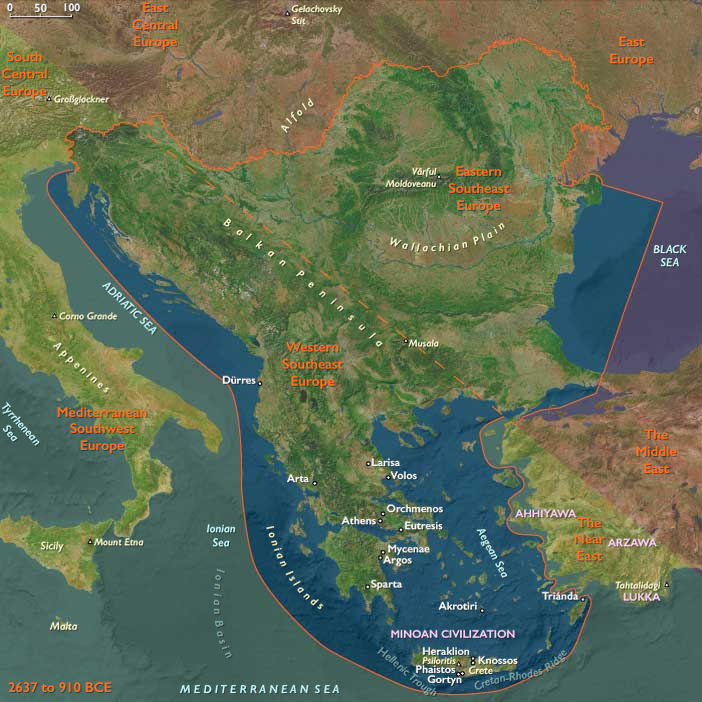
Southeast Europe
View →Subregions