An earthquake shakes many places in northern…
717 CE
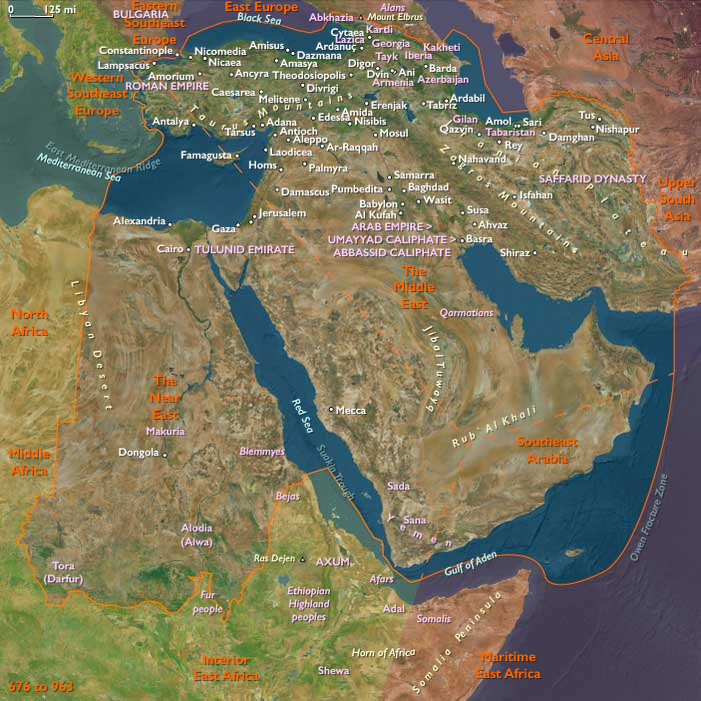
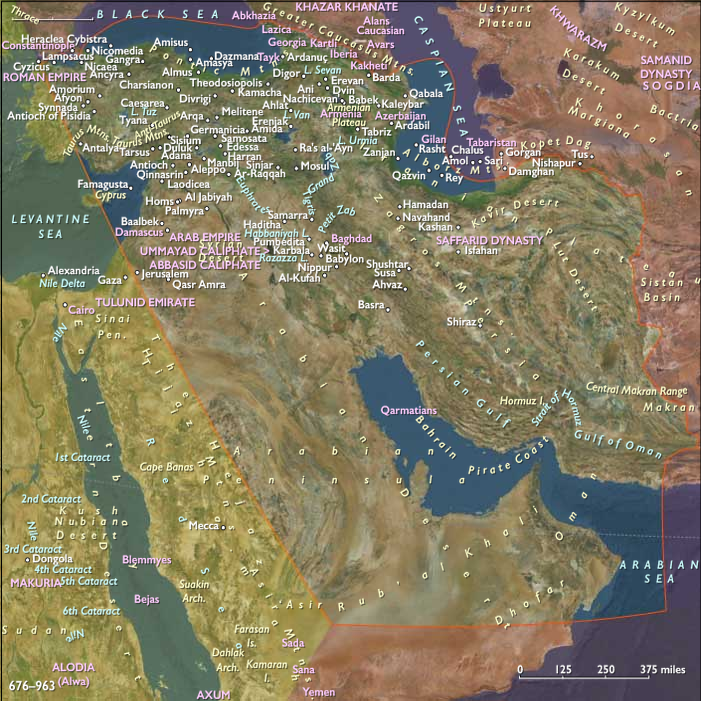
An earthquake shakes many places in northern Syria on December 24, 717, and destroys the Old Church of Edessa.

Subjects
Regions
The Near and Middle East
View →Subregions
Middle East
View →Related Events
No active filters.
Showing 10 events out of 55687 total
Theodosios' son had been captured by Leo in Nicomedia.
The feeble emperor, realizing that opposition is futile,chooses to resign the throne on March 25, 717.
He and his son subsequently enter the clergy; Theodosios will end his life in a monastery at Ephesus.
Leo now heads an empire humiliated by the presence of pagan barbarians upon Balkan soil rightfully considered “Roman,” threatened by an attack upon its Anatolian heartland and its capital, and reduced, finally, in the West to Sicily and the remnants of the Ravenna exarchate.
Leo's first task is the organization of the defense of Constantinople against eighty thousand Arab troops under Maslama ibn Abd al-Malik, who has angrily perceived his client’s deception.
Approaching Constantinople from Pergamon (Bergama), the Arabs besiege the Roman capital by land and sea from August 15, 717.
Leo's military prowess, augmented by the skillful deployment of Greek fire, forces the invaders from the city walls.
Caliph Sulayman joins the attack with two thousand warships and another eighty thousand troops, but upon landing is driven back by the Roman army.
The caliphate's forces camp for the winter.
Yazid ibn al-Muhallab, who in the first years of the century had been a provincial governor of Khorasan, had soon come into conflict with the powerful governor of Iraq, al-Hajjaj bin Yusef.
In 704/705, al-Hajjaj had replaced Yazid, naming his younger brother al-Mufaddal governor of Khurasan.
Various reasons are suggested, including that al-Hajjaj encountered a prophecy that his successor would be named Yazid and al-Hajjaj considered this Yazid the only one threatening enough to worry about.
Al-Hajjaj imprisoned and tortured Yazid.
Yazid had managed to escape in disguise in 708, fleeing to the protection of Sulayman, al-Walid's brother.
Al-Hajjaj pressed al-Walid, who commanded his brother to send him Yazid in chains.
Sulayman had had his own son chained to Yazid approach the caliph and speak in favor of Yazid's safety.
Al-Walid accepted this and told al-Hajjaj to desist.
Yazid returned to Suleiman and the two were very close to each other.
When, in 715, Sulayman himself had become caliph, Yazid had been named governor of Iraq and embarked on a persecution of the followers of al-Hajjaj, who had died in 714.
Later he was also named governor of Khorasan, while retaining supreme command in Iraq.
Yazid has fought in Jurjan and Tabaristan, personally engaging in combat.
Cruelty and extortion have characterized his administration.
The new caliph, Umar ibn Abd al-Aziz, dismisses Yazid in 717 due to his tortures against people of conquered territories, especially Turks and Sogdians.
Yazid is captured on his way to Basra and brought before Umar, who intensely dislikes him, and imprisons him.
Arab armies have meanwhile invaded Asia Minor.
Leo the Isaurian deceives them into believing that he will subjugate the empire for them, and thus wins their goodwill and support for his own attempt to seize the throne.
After persuading them to spare Roman territory, he rebels against Theodosius' rule in collusion with Artabasdos, the strategos of the Armeniac Theme, and marches on Constantinople.
Sulayman is on his way to attack the borders of the Empire when he dies in late 717.
Having broken with tradition by ignoring his brothers and son and thereby not maintaining a hereditary dynasty, he had appointed Umar ibn Abd al-Aziz as his successor because of Umar's reputation as being one of the most wise, capable and pious persons of this era.
This appointment is rare, although it technically fulfills the Sunni Islamic method of appointing a successor, whereas hereditary succession does not.
Barcelona falls in about 717 to the Moors, who open the port to Arab shipping from the eastern Mediterranean.
Charles Martel’s Victory at Vincy and the Pursuit of Chilperic II
In 717, Charles Martel launches a decisive campaign into Neustria, determined to assert his dominance over the Frankish realm. His forces meet the combined army of King Chilperic II and Mayor of the Palace Ragenfrid at Vincy, near Cambrai, where Charles secures a resounding victory.
With the Neustrian forces shattered, ...
...Chilperic and Ragenfrid flee toward Paris, pursued by Charles. However, rather than pressing the siege, Charles redirects his efforts toward consolidating power in Austrasia. Recognizing the need to eliminate any remaining threats to his rule, he turns back to confront Plectrude, who still holds Cologne, the seat of power in Austrasia.
This victory at Vincy establishes Charles as the undisputed military leader of Francia. His campaign against Plectrudeand his consolidation of Austrasian support will mark the next step in his rise to absolute power, paving the way for his later dominance over the entire Frankish kingdom.
Charles Martel Consolidates Power: The Deposition of Archbishop Rigobert
Following his victory at Vincy (717) and his consolidation of power in Austrasia, Charles Martel continues his efforts to secure loyalty within the Frankish Church. As part of this strategy, he deposes Rigobert, the Archbishop of Reims, and replaces him with Milo, a steadfast supporter of his rule.
This move underscores Charles’s determination to control both secular and ecclesiastical power, ensuring that key church figures align with his political interests. By installing Milo, he strengthens his influence over the Frankish clergy, reinforcing the alliance between his faction and the religious institutions that will later play a crucial role in legitimizing Carolingian rule.
Rigobert’s removal is one of many political purges Charles undertakes as he reshapes the Frankish kingdom, eliminating opposition and rewarding those who prove their loyalty to his cause.
Charles Martel Secures the Frankish Borders and Asserts Absolute Power
Having subjugated all of Austrasia, Charles Martel turns his attention to external threats. In a decisive campaign, he marches against Radbod, the ruler of Frisia, driving him back into his own lands and forcing the concession of West Frisia (later Holland) to Frankish control. This victory reasserts Frankish dominance over a key North Sea trading region, further consolidating Charles’s power.
At the same time, Charles confronts the Saxons, long-standing adversaries of the Franks. He pushes them back over the Weser, securing the eastern frontier and ensuring stability within the Frankish realm—nominally in the name of the new Merovingian king, but in practice, as an assertion of his own authority.
The Real Power Behind the Throne
Though officially serving as Mayor of the Palace, Charles wields absolute power in a way no previous mayor had. Unlike earlier figures who ruled through compromise with the Merovingian monarchy, Charles now commands the Frankish state as its true leader, with the king serving as little more than a symbolic figurehead.
His military triumphs not only secure the Frankish borders but also cement his status as the unquestioned ruler of Francia, laying the foundation for the eventual rise of the Carolingian dynasty.
Charles takes Cologne and disperses Plectrude’s adherents.
He allows both Plectrude and Theudoald to live, and treats them with kindness—unusual for these Dark Ages, when mercy to a former jailer, or a potential rival, is rare.
On this success, he proclaims one Clotaire IV king of Austrasia in opposition to Chilperic II.