
An exceptionally high flood of the Nile…
873 BCE to 862 BCE
An exceptionally high flood of the Nile covers the floors of the Temple of Luxor in 872 BCE, around the time that Osorkon II succeeds Shoshenq II as king of the Twenty-second dynasty of Egypt.
Locations
People
Topics
Regions
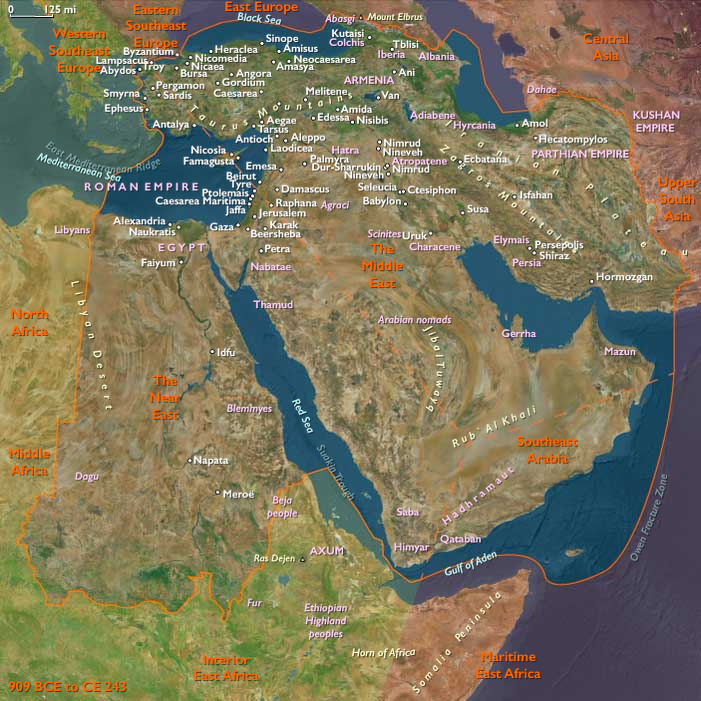
The Near and Middle East
View →Subregions
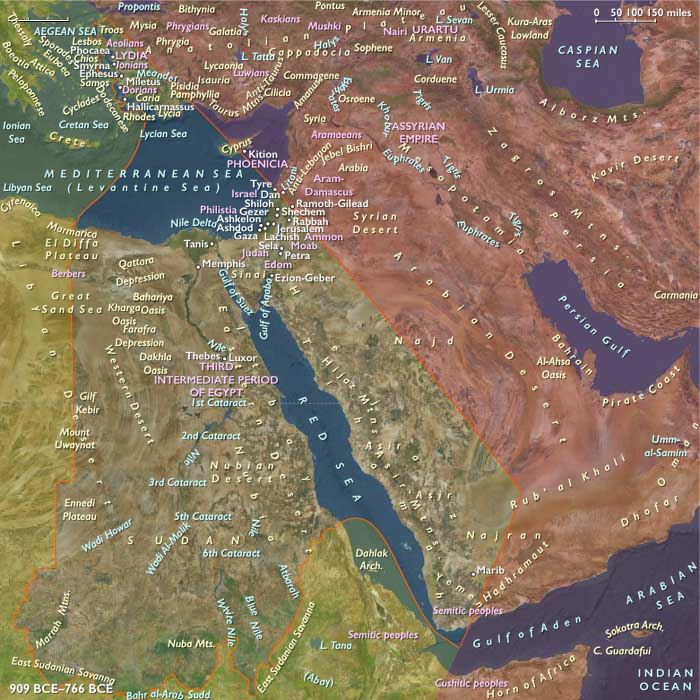
Near East
View →Related Events
No active filters.
Showing 10 events out of 66616 total
The Middle East, 873 to 862 BCE: Consolidation and Monumental Architecture under Ashurnasirpal II
During the era 873 to 862 BCE, the Neo-Assyrian Empire continues to flourish under the rule of Ashurnasirpal II, who significantly consolidates territorial gains and establishes impressive architectural legacies.
Territorial Consolidation and Administration
Ashurnasirpal II successfully consolidates control over recently conquered territories throughout Mesopotamia and the Levant. Having established a firm grip on regions previously known for instability, he ensures lasting Assyrian dominance through a mixture of brutal intimidation and efficient governance. The strategic placement of Assyrian governors helps maintain control, reducing dependence on potentially unreliable vassal rulers.
Monumental Architecture and Imperial Ideology
The era witnesses extensive construction projects, most notably at Ashurnasirpal II's new capital, Kalhu (Nimrud), north of modern-day Baghdad. Thousands of workers labor intensively to construct a massive five-mile (8.0 km) wall around Kalhu, symbolizing the empire's strength and permanence. Within these walls, Ashurnasirpal II erects an elaborate palace complex characterized by majestic gateways flanked by human-headed winged lions (lamassu), intricately carved reliefs, and grand inscriptions.
The palace walls, adorned with elegant alabaster bas-reliefs, depict military campaigns, hunting scenes, and ritual ceremonies, vividly celebrating Ashurnasirpal’s might and divine favor. These images not only reinforce his personal authority but also serve as enduring propaganda to assert Assyrian superiority.
Brutality and Psychological Warfare
Ashurnasirpal II's inscriptions vividly document his ruthless tactics, intended to instill fear among conquered populations and deter potential rebellions. He openly describes acts of severe cruelty, such as the mutilation and execution of captives, thereby reinforcing his authority through terror. For example, one inscription chillingly recounts:
"Many of the captives I have taken and burned in fire. Many I took alive; from some I cut off their hands to the wrists, from others I cut off their noses, ears, and fingers; I put out the eyes of many soldiers. I burned their young men, women, and children to death."
These harsh methods successfully prevent widespread revolts, consolidating Assyrian control across vast territories.
Economic Exploitation and Prosperity
While brutal, Ashurnasirpal II’s rule also focuses on economic prosperity. Rather than destroying Phoenician cities, he exploits their resources, particularly Lebanese cedar, iron, gold, and silver, essential for military and architectural projects. These economic measures ensure the continuous flow of materials necessary to sustain Assyria’s growing empire.
Archaeological Legacy
The significance of Ashurnasirpal II’s reign is rediscovered in the mid-19th century by British archaeologist A.H. Layard, who uncovers the extensive relief carvings and inscriptions at Nimrud. Today, these artifacts—displayed in museums such as the British Museum—stand as lasting testimonies to Assyria’s power and Ashurnasirpal’s ambitious rule, offering profound insights into the empire’s wealth, culture, and ideology during this era.
Assurnasirpal II has conquered Mesopotamia and the territory of what is now the Lebanon, adding these to the growing Assyrian empire.
Thousands of men have worked to build a five-mile (8.0 km) long wall surrounding Ashurnasirpal II’s new capital, Kalhu (Nimrud), and a grand palace.
Elegant bas-reliefs in hard stone express the glories of the expanding Assyrian Empire.
He builds a massive gateway at Nimrud, flanked by human-headed winged lions (lamassu).
There are many inscriptions carved into limestone including one that states, "The palace of cedar, cypress, juniper, boxwood, mulberry, pistachio wood, and tamarisk, for my royal dwelling and for my lordly pleasure for all time, I founded therein. Beasts of the mountains and of the seas, of white limestone and alabaster I fashioned and set them up on its gates."
The inscriptions also described plunder stored at the palace.
"Silver, gold, lead, copper and iron, the spoil of my hand from the lands which I had brought under my sway, in great quantities I took and placed therein."
The inscriptions also describe great feasts he had to celebrate his conquests.
The text also states, "Many of the captives I have taken and burned in a fire.
Many I took alive; from some I cut off their hands to the wrists, from others I cut off their noses, ears and fingers; I put out the eyes of many of the soldiers.
I burned their young men, women, and children to death."
About a conquest in another vanquished city he wrote "I flayed the nobles as many as rebelled and spread their skins out on the piles."
These shock tactics had brought success in 877 BCE, when after a march to the Mediterranean he had announced "I cleaned my weapons in the deep sea and performed sheep-offerings to the gods.”
The Near East (873–862 BCE): The Ascendancy of Omri and Alliances in Israel and Judah
Omri's Consolidation and Expansion in Israel
In the Northern Kingdom of Israel, King Omri continues to solidify his rule following the turbulent years of dynastic conflict. After successfully overcoming opposition, Omri further establishes Israel's strength by conquering the territory of Moab. Recognizing the importance of strategic alliances, Omri fosters diplomatic ties with the Phoenician city of Tyre, significantly enhancing Israel's economic and military stature in the region. Around 875 BCE, Omri moves Israel’s capital permanently to the fortified city of Samaria, thereby anchoring his political legacy and stabilizing the kingdom.
Omri’s reputation extends well beyond his lifetime, with Assyrian records frequently referencing Israel as "the land of Omri." Despite his negative portrayal by Biblical authors, contemporary historians regard Omri as one of the most influential and effective rulers in Israel's history.
Ahab's Succession and Further Alliances
Following Omri’s death, his son Ahab ascends the throne, inheriting a kingdom poised for regional prominence. Ahab's marriage to Jezebel, daughter of Ithobaal of Tyre, solidifies Israel’s alliance with the Phoenicians. Under Ahab’s leadership, the longstanding hostility between Israel and Judah finally comes to an end, as he secures a crucial alliance with King Jehoshaphat of Judah, thus concluding nearly half a century of inter-kingdom warfare.
During his reign, Ahab actively engages in military confrontations with the kingdom of Aram (Syria) and undertakes significant infrastructure projects, notably the extensive reconstruction and expansion of the ancient city of Jericho. Today, Jericho is recognized as one of the oldest continuously inhabited settlements on Earth, underscoring its historical importance during Ahab's time.
Stability and Reform under Jehoshaphat in Judah
In the southern kingdom of Judah, King Asa dies in 871 BCE after a long but troubled reign marked by religious reform and political controversy. He is succeeded by his son Jehoshaphat, who assumes the throne at the age of thirty-five and reigns for twenty-five years.
Jehoshaphat initially focuses on strengthening Judah's defenses against potential threats from Israel, yet soon capitalizes on the newfound peace established through his alliance with Ahab. During his rule, Jehoshaphat emphasizes religious education and judicial reform, dispatching priests and Levites throughout the kingdom to instruct the people in the Law, actions praised by Biblical chroniclers for fostering spiritual renewal and stability.
Dynastic Stability in Egypt
In Egypt, the Twenty-second Dynasty sees continued stability with the ascension of Osorkon II in 874 BCE, succeeding Takelot I. Osorkon II’s reign begins amidst significant natural events, notably an exceptionally high flooding of the Nile in 872 BCE that inundates the Temple of Luxor, a sign interpreted variously by contemporary Egyptians.
Summary of the Era
The period from 873 to 862 BCE is characterized by strategic political alliances and strengthened governance across the Near East. In Israel, Omri’s foundational stability paves the way for Ahab’s expansive diplomacy and construction projects, while Judah experiences a period of internal consolidation and religious reform under Jehoshaphat. Concurrently, Egypt maintains its dynastic continuity and relative peace, highlighting a contrasting regional narrative marked by stability amidst the ongoing political complexities in neighboring kingdoms.
King Omri, after conquering Moab, forms an alliance with the Phoenician city of Tyre and moves the capital of Israel to Samaria.(Omri, whose name appears frequently in Assyrian inscriptions, is mentioned briefly and unfavorably in I Kings 16 Micah 6:16 but is thought by modern scholars to have been one of the most important rulers of the northern kingdom.)
Ahab, who succeeds Omri as king of Israel, concludes an alliance with King Asa of Judah, ending the nearly half-century of warfare between the two nations.
Omri has reestablished Israel's economic and military significance among the Syrian and Palestinian minor kingdoms, so much so that years after his death the Assyrians will refer to the northern kingdom as “the land of Omri” He leaves to his son Ahab an empire that comprises not only territory east of the Jordan River, in Gilead and probably Bashan, but also the land of Moab, whose king is tributary.
The southern kingdom of Judah, if not actually subject to Omri, is certainly a subordinate ally.
Ahab's marriage to Jezebel, daughter of Ethbaal of Sidon, reported in the Bible, forges an alliance with the Phoenicians.
According to the Hebrew scriptures, King Ahab leads Israel in incessant warfare with neighboring Aram (Syria) and undertakes large-scale construction projects in the cities of Israel, …
…greatly expanding the city of Jericho.
Today the capital of the Jericho Governate, its current population of more than twenty thousand occupies the lowest permanently inhabited site on earth.
Jericho is also believed to be the world’s oldest continuously inhabited city.
Asa dies in 871 BCE and is buried with his ancestors in Jerusalem, in the grave that he had dug for himself (2 Chronicles 16:13-14); his son Jehosophat succeeds him.
Jehoshaphat takes the throne at the age of thirty-five; he will reign for twenty-five years.
William F. Albright has dated the reign of Jehoshaphat to 873—849 BCE.
E. R. Thiele held that he became coregent with his father Asa in the latter’s thirty-ninth year, 872/871 BCE, the year Asa was afflicted with a severe disease in his feet, and then became sole regent when Asa died of the disease in 870/869 BCE, his own death occurring in 848/847 BCE.
Thiele's chronology for the first kings of Judah contained an internal inconsistency that later scholars corrected by dating these kings one year earlier, so that Jehoshaphat's dates are taken as one year earlier in the chronology presented herein: coregency beginning in 873/871, sole reign commencing in 871/870, and death in 849/848 BCE.
Jehoshaphat spends the first years of his reign fortifying his kingdom against Israel (2 Chronicles 17:1-2).
The Bible lauds the king for overcoming sexual corruption (1 Kings 22:47).
In the third year of his reign, Jehoshaphat sends out priests and Levites over the land to instruct the people in the Law (2 Chronicles 17:7-9), an activity that is commanded for a Sabbatical year in Deuteronomy 31:10-13.
The author of 2 Chronicles generally praises his reign, stating that the kingdom enjoyed a great measure of peace and prosperity, the blessing of God resting on the people "in their basket and their store."
The first known stone architecture in Mesoamerica is built in the fertile Copán River valley in western Honduras, not far from the border with Guatemala, in about the ninth century BCE; the region had long been a site of agriculture.
The Middle East, 861 to 850 BCE: Emergence of Urartu and Iranian Peoples
During the era 861 to 850 BCE, significant political shifts occur in the northern and eastern regions surrounding Assyria, notably with the emergence of Urartu as a unified kingdom and the early consolidation of Iranian peoples on the Iranian Plateau.
The Rise of Urartu
Originally one of the fragmented states of Nairi, located in the Armenian Highlands around Lake Van, Urartu (also known as Uruartri) transitions into a cohesive kingdom under King Aramu (circa 860–843 BCE). Earlier Assyrian inscriptions from rulers such as Tukulti-Ninurta I, Tiglath-Pileser I, and Ashurnasirpal II repeatedly mention conflicts with the Nairi states. However, by this era, these disparate tribes and small kingdoms coalesce, transforming Urartu into a formidable rival to Assyrian dominance in the north. This consolidation signifies a critical turning point in the balance of power, presenting new challenges to Assyria’s northern frontier.
Neo-Assyrian Imperial Iconography
The Neo-Assyrian kings continue to solidify their image as formidable warriors and divinely favored rulers. Monumental sculptures featuring man-headed winged bulls, known as lamassu, increasingly dominate Assyrian art and architecture. These imposing figures serve both protective and propagandistic roles, symbolizing royal power and divine guardianship throughout the expanding Assyrian realm.
Arrival and Consolidation of Iranian Peoples
Around this period, the Iranian peoples—descendants of the ancient Indo-Iranians—further establish their presence on the Iranian plateau. Significant among these groups are the Old Persians, who by 850 BCE refer to themselves as the Parsa, occupying territory around Persis (modern-day Fars Province), bounded by the Tigris River to the west and the Persian Gulf to the south. Assyrian inscriptions from the ninth century BCE provide the earliest known written references to these peoples, naming them as Parsuash and Parsua.
These early Iranian communities, initially pastoral and nomadic, gradually settle and consolidate, laying the foundations for future empires. Their cultural identity revolves around a shared linguistic heritage and religious traditions centered on the worship of Ahura Mazda, a pivotal deity in their emerging religious framework.
Geopolitical Shifts
The concurrent rise of Urartu and the arrival and settlement of the Iranian peoples on Assyria’s northern and eastern frontiers mark the beginning of significant geopolitical changes. These developments signal an era of emerging regional powers that will profoundly influence the political and cultural landscape of the Middle East in the subsequent centuries.
Assyrian inscriptions of Shalmaneser I from about 1270 BCE first mention Uruartri as one of the states of Nairi—a loose confederation of small kingdoms and tribal states in Armenian Highland in the thirteenth to eleventh centuries BCE.
Uruartri itself is in the region around Lake Van.
The Nairi states have been repeatedly subjected to attacks by the Assyrians, especially under Tukulti-Ninurta I (circa 1240 BCE), Tiglath-Pileser I (circa 1100 BCE), Ashur-bel-kala (circa 1070 BCE), Adad-nirari II (circa 900), Tukulti-Ninurta II (circa 890), and Ashurnasirpal II (883-859 BCE).
Urartu reemerges in Assyrian inscriptions in the ninth century BCE as a powerful northern rival: the Nairi states and tribes become a unified kingdom under king Aramu (circa 860-843 BCE).
The neo-Assyrian kings depict themselves as warlike heroes in their sculpted portraiture.
Man-headed winged bulls dominate Assyrian art and architecture.