
Leipzig introduces an oil-fueled street lighting system…
1701 CE
Leipzig introduces an oil-fueled street lighting system on December 24, 1701.
The city employs light guards who have to follow a specific schedule to ensure the punctual lighting of the seven hundred lanterns.
Locations
Groups
Topics
Commodities
Regions
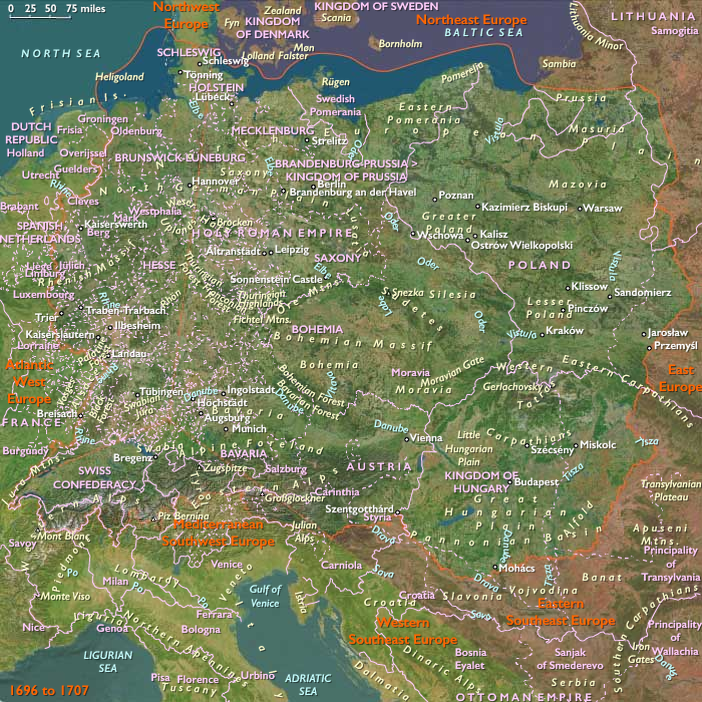
Central Europe
View →Subregions

East Central Europe
View →Related Events
No active filters.
Showing 10 events out of 28887 total
William Dampier, given command of the ship Roebuck by the British Admiralty, explores the coast of Australia, New Britain and New Guinea between 1699 and 1701.
The electorate of Brandenburg-Prussia becomes the Kingdom of Prussia as Elector Frederick III is proclaimed King Frederick I. Prussia remains part of the Holy Roman Empire.
It consists of Brandenburg, Pomerania and East Prussia.
Berlin is the capital.
Giacomo Pylarini becomes the first immunologist: he inoculates with smallpox the children of the English ambassador to Constantinople in 1701 in hopes of preventing more serious smallpox sickness when the children are older.
Pylarini, a Venetian born in Cefalonia, had studied law and then physic at Padua before receiving his degree of MD, then traveled to different parts of Asia and Africa and practiced both at Smyrna and Constantinople.
In Moscow, he had been appointed physician to the Russian Tsar Peter the Great.
Returning to Smyrna for the second time, he resides there as the Venetian Consul as well as practicing physician.
Emperor Leopold I decrees Transylvania's Orthodox Church to be one with the Roman Catholic Church in 1699 and 1701; the Habsburgs, however, never intend to make the Uniate Church a "received" religion and do not enforce portions of Leopold's decrees that give Uniate clergymen the same rights as Catholic priests.
Despite an Orthodox synod's acceptance of union, many Orthodox clergy and faithful reject it.
The Chogyar Namgyal establishes the first monastery known as the Dubdi Monastery in 1701, at Yuksom in Sikkim.
Established in 1701, it is professed to be the oldest monastery in Sikkim and is located on the top of a hill which is about an hour's walk (three kilometers [one point nine miles) from Yuksom.
It is also known as the Hermit's Cell after its ascetic founder Lhatsun Namkha Jigme, who along with two other lamas from Tibet had met at Norbugang near Yuksom and crowned Phuntsog Namgyal as the first King or Chogyal of Sikkim at Norbugang Yuksom in 1642.
The literal meaning of 'Dubdi' in local language is "the retreat".
The War of the Spanish Succession begins in 1701.
It is an international retaliation to Louis XIV’s acceptance in 1700 of the Spanish crown on behalf of his grandson Philip of Anjou, who has become Philip V, first Bourbon king of Spain.
Leopold I, Holy Roman Emperor, forms the Grand Alliance with England, the Netherlands, Denmark, Portugal, Savoy and Prussia.
Louis XIV allies France with Spain and Bavaria.
Joseph Sauveur, a member of the French Academy, coins the French word acoustique, from which the English word acoustics is derived.
Most European rulers accept Philip as King of Spain, though some only reluctantly.
Depending on one's views of the war as inevitable or not, Louis acts reasonably or arrogantly.
He confirms that Philip V retains his French rights despite his new Spanish position.
Admittedly, he may only have been hypothesizing a theoretical eventuality and not attempting a Franco-Spanish union, but his actions are certainly not read as being innocent.
Moreover, Louis has also sent troops to the Spanish Netherlands, evicting Dutch garrisons and securing Dutch recognition of Philip V. In 1701, he transfers the asiento to France, alienating English traders.
As tensions mounted, Louis decided to acknowledge James Stuart, James II's son, as king on the latter's death, infuriating William III.
These actions enrage England and the United Provinces.
Excessive use of opium, widely prescribed as something of a medical panacea, is mentioned in an account by a London physician named Jones in 1701, but at this time there exists no adequate comprehensive history of opium's addictive aspects, despite the Old World's centuries-long familiarity with this therapeutic and painkilling drug.
George Granville's The Jew of Venice, an adaptation of The Merchant of Venice, receives its première at Lincoln's Inn Fields, with Thomas Betterton as Bassanio.
The adaptation is so popular that it will displace the original from the stage for the next four decades.
Edmond Halley's General Chart of the Variation of the Compass is first published in 1701.
It is the first to show magnetic declination (in the Atlantic Ocean) and the first on which isogonic, or Halleyan, lines appear