
An opportunity for the Eastern Han dynasty…
47 CE
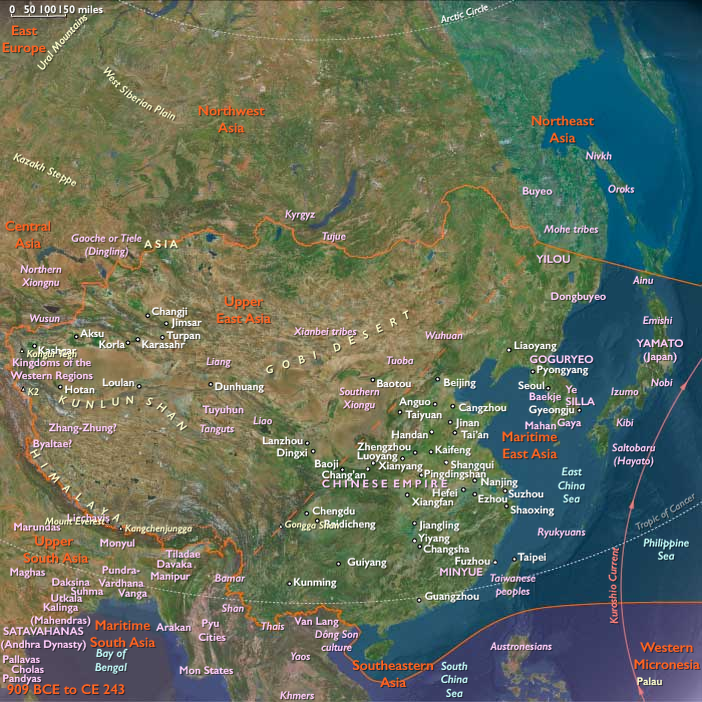
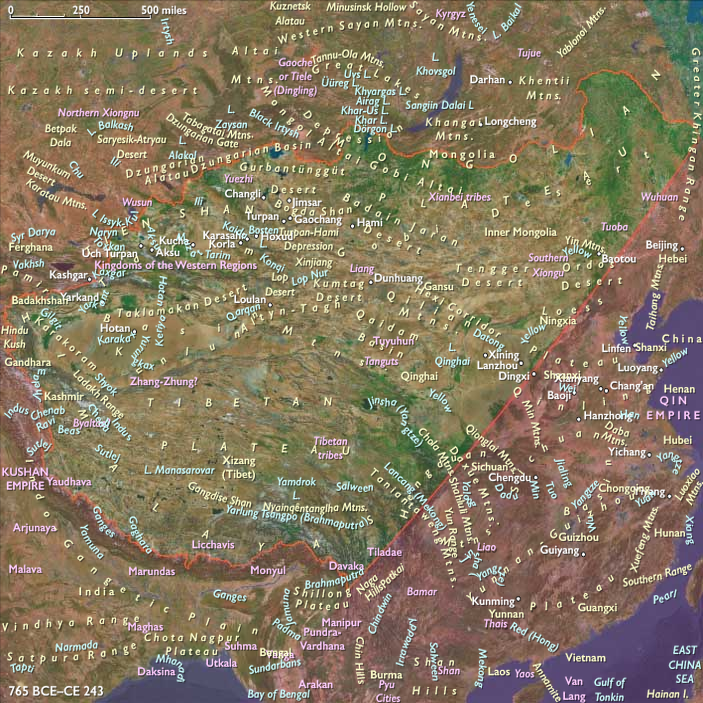
An opportunity for the Eastern Han dynasty arises in 47 with regard to the Xiongnu during a succession dispute that pits the current chanyu, Punu, against his cousin Bi, the son of a former chanyu.
Locations
People
Groups
Commodities
Subjects
Regions
East Asia
View →Subregions
Upper East Asia
View →Related Events
No active filters.
Showing 10 events out of 61798 total
Roman garrisons stationed throughout Judea have exploited Jews with punitive taxation since 63 BCE, exceeding the quota set by the Roman Empire and keeping the surplus revenues for themselves.
The Roman procurators have also subjugated the Jewish High Priesthood, appointing pro-Roman Jews to positions of authority, and desecrated sacred Jewish practices with sacrilegious pagan rituals.
The Roman Emperor Caligula in 39 had declared himself divine and ordered his troops in Jerusalem to place his name on the Temple.
When the Jews refused, he threatened to destroy the temple but his sudden timely demise saved Jerusalem from a premature siege, yet Caligula's threat had caused many of the moderate Jews to shift towards radical anti-Roman political views.
As the Roman burden becomes more onerous, Jewish priests alienated by the pro-Roman high priesthood join in the effort to attain political and religious liberty by any means possible, thus forming the Zealots, who kindle anti-Roman sentiment throughout Galilee and Judea.
Josephus' Jewish Antiquities states that there were three main Jewish sects at this time, the Pharisees, the Sadducees, and the Essenes.
The Zealots are a "fourth sect", founded by Judas of Galilee (also called Judas of Gamala) and Zadok the Pharisee in the year 6 against Quirinius' tax reform, shortly after the Roman Empire declares what had most recently been the tetrarchy of Herod Archelaus to be a Roman province, and that they "agree in all other things with the Pharisaic notions; but they have an inviolable attachment to liberty, and say that God is to be their only Ruler and Lord." (18.1.6).
Some scholars argue that the group was not so clearly marked out before the first war of 66-70 as others have supposed.
The Zealots, as strict interpreters of the Law are extremists who are willing to lay their own lives down for independence from Roman domination.
They have begun to form a growing nationalist resistance movement.
Two of Judas' sons, Jacob and Simon, are from 46 to 48 involved in a revolt and are executed by Tiberius Alexander, the procurator of Iudaea province.
Claudius pays special attention to transportation, building roads and canals throughout Italy and the provinces.
Among these is a large canal leading from the Rhine to the sea, as well as a road from Italy to Germany—both begun by his father, Drusus.
Closer to Rome, he builds a navigable canal on the Tiber, leading to Portus, his new port just four kilometers (two and a half miles) north of Ostia, Rome's original harbor.
The port at Ostia is part of Claudius' solution to the constant grain shortages that occur in winter, after the Roman shipping season.
The other part of his solution is to insure the ships of grain merchants who are willing to risk traveling to Egypt in the off-season.
He also grants their sailors special privileges, including citizenship and exemption from the Lex Papia-Poppaea, a law that regulates marriage.
In addition, he repeals the taxes that Caligula had instituted on food, and further reduces taxes on communities suffering drought or famine.
The new port, enclosing an area of sixty-nine hectares (one hundred and seventy acres), is constructed in a semicircle with two long curving moles projecting into the sea, and an artificial island, bearing a lighthouse, in the center of the space between them.
The foundation of this lighthouse is provided by filling one of the massive Obelisk ships, used to transport an obelisk from Egypt to adorn the spina of Vatican Circus, built during the reign of Caligula.
The harbor thus opens directly to the sea on the northwest and communicates with the Tiber by a channel on the southeast.
The object is to obtain protection from the prevalent southwest wind, to which the river mouth is exposed.
Though Claudius, in the inscription which he caused to be erected in CE 46, boasts that he has freed the city of Rome from the danger of inundation, his work is only partially successful: in 62 CE, Tacitus speaks of a number of grain ships sinking within the harbor during a violent storm.
Within the carefully planned town are shops, offices, and warehouses, along with public baths and lavatories, a theater, and a gymnasium.
Claudius, in front of a crowd of spectators, fights a killer whale that is trapped in the harbor of Ostia.
The event is witnessed by Pliny the Elder: A killer whale was actually seen in the harbor of Ostia, locked in combat with the emperor Claudius.
She had come when he was completing the construction of the harbor, drawn there by the wreck of a ship bringing leather hides from Gaul, and feeding there over a number of days, had made a furrow in the shallows: the waves had raised up such a mound of sand that she couldn't turn around at all, and while she was pursuing her banquet as the waves moved it shorewards, her back stuck up out of the water like the overturned keel of a boat.
The Emperor ordered that a large array of nets be stretched across the mouths of the harbor, and setting out in person with the Praetorian cohorts gave a show to the Roman people, soldiers showering lances from attacking ships, one of which I saw swamped by the beast's waterspout and sunk.— "Historia Naturalis" IX.14–15.
Many other senators attempt different conspiracies and are condemned.
Claudius' son-in-law Pompeius Magnus is executed for his part in a conspiracy with his father Crassus Frugi.
Another plot involves the consulars Lusiius Saturninus, Cornelius Lupus, and Pompeius Pedo.
Suetonius states that a total of thirty-five senators and three hundred knights were executed for offenses during Claudius' reign, which could not have helped Senate-emperor relations.
In 47 CE, Claudius assumes the office of Censor with Lucius Vitellius, which had been allowed to lapse for some time.
He strikes the names of many senators and equites who no longer meet qualifications, but shows respect by allowing them to resign in advance.
At the same time, he seeks to admit eligible men from the provinces.
The Lyon Tablet preserves his speech on the admittance of Gallic senators, in which he addresses the Senate with reverence but also with criticism for their disdain of these men.
He also increases the number of Patricians by adding new families to the dwindling number of noble lines.
Here he follows the precedent of Lucius Junius Brutus and Julius Caesar.
Nevertheless, many in the Senate remain hostile to Claudius, and many plots are made on his life.
This hostility carries over into the historical accounts.
As a result, Claudius is forced to reduce the Senate's power for efficiency.
The administration of Ostia is turned over to an Imperial Procurator after construction of the port.
Administration of many of the empire's financial concerns is turned over to Imperial appointees and freedmen.
This leads to further resentment and suggestions that these same freedmen are ruling the Emperor.
According to Suetonius, Claudius was extraordinarily fond of games.
He is said to have risen with the crowd after gladiatorial matches and given unrestrained praise to the fighters.
Claudius also presides over many new and original events.
Soon after coming into power, Claudius had instituted games to be held in honor of his father on the latter's birthday.
Annual games were also held in honor of his accession, and took place at the Praetorian camp where Claudius had first been proclaimed Emperor.
Claudius performs the Secular games, marking the eight hunredth anniversary of the founding of Rome.
Augustus had performed the same games less than a century prior.
Augustus' excuse is that the interval for the games is one hundred and ten years, not one hundred, but his date actually does not qualify under either reasoning.
Claudius also presents naval battles to mark the attempted draining of the Fucine lake, as well as many other public games and shows.
Claudius also restores and adorns many of the venues around Rome.
The old wooden barriers of the Circus Maximus are replaced with ones made of gold-ornamented marble.
A new section of the Circus is designated for seating the senators, who previously had sat among the general public.
Claudius rebuilds Pompey's Theater after it had been destroyed by fire, throwing special fights at the re-dedication, which he observes from a special platform in the orchestra box.
The Romans prevail in southeastern Britain, and in 47 establish their first British colony in the province of Roman Britain, Camulodunum (present Colchester), situated on the Colne River, in present Essex.
Extensive trade with the Romans also takes place, with such items as grains, furs, and enslaved people exchanged for wine and other luxuries.
Londinium, situated on a terrace near the north bank of the tidal River Thames, forty miles (sixty-four kilometers) from its estuary on the North Sea, is established as a town by the Romans after the invasion of CE 43 led by the Roman Emperor Claudius.
Archaeologists now believe that Londinium was founded by CE 50 as a civilian settlement or civitas.
A wooden drain by the side of the main Roman road excavated at No. 1 Poultry has been dated by dendrochronology to CE 47, which is likely to be the foundation date.
Before the arrival of the Roman legions, the area was almost certainly lightly rolling open countryside traversed by streams such as Walbrook.
Londinium is established at the point where the Thames is narrow enough to build a bridge, but deep enough to handle seagoing marine vessels.
Remains of a massive Roman pier base for a bridge will be found in 1981, close to the modern London Bridge.
It was traditionally thought that Londinium started as a civilian settlement, although there is also slight evidence that there was a Roman fortress.
However, archaeological excavation undertaken since the 1970s by the Department of Urban Archaeology of the Museum of London, now called MOLAS, has failed to unearth any convincing traces of military occupation on the site, so many archeologists now believe that Londinium was the product of private enterprise.
Its site on a busy river-crossing makes it a perfect place for traders from across the Roman Empire to set up business.
The name Londinium is thought to be pre-Roman (and possibly pre-Celtic) in origin, although there has been no consensus on what it means.
It is common practice for Romans to adopt native names for new settlements.
A common theory is that the name derives from a hypothetical Celtic placename, Londinion which may have been derived from the personal name Londinos, from the word lond, meaning 'wild'.
A theory proposed by Richard Coates, which does not have widespread acceptance, suggests that the name derives from a Celticized Old European river-name forming part of the oldest stratum of European toponymy, in the sense established by Hans Krahe; Coates suggested a derivation from a pre-Celtic Plowonida — from two roots, plew and nejd, possibly meaning "the flowing river" or "the wide flowing river".
Therefore, Londinium would mean "the settlement on the wide river".
He suggests that the river was called the Thames upriver where it was narrower, and Plowonida downriver, where it is too wide to ford.
Inscriptions and graffiti found by archaeologists confirm that Latin was the local language.
It has been implied by modern scholars that many of the local people spoke the Celtic language now termed Brythonic, called lingua Gallica (Gaulish) by the Romans; this language is ancestral to Welsh, Cornish and Breton.
The status of Londinium is uncertain.
It was not the capital of a civitas, though Ptolemy lists it as one of the cities of the Cantiaci.
Starting as a small fort guarding the northern end of the new bridge across the River Thames, it will grow to become an important port for trade between Britain and the Roman provinces on the continent.
The lack of private Roman villas (plentiful elsewhere) suggests military or even imperial ownership.
Publius Ostorius Scapula, who is probably the son of Quintus Ostorius Scapula, the first joint commander of the Praetorian guard appointed by Augustus and later prefect of Egypt, was suffect consul, probably in 46.
He is In the winter of 47 appointed the second governor of Roman Britain by the emperor Claudius, succeeding Aulus Plautius.
The south and east of the island is securely occupied and alliances have been made with tribes outside the Roman-controlled area, but other tribes continue to resist.
They stage attacks and uprisings, believing a new governor will be reluctant to campaign so late in the year.
Ostorius responds vigorously, attacking relentlessly and allowing the native resistance no time to regroup.
He apparently (based on an emendation of a corrupt passage in Tacitus's Annals) declares his intention to disarm all the Britons south and east of the rivers Trent and Severn.
The geographical area described has led to discussion about the role of the Fosse Way as a desired frontier line during the period as it links the Trent and the Severn.
The Iceni, a tribe based in Norfolk who have not been conquered but have allied themselves with the Romans voluntarily, object to this plan and lead neighboring tribes in an uprising.
Ostorius defeats them by storming a hill fort, possibly Stonea Camp in the Fens near March in Cambridgeshire, in a hard-fought battle. (Human remains have been found around the site, including sword-marked adult bones and the cloven skull of a child, indicating that the inhabitants were trapped and attacked within the settlement.)
His son, Marcus Ostorius Scapula, wins the corona civica for saving a Roman citizen's life during the fighting.
The Iceni remain independent, and it is likely that Prasutagus is installed as a pro-Roman ruler at this time, although he may have been one of the eleven kings who surrendered to Claudius in 43 following the Roman conquest.
In any case, as an ally of Rome his tribe are allowed to remain nominally independent, and to ensure this Prasutagus names the Roman emperor as co-heir to his kingdom, along with his two daughters.
Bi also claims the title of chanyu in 48 and submits to Emperor Guangwu's authority.
Punu also submits, in response, and the divided Xiongnu stop waging war against the Eastern Han.
Some traces remain of the presence of the Kushans in the area of Sogdiana.
Khalchayan (also Khaltchaïan) is an archaeological site, thought to be a small palace or a reception hall, located near the modern town of Denov in Surxondaryo Province of southern Uzbekistan.
It is located in the valley of the Surkhan Darya, a northern tributary of the Oxus (modern Amu Darya).
The site is usually attributed to the early Kushans, or their ancestors the Yuezhi.
It was excavated by Galina Pugachenkova between 1959 and 1963.
The interior walls are decorated with clay sculptures and paintings dated to the mid-first century BCE.
Various panels depict scenes of Kushan life: battles, feasts, portraits of rulers.
Various sculptures and friezes are known, representing horse-riding archers and, significantly, men with artificially deformed skulls, such as the Kushan prince of Khalchayan (a practice well attested in nomadic Central Asia).
Gandhara falls to the Kushans in 48.
The conquest of northwest India led by Kujula Kadphises lays the basis for the Kushan Empire which will be rapidly expanded by his descendants.
The origins of Kujula Kadphises are obscure, and it is usually considered he was a descendant of the Kushan ruler Heraios, or even identical with him.
Interestingly however, Kujula shares his name (on some of his "Hermaeus" coins, or on his "Augustus" coins) with some of the last Indo-Scythian rulers, such as Liaka Kusulaka, or his son Patika Kusulaka, which might suggest some family connection.
In the process of their expansion eastward, Kujula Kadphises and his son Vima Takto seem to have displaced the Indo-Parthian kingdom, established in northwestern India by the Parthian Gondophares since around CE 20.
This invasion of Kujula Kadphises is thought to have occurred during the reign of Abdagases and Sases, the successors of Gondophares, after 45 CE.
Most of Kujula's coins are Hellenic or Roman in inspiration.
Some coins use the portrait, name and title of the Indo-Greek king Hermaeus on the obverse, indicating Kujula's wish to relate himself to the Indo-Greek king.
Since the Kushans and their predecessors the Yuezhi were conversant with the Greek language and Greek coinage, the adoption of Hermaeus cannot have been accidental: it either expresses a filiation of Kujula Kadphises to Hermaeus by alliance (possibly through Sapadbizes or Heraios), or simply a wish to show himself as heir to the Indo-Greek tradition and prestige, possibly to accommodate Greek populations.
These coins bear the name of Kujula Kadphises with representations of the Greek demi-god Heracles on the back, and titles ("Yavugasa") presenting Kujula as a "ruler" (not actual king), and a probable Buddhist ("Dharmathidasa", follower of the Dharma).
Later coins, possibly posthumous, do describe Kujula as "Maharajasa", or "Great King.
Some fewer coins of Kujula Kadphises also adopted a Roman style, with effigies closely resembling Caesar Augustus, although all the legends were then associated with Kujula himself.
Such influences are linked to exchanges with the Roman Empire around that date.