Another Israeli land expropriation measure evolves from…
February 1950 CE
Another Israeli land expropriation measure evolves from the Defense (Emergency) Regulations, which are passed in 1949 (and will be renewed annually until 1972 when the legislation is allowed to lapse).
Under this law, the Ministry of Defense can, subject to approval by an appropriate committee of the Knesset, create security zones in all or part of what is designated as the "protected zone," an area that includes lands adjacent to Israel's borders and other specified areas. (According to Sabri Jiryis, an Arab political economist who based his work exclusively on Israeli government sources, the defense minister used this law to categorize "almost half of Galilee, all of the Triangle, an area near the Gaza Strip, and another along the Jerusalem-Jaffa railway line near Batir as security zones.")
A clause of the law provides that permanent as well as temporary residents can be required to leave the zone and that the individual expelled has four days within which to appeal the eviction notice to an appeals committee.
The decisions of these committees are not subject to review or appeal by a civil court.
Another measure enacted by the Knesset in 1949 is the Emergency Regulations (Cultivation of Waste Lands) Ordinance.
One use of this law is to transfer to kibbutzim or other Jewish settlements land in the security zones that is lying fallow because the owner of the land or other property is not allowed to enter the zone because of national security legislation.
The 1949 law provides that such land transfers are valid only for a period of two years and eleven months (but subsequent amending legislation will extend the validity of the transfers for the duration of the state of emergency).
Locations
Commodities
Subjects
Regions
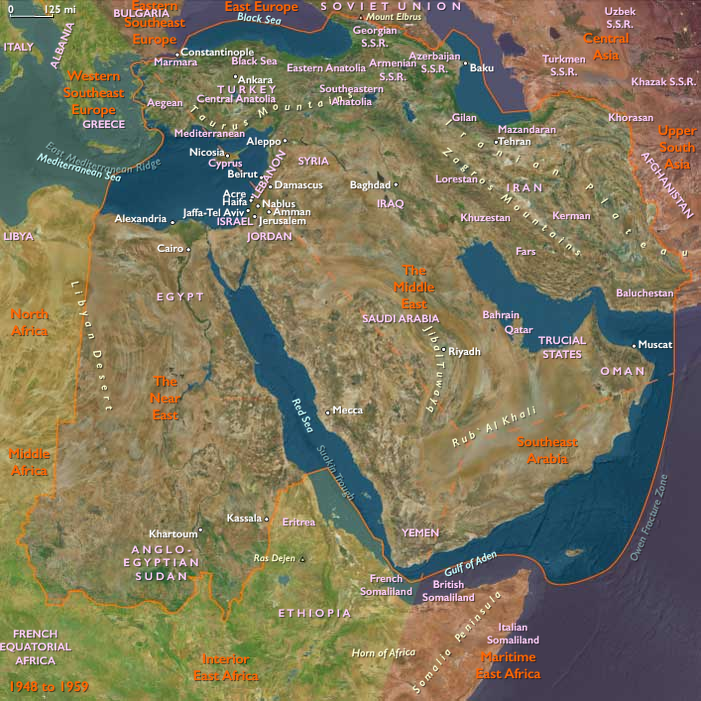
The Near and Middle East
View →Subregions