
Another of the five new Bulgar subdivisions…
669 CE
Another of the five new Bulgar subdivisions migrates to central Europe and is merged with the Avars.
Groups
Regions
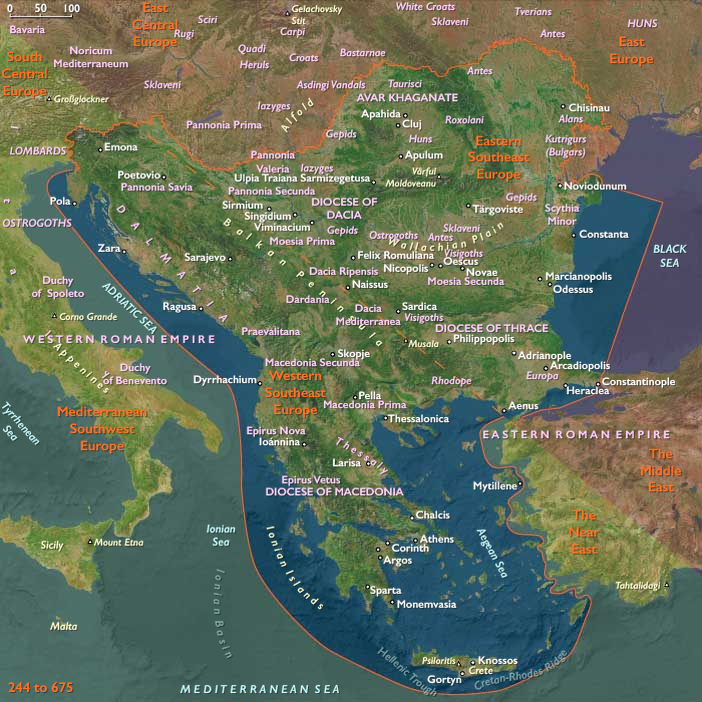
Southeast Europe
View →Subregions
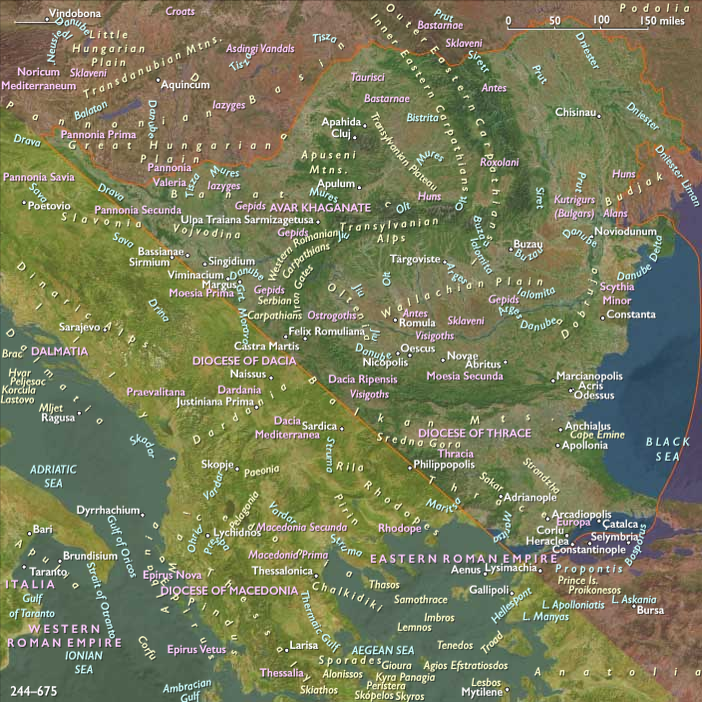
Eastern Southeast Europe
View →Related Events
No active filters.
Showing 10 events out of 56265 total
Tarumanagara, an early Sundanese Indianized kingdom in Java, is divided in 669 into two kingdoms: Sunda Kingdom and Galuh Kingdom, with the Citarum river as the boundary.
The Galuh Kingdom comprises many vassal kingdoms that cover areas of present-day West and present-day Central Java Provinces.
King Tarusbawa then establishes a new capital of his kingdom near the Cipakancilan river upstream which centuries later will become the city of Pakuan Pajajaran (or shortly called Pakuan or Pajajaran).
King Tarusbawa becomes the predecessor of the Sunda kings.
Nakatomi-no-Kamatari renames himself Fujiwara-no-Kamatari shortly before his death in 669, inaugurating Japan’s powerful Fujiwara clan.
Khan Kubrat’s five sons split the Bulgar people into five hordes, according to Greek sources.
One of these five, remaining on the coast of the Sea of Azov, is absorbed into the new empire of the Khazars.
Two of the five Bulgar hordes are to have longer futures.
Kubrat's son Bezmer, or Batbayan, avoids the Khazars by leading his horde far to the north, where it eventually occupies an ill-defined country around the confluence of the Volga and Kama rivers.
Subdivided here into three groups (probably through mergers with indigenous peoples or with other immigrants), the horde will maintain itself in prosperity for some six hundred years.
The Muslim forces based in Chalcedon cross the Bosporus in 669 in an attack on Constantinople, but the Romans repel the attack from the city walls.
A new Arab fleet conducts a series of campaigns against Constantinople, beginning in 669.
Muawiyah initiates another land invasion of the Empire, using his army to seize the city of Chalcedon on the Bosporus across from Constantinople.
Hasan, the deposed Shiite claimant to the caliphate and the son of the murdered Ali, dies mysteriously around 669.
When the news of the assassination of Constans reached his son Constantine IV in Constantinople, an expedition had been sent to depose and kill Mezezius.
His court is deported in 669 to Constantinople.
The Arabs drive the Romans from Utica in 669, totally destroying the city in the process.
The Rise of Ebroin and the Growing Influence of the Mayors of the Palace (c. 666–669 CE)
After the death of Erchinoald, Mayor of the Neustrian Palace, a council of Franks elects Ebroin as his successor. By 668 CE, according to Bede, Ebroin is effectively controlling both foreign policy and internal security, making him the most powerful man in Neustria. Meanwhile, King Chlothar III, who had been largely a puppet ruler, may have begun to assert real authority in 669, if the Liber Historiae Francorum's account of his four-year reign is accurate.
1. The Election of Ebroin as Mayor of the Neustrian Palace
- Following Erchinoald’s death, the Frankish nobility convenes a council to select his successor, reflecting the growing trend of aristocratic influence in royal administration.
- Ebroin, a capable but ruthless political figure, is chosen as Mayor of the Palace, further entrenching the power of the office over the Merovingian kingship.
- His tenure will be marked by strong centralization, suppression of opposition, and conflicts with both nobles and clergy.
2. Ebroin’s Dominance Over Neustrian Governance (668 CE)
- Bede records that by 668, Ebroin is essentially running Neustrian foreign policy and overseeing internal security, making him the de facto ruler of Neustria.
- He consolidates power by controlling court appointments, suppressing rivals, and enforcing his will through military campaigns.
- His authoritarian rule makes him one of the most controversial figures of the late Merovingian period.
3. The Role of Chlothar III: A Late Assertion of Power? (669 CE)
- Chlothar III, initially a puppet king under Ebroin, may have begun to exert real authority around 669, when his advisors deemed him an adult capable of ruling.
- However, his ability to actually govern independently of Ebroin remains questionable.
- If the Liber Historiae Francorum is correct in giving Chlothar only four years of effective reign, his personal rule would have been short-lived before his death in 670.
4. The Political Climate: The Growing Divide Between Kings and Mayors of the Palace
- Ebroin’s tight grip on power reflects the ongoing decline of Merovingian royal authority, as the Mayors of the Palace now function as true rulers.
- The Frankish nobility is increasingly divided, with many aristocrats resenting Ebroin’s centralization efforts and siding with rival factions.
- This political instability will continue after Chlothar III’s death, leading to further struggles between Ebroin and his opponents.
Conclusion: The Shift Toward Aristocratic Rule
The election of Ebroin as Mayor of the Palace in 666–667 CE and his dominance by 668 CE mark another stage in the decline of Merovingian kingship. While Chlothar III may have begun to exercise some personal rule in 669, he remains overshadowed by Ebroin, whose ruthless leadership further erodes the power of the Merovingian monarchy. This period sets the stage for further aristocratic conflicts, foreshadowing the eventual Carolingian takeover of Francia.