
The first ascent of Finsteraarhorn, the highest…
August 1826 CE
The first attempt had been made on August 16, 1812, by the Aargau merchant Rudolph Meyer, guided by the locals Kaspar Huber, Arnold Abbühl, Joseph Bortes and Aloys Volker.
Bortes and Volker, guiding Meyer's father and uncle, had been the first to climb the Jungfrau the previous year.
They approached the mountain via the Oberaarjoch, Studer glacier, and south-east ridge, which is a more difficult and longer route than the current normal route over the north-west ridge.
Meyer became exhausted and remained behind after reaching the ridge, perhaps near P. 3883 (Meyer's Peak).
Huber kept him company, while the three other guides went on and purportedly reached the summit after three hours.
On August 19, 1828, Franz Joseph Hugi, a geologist from Solothurn, had made another attempt with seven local climbers.
Among these was Arnold Abbühl, who told Hugi about his ascent sixteen years earlier, but Hugi scoffingly dismissed his account, partly because Abbühl had misidentified the peak in the beginning of their approach.
The group had reached a 4,080-metre (13,390-foot) saddle (the Hugisattel) on the north-west ridge, but had to retreat because of bad weather after Hugi and one of the guides (Arnold Dändler) nearly fell off the ridge.
The next year Hugi organizes another expedition via the same route.
While an attempt on the 3rd of August had faltered, on August 10, 1829, two of his guides, Jakob Leuthold and Johann Währen, are able to reach the summit, where they spend three hours building a seven-foot pyramid to anchor a flagpole.
Hugi stays behind somewhat above the saddle not daring to cross a steep slope, partly because he had twisted an ankle four weeks earlier.
On the way back Hugi's ankle plays up and Leuthold, Währen and Joseph Zemt take turns carrying him down the glacier.
Hugi's account makes no mention of evidence of an earlier ascent.
Locations
Groups
Subjects
Regions
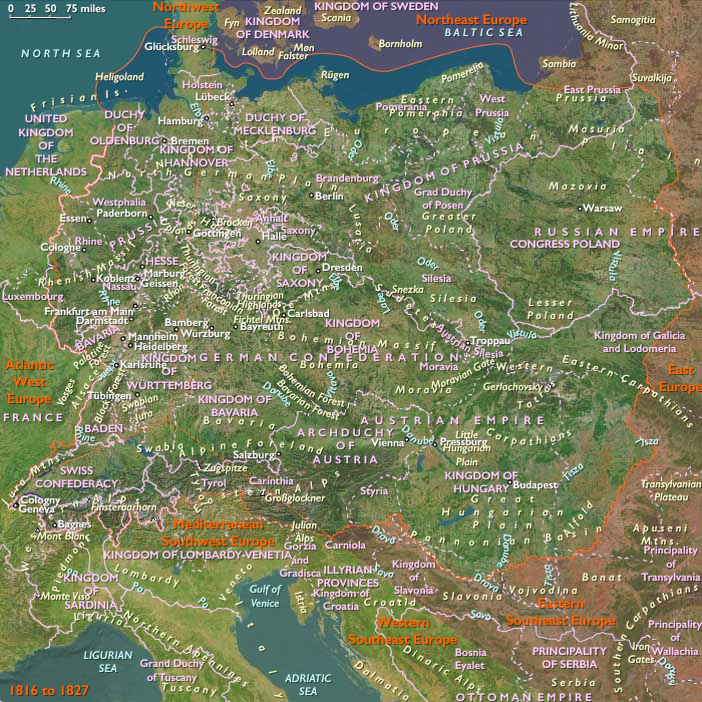
Central Europe
View →Subregions
