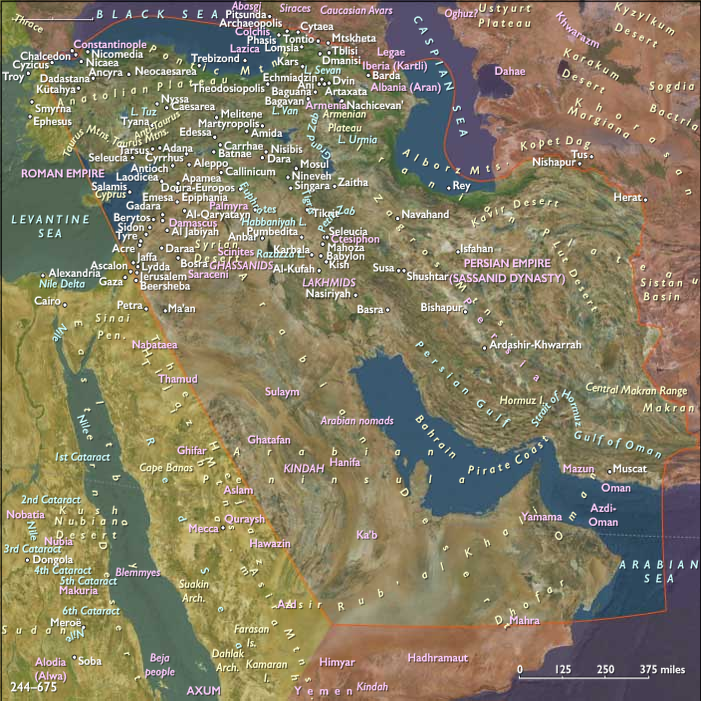
The Sassanians establish an empire roughly within…
244 CE to 387 CE
The Sassanians establish an empire roughly within the frontiers achieved by the Achaemenians, with its capital at Ctesiphon.
The Sassanians seek to resuscitate Iranian traditions and to obliterate Greek cultural influence.
Their rule is characterized by centralization, ambitious urban planning, agricultural development, and technological improvements.
Sassanian rulers adopt the title shahanshah (king of kings), as sovereigns over numerous petty rulers, known as shahrdars.
Historians believe that society was divided into four classes: priests, warriors, secretaries, and commoners.
The royal princes, petty rulers, great landlords, and priests together constitute a privileged stratum, and the social system appears to have been fairly rigid.
Not phil-Hellene, as their predecessors described themselves, Ardashir and his successors seek to establish a national Persian renaissance in both culture and ideology.
Sassanian rule and the system of social stratification are reinforced by Zoroastrianism, which had arisen in Persia between 1500 BCE and 1000 BCE and has become the state religion under the Sassanians.
The Zoroastrian priesthood becomes immensely powerful.
The head of the priestly class, the mobadan mobad, along with the military commander, the eran spahbod, and the head of the bureaucracy, are among the great men of the state.
The Roman Empire has replaced Greece as Iran's principal western enemy, and hostilities between the two empires are frequent.
Shapur I (241- 72), son and successor of Ardashir, wages successful campaigns against the Romans and in 260 even takes the emperor Valerian prisoner.
Locations
Groups
Topics
Regions
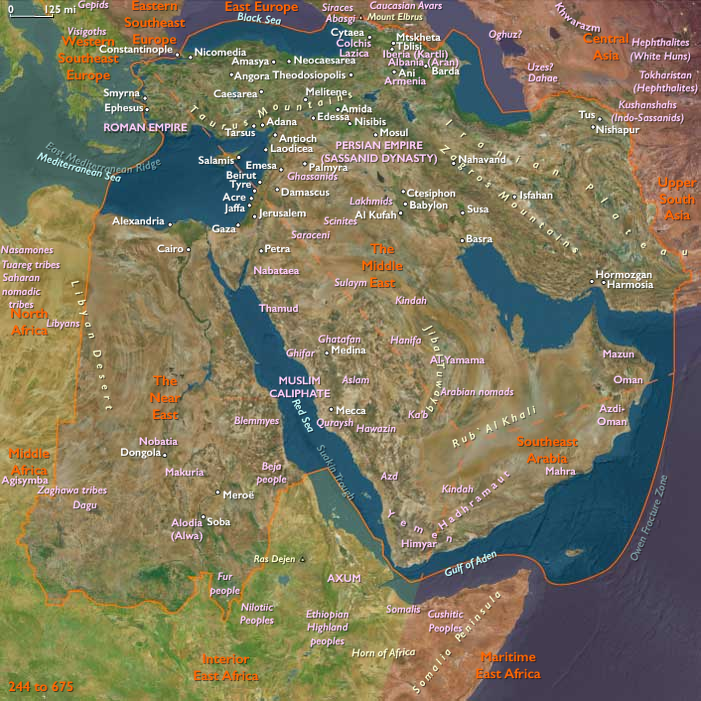
The Near and Middle East
View →Subregions