Argentine poet Esteban Echeverría is forced to…
1839 CE
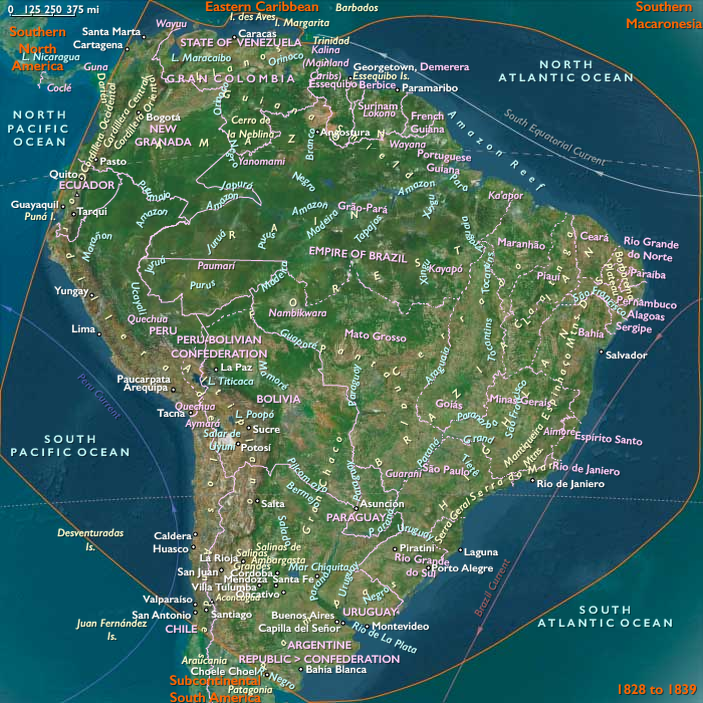
Argentine poet Esteban Echeverría is forced to go into exile in nearby Uruguay, where he will write La Insurrección del Sur and his powerful short story "El Matadero" ("The Slaughterhouse," written in 1838 but not published until 1871), on which his renown as a writer largely rests.
A landmark in the history of Latin American literature, it is mostly significant because it displays the perceived clash between "civilization and barbarism,” that is, between the European and the "primitive and violent" American ways.
Domingo Faustino Sarmiento, another great Argentine writer and thinker, is to characterize this clash as the core of Latin American culture.
Read in this light, "The Slaughterhouse" is a political allegory.
Its more specific intention is to accuse Juan Manuel de Rosas of protecting the kind of thugs who murder the cultivated young protagonist at the Buenos Aires slaughterhouse.
Rosas and his henchmen stand for barbarism, the slain young man for civilization.
Echeverría, who will remain in Uruguay until his death, had returned to Buenos Aires in 1830 from four years of close contact with the Romantic Movement in Paris.
In 1832, he had written “Elvira”, one of the earliest romantic poems written in the Spanish language, and in 1837 published a book of romantic poetry entitled “La Cautiva”, a long narrative poem about a white woman abducted by Mapuche Indians; it will become one of the better-known works of nineteenth century Latin American literature.
He is a member of the group of young Argentine intellectuals who in 1838 had organized the Asociación de Mayo ("May Association", after the May Revolution that initiated Argentina's move towards independence).
This institution, which seeks to disseminate romantic ideas by establishing political liberalism and creating a literature based on national concerns, aspires to develop a national literature responsive to the country's social and physical reality.
Echeverría has also devoted himself to the overthrow of Rosas.
Commodities
Subjects
Regions
South America
View →Subregions