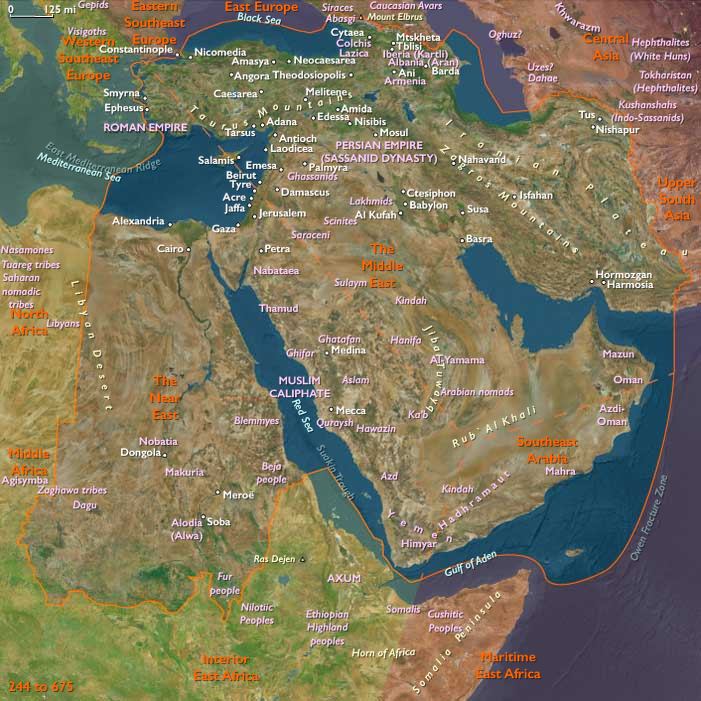
…as far inland as Jerusalem.
501 CE
…as far inland as Jerusalem.
Groups
Subjects
Regions
The Near and Middle East
View →Subregions
Near East
View →Related Events
No active filters.
Showing 10 events out of 58343 total
The general Yu Lie and Yuan Xiang warn Xuanwu in 501 that Yuan Xi is growing corrupt and Yuan Xie is growing too popular, and suggests that they be relieved of their posts.
Xuanwu does so, and formally personally takes over governmental matters, but at his age, he cannot actually properly handle governmental affairs himself, so his trusted attendants and Gao Zhao begin to become more powerful and corrupt.
Traditional historians generally regard this as the starting point of Northern Wei's decline.
Late in 501, Yuan Xi, displeased that his power is being stripped and fearful that he will be killed, plots a rebellion to secede with the provinces south of the Yellow River.
His plot is discovered, however, and he is executed.
From this point on, Xuanwu grows increasingly suspicious of members of the imperial clan.
Later in 501, Xuanwu creates Yu Lie's niece, Consort Yu, empress.
Near the end of the year, with Xiao Yan's forces crushing Xiao Baojuan's, Xuanwu's general Yuan Ying suggests that a major attack be launched against Southern Qi to take advantage of Southern Qi's civil war.
However, Xuanwu only authorizes small scale attacks, which are generally fruitless.
Xiao Baorong is proclaimed emperor (as Emperor He) in spring 501 but actual powers are in Xiao Yingzhou's hands.
While Xiao Yan's campaign east initially stalemates at Yingcheng (in modern Wuhan, Hubei), by fall 501 he has captured Yingcheng and continues to advance east.
He quickly arrives at the capital Jiankang, putting it under siege.
(During the siege of Jiankang, Xiao Yingzhou, anxious over the facts that Xiao Baojuan's general Xiao Gui is approaching Jianling and that Xiao Yan is so easily able to reach Jiankang and gain popularly support, dieds; from that point on, Emperor He is controlled by Xiao Yingzhou's lieutenant Xiahou Xiang and Xiao Yan's brother Xiao Dan, both of whom support Xiao Yan.)
Muryeong becomes king of Baekje.
He is described as the second son of the twenty-fourth king, Dongseong, who became king when Dongseong was assassinated by the court official Baekga.
The following year, he crushed a planned rebellion by Baekga.
China's Liang shu gives his surname as Yeo and personal name as Yung, and states that he restored Baekje into a strong nation.
Japan's Nihonshoki gives his birth year as 461, and describes him as the son of Gonji, the younger brother of the twenty-first king, Gaero, making him the stepbrother of Dongseong.
It is said Gonji escaped the invading Goguryeo forces with King Muryeong's mother to Japan, and she went into labor as their ship was passing by a small Japanese island.
He was called Semakishi and King Shima in Japanese records because he was born in an island.
Some scholars claim Muryeong ruled the Yamato region under the name of King Bu before he moved to Baekje to be a king of kings.
He sends an army to attack Goguryeo's Sugok-seong in 501.
During his reign, the kingdom will remain allied with Silla and expand its relationships with China and Japan.
A massive earthquake devastates coastal Palestine on July 23, 501, partially destroying Acre and causing damage …
Gundobad eventually breaks his promise of tribute as he regains his power and besieges Godegisel, locked up in the city of Vienne.
As famine devours Vienne, Godegisel expels the common people from the city for fear for himself.
An outraged expelled artisan, seeking vengeance on Godegisel, goes to Gundobad, and with his help he navigates the aqueduct and breaks into the city.
Gundobad murders Godegisel in 501 in an Arian church along with the bishop.
The senator Rufius Postumius Festus, a supporter of Laurentius, accuses Symmachus of various crimes in 501.
The initial charge is that Symmachus celebrates Easter on the wrong date.
Theodoric summons him to Ariminum to respond to the charge.
The pope arrives only to discover a number of other charges, including unchastity and the misuse of church property, will also be brought against him.
Symmachus panics, fleeing from Ariminum in the middle of the night with only one companion.
His flight proves to be a miscalculation, as it is regarded as an admission of guilt.
Domangart Réti succeeds his father Fergus Mór after he dies during a campaign against the Picts.
He becomes the new king of Dál Riata (modern Scotland).
This according to the Annals of Tigernach.
The Maya are peaking in economic prosperity.
The civilization at Teotihuacan has begun to decline and its people are migrating to the greatest Mayan city, Tikal, bringing with them ideas about weaponry and new ritual practices.
Tikal’s ruling dynasty has overcome its northern neighbor, Uaxactun, and adopted the symbolism and weaponry used at Teotihuacán.
Ahkal Mo' Naab' I comes to power in the Maya city of Palenque (Mexico) on June 5, 501.
The earliest recorded ruler of Palenque whose exact dates of birth, accession and death have been verified, he is possibly the younger brother of his immediate predecessor, B'utz Aj Sak Chiik.
For unknown reasons, Ahkal Mo' Naab' is mentioned several times in official narratives left by Pacal the Great, who will rule Palenque a century later.
It is believed Pacal considered Ahkal Mo' Naab' I a particularly important historical figure or his ancestor.
The Nanhua Temple, located southeast of Shaoguan, is founded by the Indian monk Zhiyao Sanzang.
Originally named the Baolin Temple, it covers an area of forty-two and a half hectares (one hundred and five acres) and consists of a set of historical Buddhist buildings.