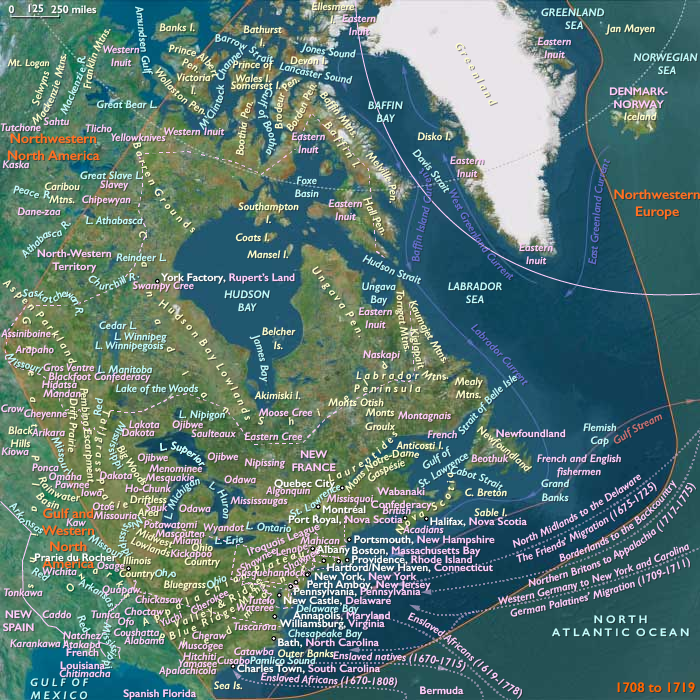
As no major Cherokee-British attack has materializes…
February 1717 CE
As no major Cherokee-British attack has materializes in 1716 and 1717, the Lower Creek have found themselves in a position of increased power and have resumed raiding their enemies—British, Cherokee, and Catawba.
Cut off from British trade, however, they had begun to experience problems in the supply of ammunition, gunpowder, and firearms.
The Cherokee, on the other hand, are well-supplied with British weaponry.
The lure of British trade undermines anti-British elements among the Creek.
A few emissaries from Charles Town go to the Lower Creek territory in early 1717, and a few Creek go to Charles Town, tentatively starting the process that will lead to peace.
At the same time other Lower Creeks are looking for ways to continue to fight.
A group representing many Muskogean Creek nations had traveled in late 1716 all the way to the Iroquois Six Nations in New York.
The Iroquois, impressed by the Creek's diplomacy, had sent twenty of their own ambassadors to accompany the Creek back home.
The Iroquois and Creek are mainly interested in planning attacks on their mutual native enemies, like the Catawba and Cherokee, but to South Carolina, a Creek-Iroquois alliance is something to be avoided at all costs.
In response, South Carolina sends a group of emissaries to the Lower Creek towns, along with a large cargo of trade good presents.
People
Groups
Topics
Commodities
Regions

Northern North America
View →Subregions